


Delhi, Himachal police in bitter face-off over arrest of Youth Congress activists
Standoff intensifies at Shogi border as Himachal Police files a kidnapping case and stops Delhi Police vehicles heading to the capital
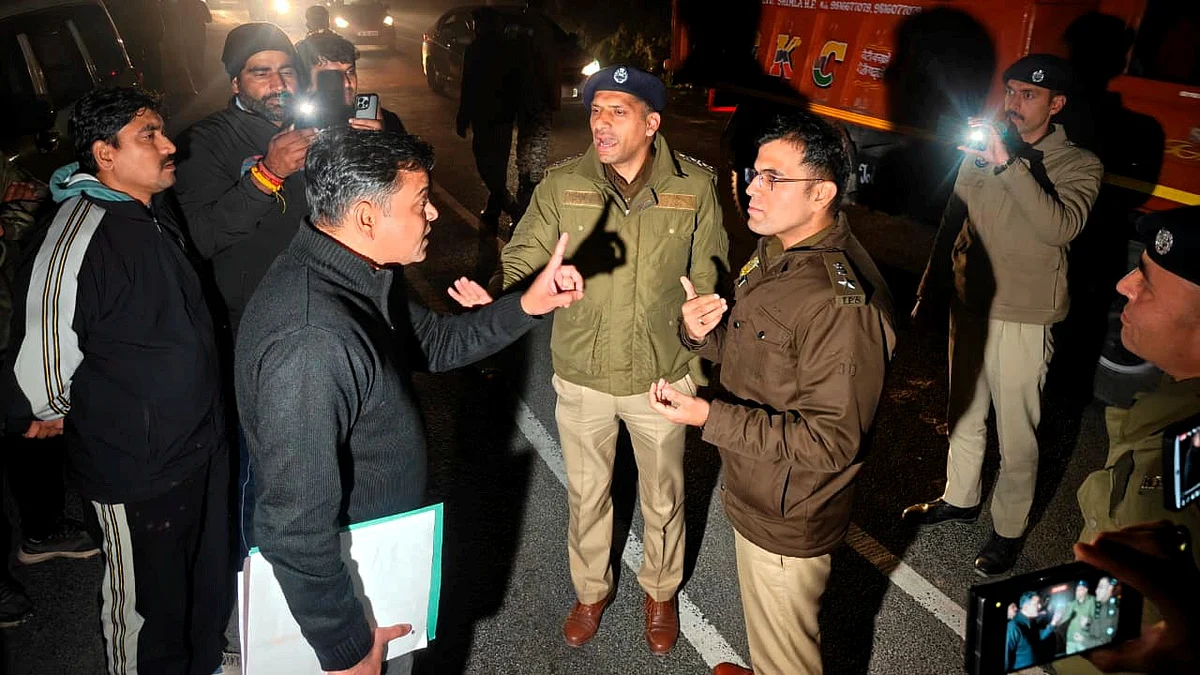


An ugly inter-state confrontation erupted on Wednesday between Delhi Police and Himachal Pradesh Police after three Youth Congress activists arrested in connection with the 20 February “shirtless protest” at the AI Impact Summit were taken into custody from Himachal Pradesh.
The standoff escalated dramatically near the Shogi border on the outskirts of Shimla when Himachal Police registered a kidnapping case against unidentified personnel in plain clothes and detained vehicles carrying Delhi Police officials and the arrested activists as they were heading back to the national capital.
Arrest and counter-claims
Earlier in the day, Delhi Police had announced the arrest of three Youth Congress members — Saurabh, Siddharth and Arbaz — from a hotel in the Chirgaon area of Rohru subdivision in Shimla district. The arrests were carried out by the Special Cell in connection with an FIR registered over the protest at Bharat Mandapam during the AI Impact Summit.
According to a Delhi Police official, the trio was produced before a local court, which granted transit remand to enable their transfer to Delhi for further questioning.
However, Himachal Police sources disputed this claim, asserting that Delhi Police had not obtained valid transit remand at the time of interception. They alleged that the operation was conducted without informing local authorities.
Shimla Police said a case had been registered against 15–20 unknown individuals in plain clothes for “forcibly taking away” three people staying at a resort in Rohru. The statement also alleged that CCTV equipment from the premises was removed without any receipt being issued.
Vehicles intercepted, personnel detained
Acting on the complaint, Himachal Police intercepted three vehicles — two in Shimla district and one near Dharampur in Solan district — and brought them back to Shimla. Around 20 individuals, including Delhi Police personnel, were reportedly detained.
Later, as the Delhi Police team again attempted to leave for the capital, they were stopped at the Shogi border on the road towards Chandigarh on Wednesday night.
In a video that surfaced from the site, a Delhi Police officer is heard saying:
“We have to produce the accused arrested at 5 am today in court within 24 hours, and you have stopped us after registering an FIR at 8 pm.”
Shimla Police officials countered that an abduction case had been registered and maintained that Delhi Police had failed to show arrest documents, FIR details or valid transit remand papers.
“I asked you for legal documents in the morning, but neither have you shown any document nor the FIR number nor taken transit remand,” a Shimla Police officer is heard saying in the video.
Both forces accused each other of obstructing the investigation.
Wider crackdown in protest case
The 20 February protest at Bharat Mandapam had triggered a major security response. Delhi Police invoked charges including rioting and promoting enmity under provisions of the Bharatiya Nyaya Sanhita (BNS).
So far, 11 people have been arrested in connection with the case. On Tuesday, Indian Youth Congress president Uday Bhanu Chib and former national spokesperson Bhudev Sharma were arrested and later remanded to police custody.
On Wednesday, chief judicial magistrate Mridul Gupta extended by four days the police custody of five accused — Krishna Hari, Kundan Yadav, Ajay Kumar Singh, Narasimha Yadav and another individual — after Delhi Police argued that the protest was not spontaneous but a pre-planned action involving structured role allocation, concealment tactics and coordinated movement across states.
Police said further investigation is required to uncover the alleged conspiracy’s hierarchy, funding channels and inter-state coordination.
Meanwhile, Delhi Police denied permission to the Delhi Youth Congress to hold a dharna at Jantar Mantar on 26 February, citing short notice and law and order concerns. The protest had been called against police action in the case.
With both state police forces standing firm on procedural grounds and political rhetoric intensifying, the episode has exposed rare and sharp friction in what is typically routine inter-state law enforcement coordination.
With PTI inputs
Join our official telegram channel (@nationalherald) and stay updated with the latest headlines