


Jantar Mantar: The invisible faces of the student movement
The caring on display is a protest against the politics of hate that, since 2014, has divided the nation along communal faultlines


Solidarity is the soul of any mass mobilisation. Add diversity to the mix and it springs to life. On 20 July, those who gathered at Jantar Mantar to demand accountability from the Central government over the paper leak issue made it clear: the young people of this country are angry and unafraid. Even as the Delhi Police, under orders to crush the movement in its infancy, rained blows and fired tear gas shells, the protesters stood their ground.
If anything, the police brutalities solidified their resolve, as more and more young people flowed in and out of the site at all hours, standing patiently in long queues, braving bad weather, internet shutdowns and closed Metro stations to get there and stay there.
The circle of protest expanded to a circle of care and community. Unable to get sleep, Mohammad Ahmed Saifi, a resident of Old Delhi, decided to tend to those sleeping by the road, exhausted by the oppressive heat and humidity. A video of him fanning them as tenderly as a mother went viral. Soon, that became a common scene at Jantar Mantar. Anyone holding a hand fan would cool themselves and anyone around.
This instinctive caring is also a protest against the politics of hate that, since 2014, has divided friend from friend, strained family ties, and split neighbourhoods down communal faultlines.
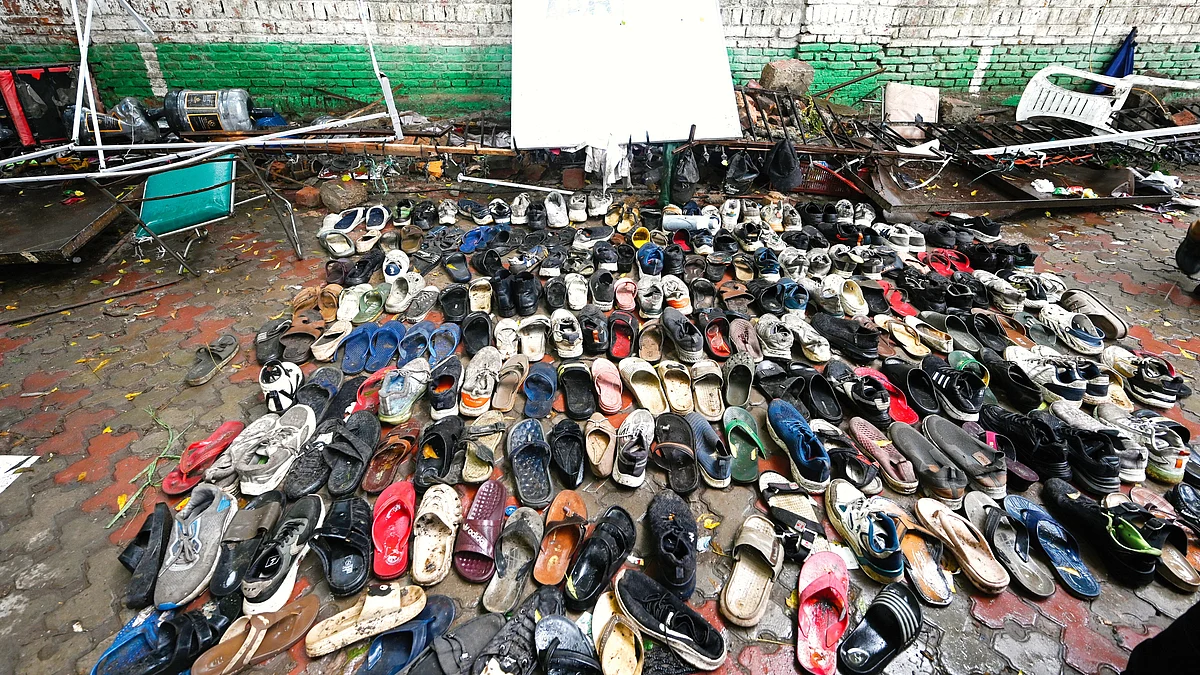
The shoes and slippers that lay scattered in the aftermath of the police lathi-charge have been gathered into something like a site-specific installation by JNU research scholar and former NSUI Uttar Pradesh president Akhilesh Yadav. “We want both Modi and Amit Shah to resign,” says Yadav. “These shoes are the symbol of our struggle.”
****
Also Read: To Be Young Was Very Heaven
In the enormous crowd of youngsters on 20 July, I noticed a large number of women, who had travelled to Jantar Mantar not only from different parts of Delhi, but also from Shimla, Chandigarh, Gurugram… Quietly and with remarkable composure, they expressed their anger. Not all of them were willing to do so on camera, but their very presence lent dignity and seriousness.
Anjali Vajpayee, six months pregnant and a law student, was there with her husband. “My father is a BJP supporter,” she said, “and even he admits that accountability is beyond Modi. If they could indulge in corruption over some- thing as sacred to them as the Ram Mandir, why would they care about students or ordinary citizens?”
When the police removed Sonam Wangchuk from the protest site (on 18 July), thousands more poured in. There was hardly any room to stand, and it was unbearably hot.
Tavisha from Shimla had the foresight to bring a large crate of bottled water with her. “People may have woken up late,” she said, “but they have awakened. If the education system isn’t reformed, students aren’t going to shut up and go away.”
Raj, a tenth-grade student from Prayagraj, ran away from home a week earlier to reach Jantar Mantar in time. “I didn’t tell my family!” he said. “They would never have allowed me to come.”
Carrying only a single change of clothes, he spent his days distributing food and water to protesters, living on whatever he got. As people began to feel the urge to participate in the protest, if only by helping in some small way, supplies started pouring in.
Also Read: The full worth of citizens as custodians
Sandeep, who sells ‘Ram laddus’ near Jantar Mantar Lane, handed over his entire stock (for the token sum of Rs 500) to Asad Ahmed and his companions to give the students a pop of energy. A young man from Sambhal, Uttar Pradesh, bought golgappas wholesale in Old Delhi with the same idea. When an Indian Express reporter approached him, he declined to give his name, saying: “I’m not here to become famous.”
Those who couldn’t come in person sent TLC through Zomato and Swiggy. Anuj Rawat from Mumbai reportedly instructed his delivery partner: “Whoever’s hungry there, just give them the food.” The delivery address simply read: Jantar Mantar. In fact, so much food arrived that organisers eventually appealed to people to stop ordering more.
Visually impaired young people were active participants, alongside countless young volunteers like Nikita, Danish, Ashu and Arya who were distributing meals free of charge: a fitting response to those making snide remarks about ‘foreign funding’.
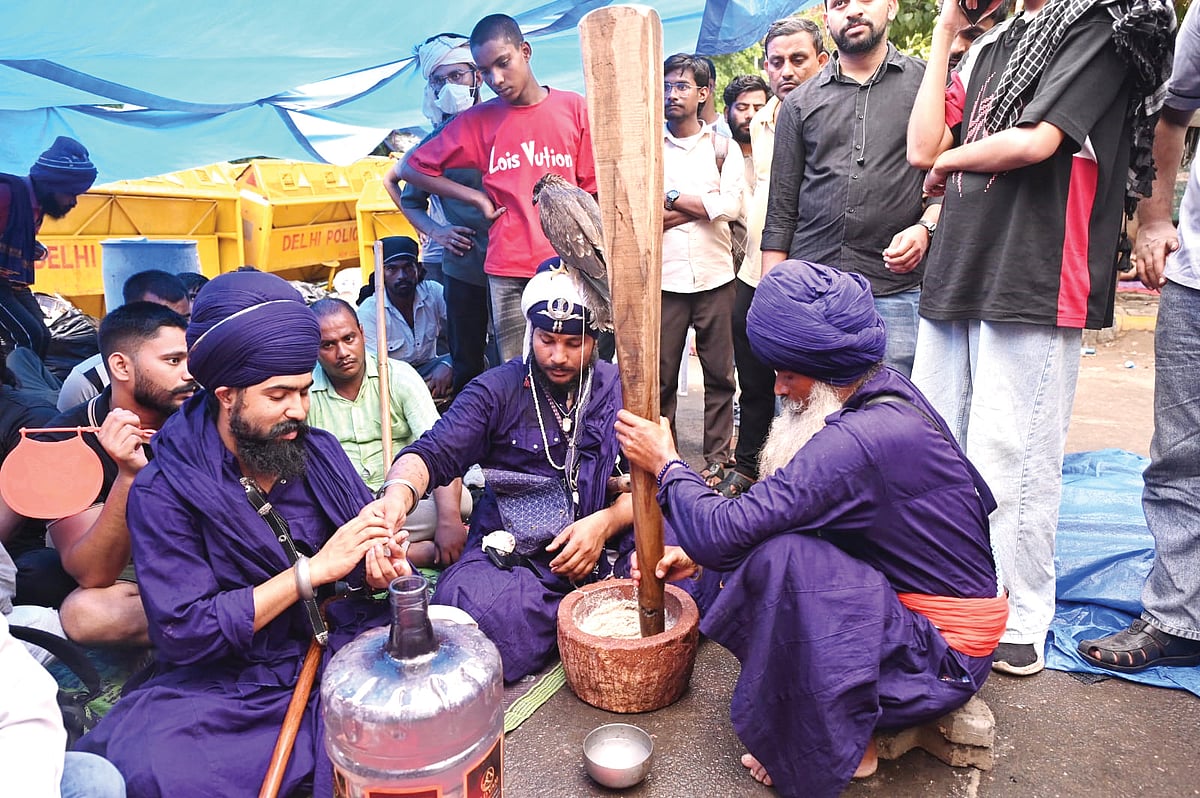
While the spirit of service was part of the protest from the get-go, it grew with the numbers. Gurdwaras located around Jantar Mantar, Sikh organisations and the Congress Seva Dal pitched in visibly from 21 July onwards. Others worked silently, off camera, cleaning the site every evening. All it took was one person to begin picking up the trash for impromptu teams to collect the garbage and deposit it at designated spots. No one considered this beneath their dignity, all were equally responsible.
What captured the public eye were the posters and banners that reached millions online. Almost every young person at Jantar Mantar carried a handmade placard bristling with satire directed at Dharmendra Pradhan, Narendra Modi, the government.
‘When will the paper leaks stop? Melody khao, khud jaan jao!’; ‘Burey din hi achhe thhey!! (the bad days were better!!)’; ‘Bollywood kidhar hai? Asli Durandhar idhar hai! (where’s Bollywood? The real heroes are here!)’; ‘56 इंच का छोटा बंदर, भाग नरेंदर भाग नरेंदर (a little monkey with a 56-inch chest, run Narendra run)'. Some unprintable ones (which the infamous IT cell might have loved to expunge) quickly flooded social media feeds.
Many young protesters who said they didn’t have any policial affiliation could be heard chanting the ever-popular ‘Hum leke rahenge azaadi (we’ll take our freedom, come what may)’. Some of them might well have gone home wearing AISA or SFI badges, picked up at the numerous stalls set up by left-wing student organisations.
Just to demand accountability has meant being labelled an ‘urban naxal’, an andolanjeevi, part of the notorious ‘Khan Market Gang’. A few days into the protest, a new label found these young students: ‘terrorists’, courtesy the education minister.
Colonel R.K. Sharma, a military veteran with 38 years of service, openly scoffed: “These are the children we took bullets for. If paper leaks are still happening and students are killing themselves, it’s only fitting that we come to Jantar Mantar and raise our voices for them, with them. If so many us are anti-national, then everyone sitting at the highest levels of power should resign.”
He wasn’t the only such ally. Unable to make it to Delhi, Param Vir Chakra awardee Captain Bana Singh and Captain Yogendra Singh Yadav spoke out in their support.
Radha Joshi (name changed), an officer in the Delhi Police Special Branch deployed at Jantar Mantar, came back to support the youth, out of uniform and off-duty. Her rationale: “My own children are already settled. I’m here for the sake of the generations to come.”
This familial feeling was echoed by 58-year-old Gurkirat Singh from Delhi: “Every child affected by a paper leak is my child. We shouldn’t wait to protest until we are personally affected.”
Perhaps it is this sentiment that has drawn hundreds of thousands to Jantar Mantar over the past month. Leaving the comfort of their homes and taking to the streets are individuals of all ages, affiliations and backgrounds. As one placard read: ‘It is so bad even the privileged are here.’
And yes, apart from the mothers with babies in their arms, the grandmothers, the veterans, the secret senders of food and the unnamed do-gooders, there was the comradely spirit of Gandhi, Bhagat Singh and Ambedkar. Carrying portraits of Bhagat Singh, chanting ‘Jai Bhim’, choosing the hunger strike as the Gandhian way of resistance — all paths seemed to converge at Jantar Mantar.
What was extraordinary was that even after the police brutalities of 20 July, the massive crowd did not abandon the path of non-violence. No matter how many nail-studded batons were raised, they did not raise their hands in retaliation. ‘Bring it on,’ they seemed to say. ‘We’re ready’.
What began with a remark about cockroaches is burgeoning into a movement that’s bringing people together, in courage and kindness. What can be more frightening for those who thrive on fear and hate?
Join our official telegram channel (@nationalherald) and stay updated with the latest headlines