


The day India felt orphaned
Jawaharlal Nehru’s death created a political vacuum and profound psychological uncertainty about the future of the republic
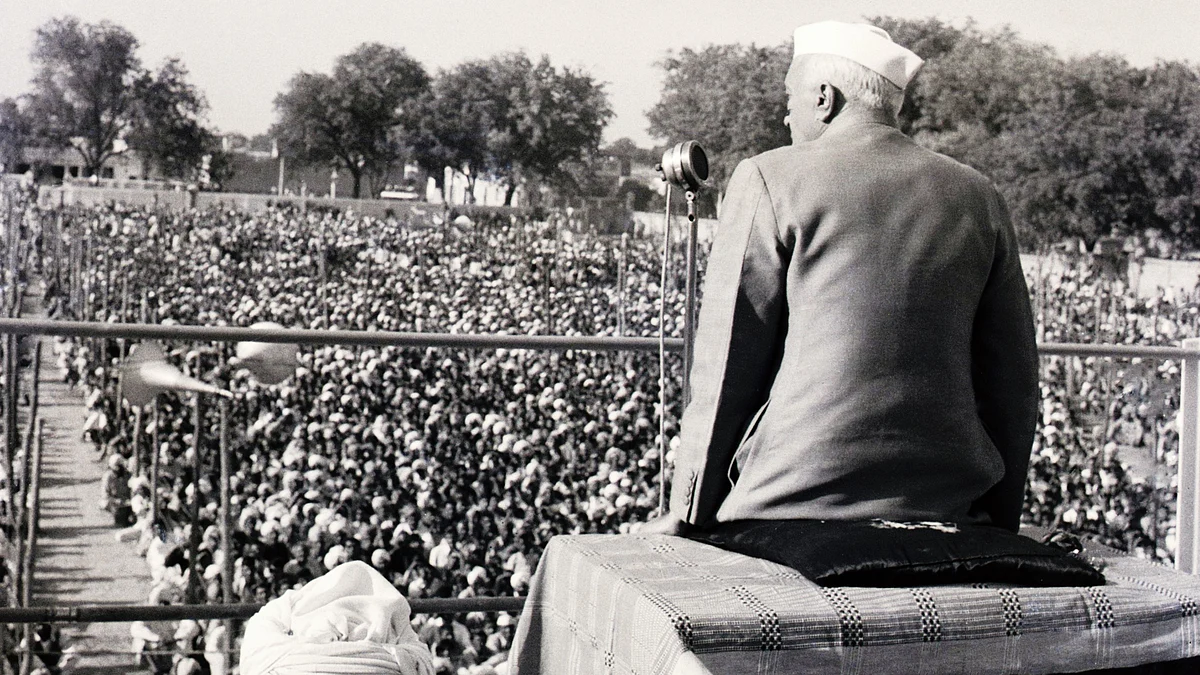


It was around 2.00 pm on 27 May 1964. Suddenly, telephones in government offices across Delhi began ringing frantically. Employees at All India Radio rushed toward their studios. Unease spread through the corridors of Parliament House. Something extraordinary — and tragic — had happened. Moments later, a solemn voice broke the silence over radio waves across the country: “Prime Minister Pandit Jawaharlal Nehru is no longer amongst us.”
Earlier that morning, at around 6.20 am, Jawaharlal Nehru had complained of severe back pain to his daughter Indira Gandhi. Soon afterward, in a frail voice, he reportedly whispered, “I think I am finished."
Senior physicians, including Dr B.N. Chugh and Dr Talwar, rushed to Teen Murti Bhavan. Oxygen cylinders were brought in. Emergency injections were administered. Yet despite every effort, at 1.44 pm, Nehru’s heart stopped beating. Indira Gandhi remained by his side.
Gulzarilal Nanda was immediately summoned. Outside Teen Murti Bhavan, anxiety had already begun spreading among staff members who sensed the gravity of the situation.
When confirmation finally came, grief engulfed the residence. Many longtime employees — some who had served Nehru since before Independence — broke down uncontrollably. An elderly gardener reportedly repeated the same sentence over and over again: “Panditji is gone… who will come here now to inspect the garden in the morning?”
A nation in mourning
Sorrow engulfed the nation, transcending distance, region, language and class.
Cinema halls in Delhi halted screenings midway. Shops in Connaught Place shut spontaneously. At Old Delhi Railway Station, passengers gathered around radios in stunned silence. In villages without electricity, people assembled at post offices and public squares to hear the broadcasts.
For countless Indians, Nehru was more than just a prime minister; he was the face of independent India itself, the man whose voice had announced freedom at midnight and whose leadership had guided the republic through its uncertain formative years.
On the morning of 28 May 1964, Nehru’s funeral procession departed from Teen Murti Bhavan.
His mortal remains, draped in white flowers, were placed upon an army gun carriage that moved slowly through Delhi’s overflowing streets. Indira Gandhi wept intermittently throughout the journey. Beside her stood her sons Rajiv Gandhi, then just 19, and Sanjay Gandhi.
According to historians and newspaper accounts, more than 1.5 million people lined the streets of Delhi. Some foreign reports estimated the crowd at nearly 2 million. People climbed trees and electric poles merely to catch one final glimpse of 'Panditji'.
Women lifted children onto their shoulders so they could witness history. Many fainted in the crushing crowds. The Army struggled to maintain order amid the sea of mourners.
Among those gathered was an elderly farmer from Agra who offered a simple explanation for his journey: “I have come to see, for the last time, the man who gave us the power of the vote."
The world pays tribute
India’s political leadership walked together in mourning. President Dr Sarvepalli Radhakrishnan, acting Prime Minister Gulzarilal Nanda, Lal Bahadur Shastri, Morarji Desai, Jagjivan Ram, K. Kamaraj, Indira Gandhi, V.K. Krishna Menon and chief ministers from across the country joined the procession.
Leaders and representatives from around the world also arrived to pay tribute. Lord Mountbatten came from Britain. Both the Soviet Union and United States sent condolences despite the tense climate of the Cold War. Egyptian President Gamal Abdel Nasser described Nehru as the “voice of Asia and Africa,” while Yugoslav leader Josip Broz Tito mourned the loss of “a great leader of peace”.
Their tributes were a quiet affirmation of Nehru’s stature as a world statesman, who helped shape the Non-Aligned Movement and gave newly independent nations a voice distinct from the competing power blocs of the era.
In his will, Nehru had expressed the wish that some of his ashes be immersed in the Ganga at Allahabad, and the rest scattered over India’s fields from an aircraft, so they might mingle with the soil of the country he loved.
And so it was done. An Indian Air Force aircraft scattered his ashes.
The architect of modern India
Nehru’s death created not only a political vacuum but also a profound psychological uncertainty about the future of the republic.
He had inherited a nation scarred by Partition, poverty, communal violence and deep social divisions. Yet he sought to hold India together through its commitment to parliamentary democracy, constitutionalism, secularism and its institutions.
Under his leadership arose many of the foundations of modern India: the IITs, AIIMS, the Bhakra Nangal Dam, scientific research institutions, public sector enterprises, the nuclear programme and the early vision that would eventually lead to India’s space ambitions.
On 27 May 1964, India lost one of its greatest sons, the towering figure who guided a newly independent country through its impossibly difficult early years, who gave it a dream, a sense of self-worth and a proud place in the comity of nations.
Hasnain Naqvi is a former member of the history faculty at St Xavier’s College, Mumbai. More of his writing here
Join our official telegram channel (@nationalherald) and stay updated with the latest headlines