


Kaziranga is one of India’s most important refuges for raptors and storks, survey finds
New study records 30 raptor species and six stork species, highlighting the Assam reserve’s growing global significance for bird conservation
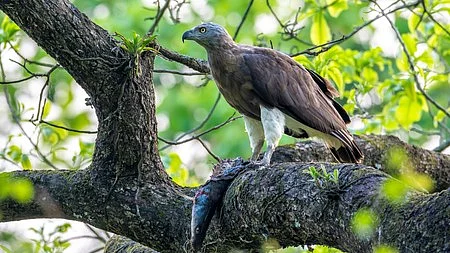


Assam’s Kaziranga National Park and Tiger Reserve has further strengthened its reputation as a biodiversity hotspot, with a recent survey documenting a rich diversity of birds of prey and storks across its vast landscape.
The survey, conducted earlier this year and released on World Environment Day, recorded 30 species of raptors comprising 217 individual birds, alongside six species of storks with a total count of 266 individuals. The findings underscore the ecological importance of Kaziranga as a crucial habitat for both resident and migratory bird species.
The exercise was carried out by the Kaziranga Tiger Reserve authority in collaboration with research scholars from universities across Assam. Conducted between late February and early March, the survey covered all administrative ranges under the Eastern Assam Wildlife Division and included known nesting sites identified during the current breeding season.
According to Kaziranga National Park and Tiger Reserve Director Sonali Ghosh, the initiative represents another step towards strengthening science-based wildlife management and conservation planning in the protected area.
The survey highlighted the remarkable avian diversity supported by Kaziranga’s varied ecosystems, which include grasslands, wetlands, forests and riverine habitats. The reserve provides ideal conditions for a wide range of raptors, including eagles, vultures, falcons, buzzards and owls, while its extensive wetlands serve as important feeding and breeding grounds for several stork species.
India is home to 112 recorded species of raptors, and nearly 50 of these have been documented within Kaziranga and its surrounding landscape. The region’s wetlands and proximity to the Himalayan foothills make it a particularly valuable refuge for birds of prey.
The study found that Kaziranga National Park recorded the highest diversity, with 21 raptor species and five stork species. The Biswanath Wildlife Division followed closely with 20 raptor species and six stork species, while the Nagaon Wildlife Division recorded 14 raptor species and five stork species.
Among storks, the Asian Openbill emerged as the most abundant species, with 92 individuals recorded across the reserve. In contrast, the Greater Adjutant, one of the world's rarest storks, was represented by only three sightings.
The Himalayan Griffon Vulture was the most frequently observed raptor, with 69 individual records. The Booted Eagle and White-tailed Eagle were among the rarest species encountered, each recorded only once during the survey.
The findings also reaffirm Kaziranga’s importance for the globally threatened Pallas’s Fish Eagle. The reserve has become a critical breeding ground for the species, which faces declining populations across its range.
In an example of international wildlife research collaboration, a male Pallas’s Fish Eagle named ‘Ider’, fitted with a tracking device in Mongolia in 2020, has returned to Kaziranga every year to breed. Researchers have observed the bird travelling annually between central-western Mongolia and Assam, demonstrating the significance of transboundary conservation efforts.
Earlier research by the Wildlife Institute of India identified 10 active nests of Pallas’s Fish Eagle in Kaziranga, the highest known concentration of breeding sites for the species anywhere in the world. Conservationists believe this places a special responsibility on the reserve to safeguard nesting habitats and floodplain ecosystems.
Experts have also emphasised the need to address threats such as habitat degradation, powerline electrocution and disturbance at nesting sites. Continued satellite tracking and international cooperation are expected to play a key role in protecting the species in the future.
Most of the raptor and stork species recorded during the survey are protected under Schedule I of the Wildlife (Protection) Act, 1972, granting them the highest level of legal protection in India.
The survey’s findings reinforce Kaziranga’s status as one of Asia’s most important wildlife landscapes, not only for its celebrated populations of one-horned rhinoceroses, tigers and elephants, but also for its critical role in conserving some of the subcontinent’s most threatened bird species.
Spread across the districts of Golaghat, Nagaon, Sonitpur and Biswanath, the UNESCO World Heritage Site remains home to an extraordinary range of wildlife, including more than 2,600 one-horned rhinoceroses, over 100 Bengal tigers, 1,200 Asian elephants and substantial populations of wild water buffalo and eastern swamp deer.
Wildlife managers say the latest bird survey will help shape future conservation strategies and ensure the long-term protection of Kaziranga’s diverse ecosystems and avian inhabitants.
With IANS inputs
Join our official telegram channel (@nationalherald) and stay updated with the latest headlines