


Maharashtra SIR: Urban seats record highest number of 'uncollectible' forms
More than 21 per cent of enumeration forms could not be collected or digitised, with rural and tribal seats performing better
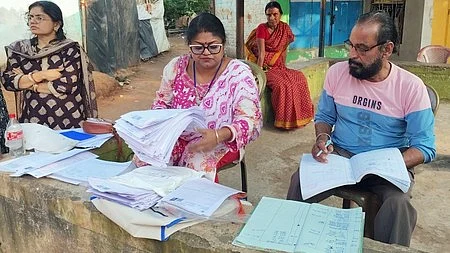


Urban constituencies in Maharashtra, including those in Thane, Pune and Mumbai, have reported some of the highest rates of uncollectible enumeration forms during the Special Intensive Revision (SIR) of electoral rolls.
Rural and tribal constituencies, on the other hand, have emerged among the best performers in form collection, according to data released by the chief electoral officer (CEO) on Friday, 21 August.
Uncollectible enumeration forms are those that could not be collected or digitised. More than 21 per cent of SIR forms in the state fell into this category.
The CEO's office released constituency-wise data for all 288 Assembly constituencies, showing a sharp contrast between several densely populated urban seats and rural constituencies in the percentage of forms that could not be collected or digitised.
Bhiwandi East in Thane recorded the highest uncollectible rate at 49.10 per cent, followed by Colaba in south Mumbai at 46.97 per cent. Khadakwasala in Pune stood at 46.57 per cent, Nalasopara in Palghar at 46.36 per cent and Kothrud in Pune at 46.22 per cent.
Nalasopara, near Mumbai, with 6,62,057 electors, had 46.36 per cent, or 3,06,930, uncollectible forms — the highest number among the constituencies analysed.
Hadapsar, with 6,51,473 electors, recorded 45.80 per cent, or 2,98,375, uncollectible forms. Khadakwasala, with 5,97,114 electors, had 2,78,076 uncollectible forms, while Kalyan Rural reported 2,52,294 and Ovala Majiwada 2,50,987.
Bhiwandi West recorded 44.72 per cent uncollectible forms, Shivajinagar 44.31 per cent, Ambarnath (SC) 44.18 per cent, Airoli 44.03 per cent, Mumbra-Kalwa 42.92 per cent, Kalyan West 42.65 per cent and Mankhurd Shivajinagar 42.31 per cent.
Colaba, Mumbai's key administrative and business district, had 46.97 per cent uncollectible forms among its 2,54,910 electors. Malabar Hill, another prominent Mumbai constituency, recorded an uncollectible rate of 39.02 per cent.
In contrast, several rural and tribal constituencies reported uncollectible rates of less than 10 per cent, indicating digitisation rates of more than 90 per cent.
Akole (ST) in Ahmednagar, now Ahilyanagar, recorded the lowest uncollectible rate in the state at 6.11 per cent, with 93.89 per cent of its forms digitised. It was followed by Jalgaon (Jamod) in Buldhana at 6.20 per cent, Khamgaon at 6.27 per cent, Ashti in Beed at 6.37 per cent and Chimur in Chandrapur at 6.46 per cent.
Mehkar (SC) in Buldhana recorded 6.50 per cent uncollectible forms, while Georai in Beed reported 7.09 per cent, Nevasa in Ahmednagar 7.18 per cent, Rajapur in Ratnagiri 7.34 per cent and Malkapur in Buldhana 7.68 per cent.
Gadchiroli (ST), Armori (ST) and Nawapur (ST) were also among the rural and tribal constituencies showing particularly high digitisation rates. Gadchiroli (ST) recorded 8.64 per cent uncollectible forms, while Armori (ST) had 9.75 per cent and Nawapur (ST) 9.33 per cent.
Maharashtra has 9,78,54,049 electors across its 288 Assembly constituencies, with 21.15 per cent of forms reported as uncollectible. Several constituencies with the highest uncollectible rates have electorates substantially larger than the state average of 3,39,771.
Nalasopara and Hadapsar, for instance, have electorates of more than 6.5 lakh each, while Khadakwasala has nearly six lakh electors. By contrast, eight of the 10 constituencies with the lowest uncollectible rates have electorates below the state average.
With PTI inputs
Join our official telegram channel (@nationalherald) and stay updated with the latest headlines