


Manipur: Fresh killings stoke anger as questions grow over Centre’s inaction
Ukhrul firing leaves three dead days after convoy ambush; criticism mounts as Delhi’s focus stays elsewhere
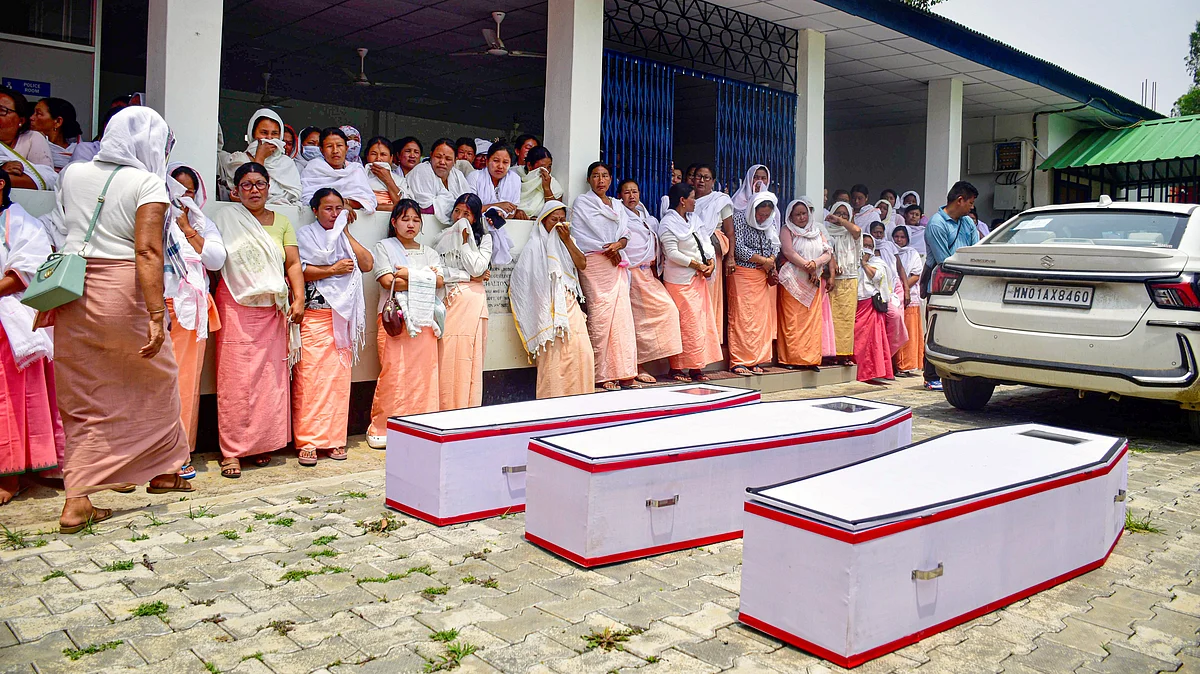


Three people were killed in fresh violence in Manipur’s Ukhrul district on Friday morning, in incidents that underline the continuing volatility in the hill districts even as political criticism over the Union government’s handling of the crisis grows sharper.
In one incident near Mullam village, security forces recovered two bodies around 11.25 am, officials said. The deceased, identified as L. Sitlhou and P. Haolai, were found in camouflage outfits with bullet injuries. Earlier in the day, at around 5.30 am, a heavy exchange of fire had broken out between armed groups in and around the village in the Tangkhul Naga-majority district. Some outlying houses were also set on fire during the clashes.
Meanwhile, the Kuki Organisation for Human Rights Trust condemned the killing of what it described as “two village volunteers” and the burning of houses at Mullam and Songphal villages, and demanded immediate registration of an FIR along with a time-bound investigation.
In a separate incident, a 29-year-old man, identified as H. Jamang from Chatric Khullen in neighbouring Kamjong district, was killed on the spot in an ambush by armed militants near Sinakeithei village in Ukhrul district early Friday morning. His body has since been recovered.
The Tangkhul Naga Long expressed “profound sadness” over Jamang’s killing, and in a statement claimed that “armed Kuki cadres” had been responsible. It said Naga village guards had been deployed following “constant movement and disruption” in the Sirarakhong–Sinakeithei stretch and were ambushed while on patrol.
Also Read: Managing conflict, not resolving it
The fresh violence comes less than a week after two Tangkhul Naga civilians — Chinaoshang Shokwungnao of Tushar village and Yaruingam Vashum of Kharasom village — were killed when suspected militants opened fire on a convoy of civilian vehicles at T.M. Kasom along NH-202 in Ukhrul district on 18 April. Tangkhul Naga bodies have blamed Kuki militants for that attack, while Kuki organisations have denied involvement.
On Thursday, 23 April, the Naga Students' Federation held a candlelight vigil at Naga Solidarity Park under the theme ‘We Rise Together: Unbreakable, Unafraid’, demanding justice for the two victims. Addressing the gathering, NSF president Mteisuding said the vigil was not only an expression of grief but “a collective stand against injustice”, and alleged that the killings reflected a pattern of targeted violence against Nagas.
The organisation said it had also submitted a memorandum to the United Nations Human Rights Council, flagging what it termed a “systematic and coordinated pattern of aggression” in Naga-inhabited areas, including incidents of arson and intimidation.
The competing claims and counter-claims from Naga and Kuki organisations point to a widening trust deficit even in districts that had, until recently, remained relatively insulated from the worst of Manipur’s ethnic conflict.
At the same time, criticism of the Union government’s response has intensified, particularly in the wake of fresh violence.
The sequence of events — ambush on 18 April, vigil on 23 April, and fresh killings on 24 April — reflects a cycle that shows little sign of easing, even in districts that had not always been at the centre of Manipur’s three-year-long ethnic conflict.
Recent developments across the state point to continuing instability. Protests and shutdowns in the wake of recent killings have centred on the failure to prevent recurring attacks, even as curfews and security restrictions have been imposed in parts of the valley in response to flare-ups. The persistence of such measures, nearly a year into the broader conflict, has reinforced the sense that normalcy remains distant.
On 17 April, chief minister Y. Khemchand Singh said there was “no option but dialogue” in addressing tensions between communities — an acknowledgment that a durable resolution will require political engagement beyond security responses.
Yet, even as violence continues and local tensions sharpen, there has been no visible, fresh intervention from the highest levels of the Union government in recent days. Prime Minister Narendra Modi and Union home minister Amit Shah have been engaged in campaigning in West Bengal, while the situation in Manipur continues to be managed largely through administrative and security measures.
That contrast has not gone unnoticed. With each new incident — from the convoy ambush to Friday’s killings — the gap between immediate security responses and a broader political settlement appears to widen.
For residents in affected districts, the pattern is by now familiar: violence, claims and counter-claims, calls for justice, and temporary controls. What remains uncertain is whether these cycles are being meaningfully interrupted — or simply endured.
With PTI inputs
Join our official telegram channel (@nationalherald) and stay updated with the latest headlines