


Politicising classroom: NCERT’s Emergency chapter and perils of partisan pedagogy
No scholar worth his salt disputes the enormity of the Emergency imposed between 1975 and 1977
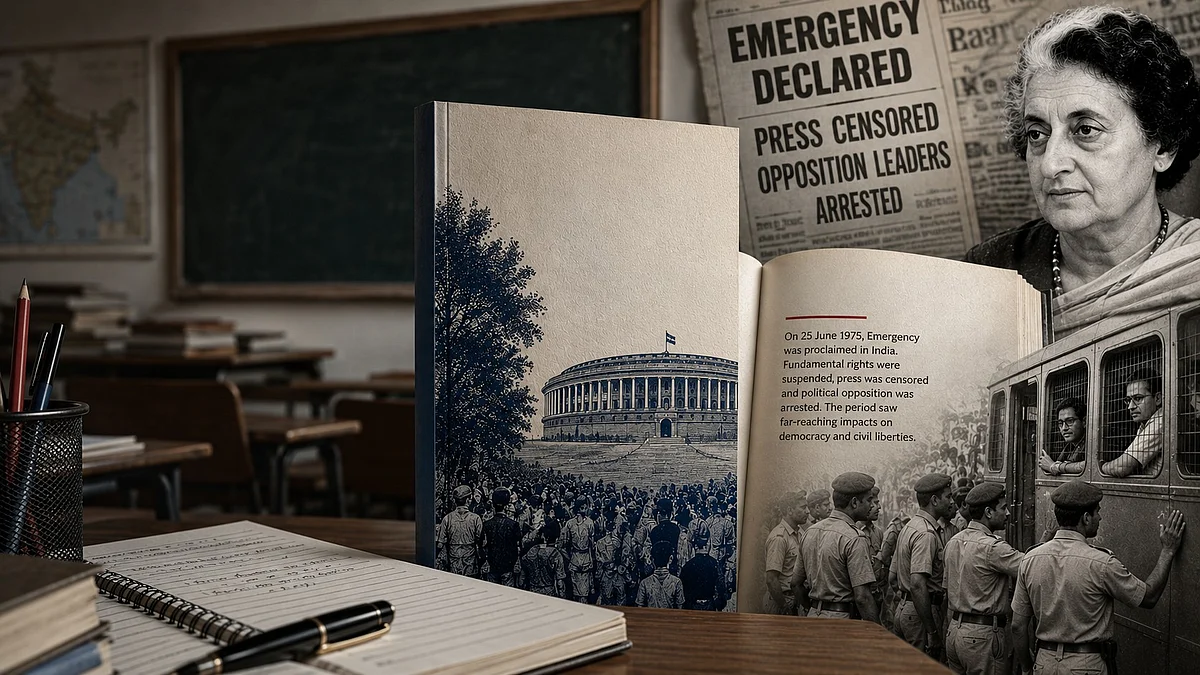


The National Council of Educational Research and Training (NCERT) released its new Social Science textbook, Understanding Society, India and Beyond: Part 1, on June 25, 2026 — the 51st anniversary of the Emergency imposed by Prime Minister Indira Gandhi.
For the first time, a dedicated section on this chapter appears in the Class IX curriculum under 'Challenges to Democratic Practices in India' within the broader chapter on 'Democracy'.
Union Education Minister Dharmendra Pradhan has vigorously defended the move, arguing that future generations must learn about the 'dark deeds' of the Emergency so that such events are never repeated. While the intent to confront history appears commendable, the timing, framing and pedagogical approach suggest a deeper political purpose that risks undermining the democratic values the curriculum claims to strengthen.
The decision to introduce the chapter alongside the government’s official observance of Samvidhan Hatya Diwas transforms education into an instrument of contemporary political messaging. Class IX students, generally fourteen or fifteen years old, are at a formative stage of intellectual development.
They are beginning to acquire the capacity for abstract reasoning but have not yet fully developed the ability to critically evaluate competing historical interpretations, distinguish evidence from political rhetoric or appreciate complex constitutional debates. Presenting one of India’s most contentious political episodes in a manner that appears to foreground partisan culpability over historical inquiry risks substituting education with political socialisation.
A constitutional catastrophe worth remembering
No serious scholar disputes the enormity of the Emergency imposed between 1975 and 1977. On the night of June 25, 1975, following the Allahabad High Court’s verdict invalidating her 1971 election, Prime Minister Indira Gandhi advised President Fakhruddin Ali Ahmed to proclaim a national Emergency under Article 352 on the ground of “internal disturbance.”
Fundamental rights were suspended, press censorship became pervasive and more than 110,000 political leaders, activists and journalists — including Jayaprakash Narayan, Morarji Desai, Atal Bihari Vajpayee and L.K. Advani — were detained without trial under the Maintenance of Internal Security Act (MISA).
Sanjay Gandhi, exercising extraordinary extra-constitutional influence, spearheaded coercive sterilisation campaigns that officially recorded more than 1.07 crore procedures in less than two years, many allegedly linked to coercion and denial of public services. Slum clearance drives, particularly the demolition at Turkman Gate in Delhi, displaced thousands of families under the supervision of officials including Jagmohan.
The 39th and 42nd Constitutional Amendments curtailed judicial oversight and strengthened executive authority, while the Supreme Court’s decision in the ADM Jabalpur case became a lasting symbol of institutional capitulation.
The Emergency exposed the vulnerability of India’s constitutional democracy. Yet its conclusion also demonstrated the resilience of democratic institutions. Indira Gandhi’s decision to hold elections in 1977 enabled the electorate to peacefully remove her government.
The subsequent Janata Party administration enacted the 44th Constitutional Amendment, introducing safeguards against future misuse of Emergency provisions and ensuring that the rights guaranteed under Articles 20 and 21 could never again be suspended.
Congress leaders, including Indira Gandhi herself, later expressed varying degrees of regret over the period. These historical facts unquestionably deserve inclusion in school curricula. The question is not whether students should learn about the Emergency, but how, when and within what broader democratic framework they should do so.
Research warns against simplistic political narratives
The pedagogical concerns surrounding the new chapter are equally significant. Developmental psychologists such as Jean Piaget have long argued that adolescence marks the beginning of formal abstract reasoning rather than its completion.
Educational research similarly emphasises that students entering secondary school are only gradually developing the capacity to evaluate conflicting historical narratives, assess evidence independently and understand constitutional complexity.
History education at this stage should therefore prioritise foundational democratic principles, constitutional institutions, citizenship, rights and responsibilities before immersing students in intensely polarising political controversies.
National curriculum frameworks developed over several decades, particularly those informed by constructivist educational philosophy, have consistently maintained that school history should cultivate inquiry rather than prescribe political conclusions.
Students should encounter history as evidence to be interpreted rather than verdicts to be memorised.
Research on teaching controversial history likewise stresses the importance of creating classrooms where multiple perspectives are examined through primary sources, reasoned discussion and critical analysis. Complex historical events cannot be reduced to moral binaries or partisan narratives. They require context, comparison and careful teacher facilitation.
NCERT’s current treatment appears to fall short of these educational principles. By locating the Emergency within a chapter on democratic challenges amid an already polarised political climate, the textbook risks presenting a selective account of history. While documenting the excesses of Indira Gandhi’s government, does it equally examine the institutional failures that enabled authoritarianism?
Does it sufficiently explain the political unrest, labour agitations, economic instability and governance crises that the government cited while proclaiming the Emergency? Does it discuss the support extended to the Emergency by influential personalities such as Vinoba Bhave and J.R.D. Tata? Most importantly, does it encourage students to analyse competing evidence independently, or merely direct them towards predetermined political conclusions?
Education is not meant to become an arena for settling historical or electoral scores. Its purpose is to cultivate informed, questioning and empathetic citizens capable of understanding complexity rather than inheriting political prejudice.
The political undercurrent
The political context surrounding the textbook’s release cannot be ignored. The Bharatiya Janata Party has consistently invoked the Emergency as the defining symbol of Congress authoritarianism and officially commemorates June 25 as Samvidhan Hatya Diwas. Prime Minister Narendra Modi, who was associated with the Rashtriya Swayamsevak Sangh (RSS) during the Emergency, frequently cites the period as evidence of dynastic authoritarianism.
Yet history is rarely so uncomplicated. The historical record also reveals that RSS chief Balasaheb Deoras wrote letters to Indira Gandhi during the Emergency seeking the removal of the ban imposed on the organisation. Such complexities rarely receive equal attention in public political discourse.
When curriculum revisions coincide so closely with contemporary political commemorations, particularly in a deeply polarised environment, legitimate concerns arise regarding the use of education to reinforce present-day political narratives. Textbooks should rise above electoral cycles and ideological contests. Their credibility depends upon scholarly independence rather than political convenience.
Democratic education requires democratic memory
Remembering the Emergency is unquestionably essential. Forgetting authoritarianism would weaken democracy. But democratic education cannot rest upon selective remembrance.
If the purpose of the chapter is genuinely to warn students against authoritarian tendencies, the discussion cannot conclude with March 1977. Students also deserve to understand that democratic decline is neither unique to one political party nor confined to one historical period.
The Emergency represented one form of democratic breakdown—a formal suspension of constitutional freedoms through legal proclamation. Contemporary democracies increasingly confront more subtle forms of democratic erosion: executive centralisation, weakening institutional autonomy, shrinking civic space, intimidation of journalists, prolonged detention of dissenters, misuse of investigative agencies, digital surveillance and organised disinformation.
Comparative political scholars Steven Levitsky and Daniel Ziblatt, in How Democracies Die, argue that modern democracies rarely collapse through dramatic coups or sudden constitutional ruptures. More often, democratic norms gradually erode while constitutional institutions continue to exist formally. That broader comparative perspective is largely absent when the Emergency is presented solely as the exclusive moral failure of one political party.
A genuinely educational approach would encourage students to ask enduring democratic questions rather than merely identify historical villains. How do democracies become vulnerable? Why do institutions fail? How should citizens respond when constitutional safeguards weaken? Can democratic erosion occur even without the formal declaration of an Emergency? Such questions remain relevant irrespective of which political party occupies power and encourage students to think critically rather than politically.
Broader imperatives for democratic education
A mature democracy requires citizens who understand both its vulnerabilities and its capacity for self-correction. The Emergency offers invaluable lessons about the dangers of concentrated executive authority, judicial deference, weakened institutional checks and curtailed civil liberties. Equally important, it demonstrates the strength of democratic accountability through elections and constitutional reform.
These lessons become far richer when situated within the broader trajectory of India’s democratic evolution—alongside the legacies of colonialism, the trauma of Partition, linguistic movements, caste struggles, economic transformations and contemporary debates over institutional autonomy, technology, privacy and civil liberties. Such an approach would draw upon archival material, the Shah Commission Report, constitutional debates, biographies and diverse scholarly interpretations rather than selectively curated narratives.
India’s school textbooks have long remained sites of ideological contestation under successive governments. The solution does not lie in omitting uncomfortable history, but in presenting it with scholarly rigour, historical balance and intellectual honesty. At the Class IX level, this would mean first grounding students in constitutional values and democratic institutions before introducing carefully contextualised case studies that encourage inquiry rather than ideological conformity.
Safeguarding education from partisanship
Fifty-one years after the Emergency, India’s democracy continues to endure because of an engaged citizenry capable of questioning authority and correcting political excess through constitutional means.
NCERT’s inclusion of the Emergency could have become an important milestone in democratic education. Instead, its politically charged timing and selective framing risk transforming an important historical lesson into a contemporary political instrument.
Future generations deserve textbooks that illuminate rather than inflame; that prepare students to recognise threats to liberty—whether dramatic or gradual, historical or contemporary—without prescribing whom they must condemn. If policymakers genuinely wish students to learn from the Emergency, they must also teach them that democracy is protected not by selective memory but by consistent constitutional principles, institutional independence and the courage to question power in every age.
The classroom should never become an extension of partisan politics. India’s students—and India’s democracy—deserve nothing less.
Hasnain Naqvi is a former member of the history faculty at St. Xavier’s College, Mumbai. More of his writing here
Join our official telegram channel (@nationalherald) and stay updated with the latest headlines