


Punjab: The arithmetic of appeasement
Herjinder on why the AAP government in Punjab plumps for 68 lakh women over 7.5 lakh employees and pensioners
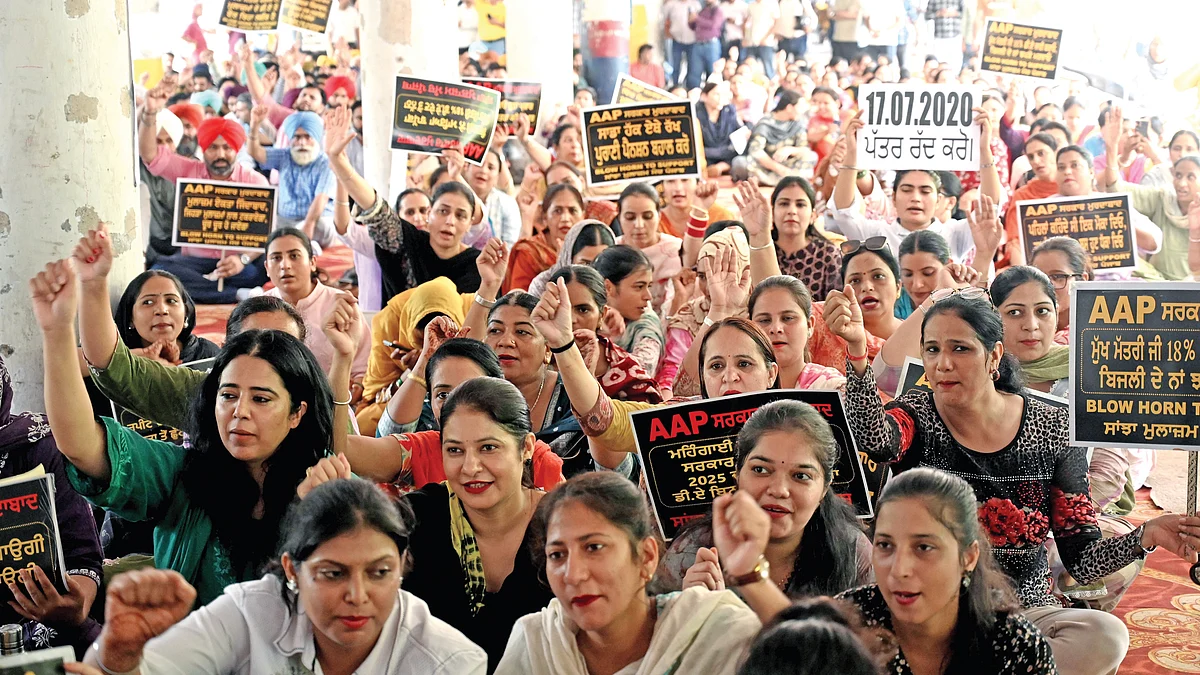


Election season has a way of turning government employees into the most persuasive lobbyists. It is, after all, the one window in the political calendar when a government cannot afford to say no — or so history has led Punjab’s employee unions to believe. Ahead of the 2027 assembly elections, they are marching, striking and petitioning courts to force the release of pending dearness allowance (DA) arrears.
This time, however, the Bhagwant Singh Mann government appears to be working off a very different playbook: one built not around 7.5 lakh employees and pensioners, but around 68 lakh women voters.
At the heart of the impasse is a litany of unresolved demands. Employee unions want payment of 18 per cent pending DA arrears, restoration of the Old Pension Scheme (OPS), withdrawal of the July 2020 decision by the previous Congress government that imposed central pay scales on all future recruits, and reversal of a letter (dated 15 January 2015) that restricted new employees to basic pay during their three-year probation period.
The unions peg the pending DA arrears and related dues at approximately Rs 14,191 crore — a figure the state government does not dispute outright. Their case is simple: with tax collections improving, the state can afford to pay up. It is a demand that carries real political weight. With around 3.5 lakh employees and 4 lakh pensioners behind the agitation, it’s large enough to unsettle any incumbent government heading into an election year.
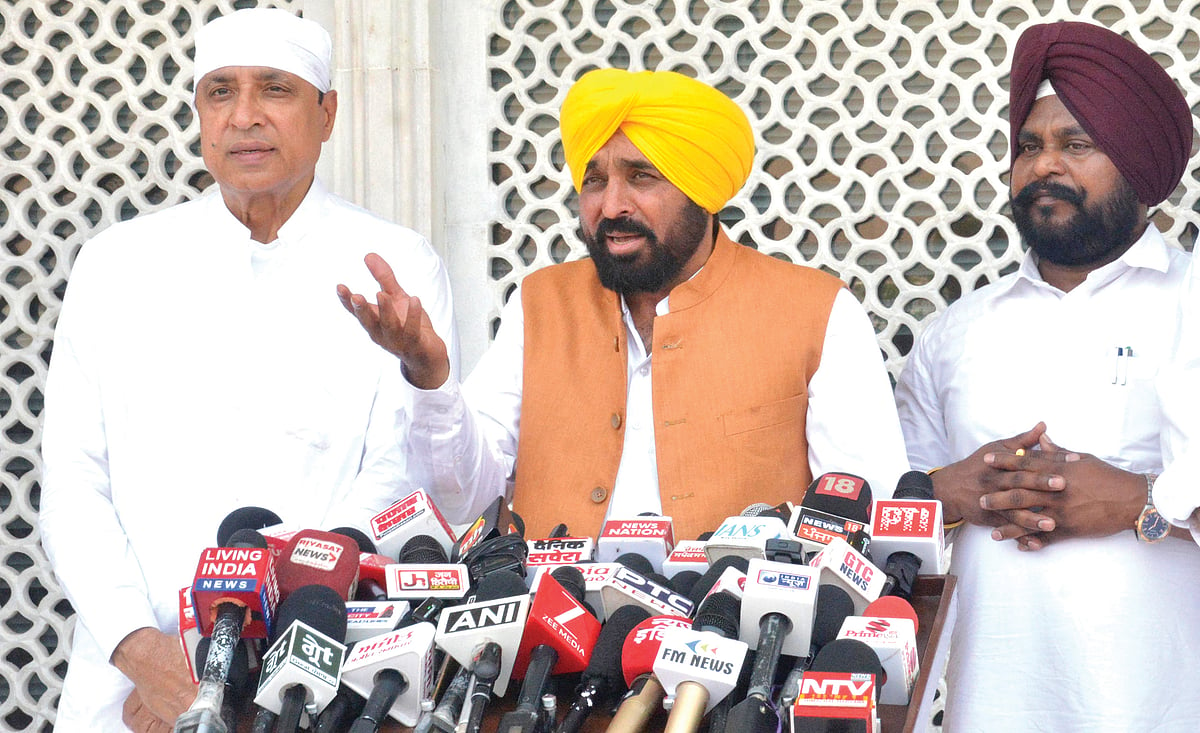
The confrontation has now spilled into the courts. The Punjab and Haryana High Court directed the state government to clear the remaining DA dues within a compressed 15-day deadline. Instead of complying, the Mann government moved the Supreme Court, arguing that immediate payment is practically impossible under treasury rules and would disrupt essential public expenditure.
That single line of argument — ‘impossible under treasury rules’— is where the story gets interesting. Even as the government pleads fiscal constraint on one hand, it is simultaneously bankrolling one of the most expensive welfare schemes in Punjab’s history on the other.
The scheme in question is the Mukh Mantri Mawan Dheeyan Satkar Yojana, also known as the Maa-Beti Samman Yojana — a women-centric direct benefit transfer programme that promises monthly financial support of Rs 1,500 for women from Scheduled Caste households and Rs 1,000 for women in other eligible categories.
The scale is enormous. Registrations have already crossed 68 lakh women, and three instalments have already been transferred directly into the Aadhaar-linked bank accounts of the beneficiaries. Three more are expected before voters head to the polls. All told, the scheme is estimated to cost the state exchequer close to Rs 20,000 crore.
There is a second layer to the programme that has drawn its own share of scrutiny. The government has enlisted a large network of women volunteers — Satkar Sakhis — across every assembly constituency, tasked with registering eligible women for the scheme. Each registration earns the volunteer a fixed payment of Rs 200.
It is being suggested, though not officially confirmed, that this registration drive doubles as a means of building a granular database of women voters in each constituency, complete with phone numbers, an asset with obvious value closer to election day.
Consider the math. On one hand, a Rs 14,191 crore DA arrears bill owed to 7.5 lakh employees and pensioners, a constituency that — however vocal — is finite and largely fixed in its political loyalties. On the other, a Rs 20,000 crore welfare scheme that reaches nearly ten times as many people, spread across every household and every constituency in the state, with fresh instalments timed to land before voting begins.
Put them side by side and you begin to see why the government is pushing one, and pleading impossibility for the other.
Finance minister Harpal Singh Cheema has publicly maintained that rising revenue collections do not translate into surplus cash, pointing to Punjab’s heavy debt-servicing obligations and structural deficits. The state’s fiscal position lends some credibility to that claim: the fiscal deficit for the year is pegged at close to Rs 39,971 crore, or about 4.1-4.2 per cent of GSDP, well above recommended consolidation targets. The revenue deficit alone is almost Rs 21,955 crore.
Punjab’s outstanding public debt has already crossed Rs 4.13 lakh crore and is projected to touch nearly Rs 4.47 lakh crore, pushing the debt-to-GSDP ratio to roughly 45 per cent, among the highest of any major Indian state. Over 90 per cent of revenue receipts are already locked into committed expenditure: salaries, pensions, power subsidies and interest payments.
In other words, the treasury genuinely may not have room for both. And when a government with limited fiscal headroom has to choose between pay-outs to 68 lakh women voters against 7.5 lakh employees and pensioners, the choice starts to look less like a matter of affordability and more like a matter of calculated benefit.
The government insists it has not abandoned its employees altogether. It points out that DA has already been raised by 14 percentage points in stages since late 2021, taking it to 42 per cent, and that over Rs 4,500 crore in arrears has been disbursed through monthly instalments.
Officials also argue that Punjab’s pay structure is already more generous than the Centre’s: a state government clerk drawing 42 per cent DA takes home more than a central government counterpart on 60 per cent DA, making a straight matching of central DA rates financially unviable.
Reviving the Old Pension Scheme or clearing DA arrears in full would buy peace with a committed but numerically limited electorate. Sustaining the Mawan Dhiyan Satkar Yojana, on the other hand, reaches a female electorate nearly ten times larger, delivers cash directly into their accounts on a schedule that conveniently peaks before polling day and, through its registration drive, potentially hands the ruling party a fresh voter database to work with. The political logic underpinning the government’s position couldn’t be clearer.
Join our official telegram channel (@nationalherald) and stay updated with the latest headlines