


Questioning dissent? Not at CJI Surya Kant's lecture
Chief Justice of India's London appearance takes awkward turn as organisers block audience member's query
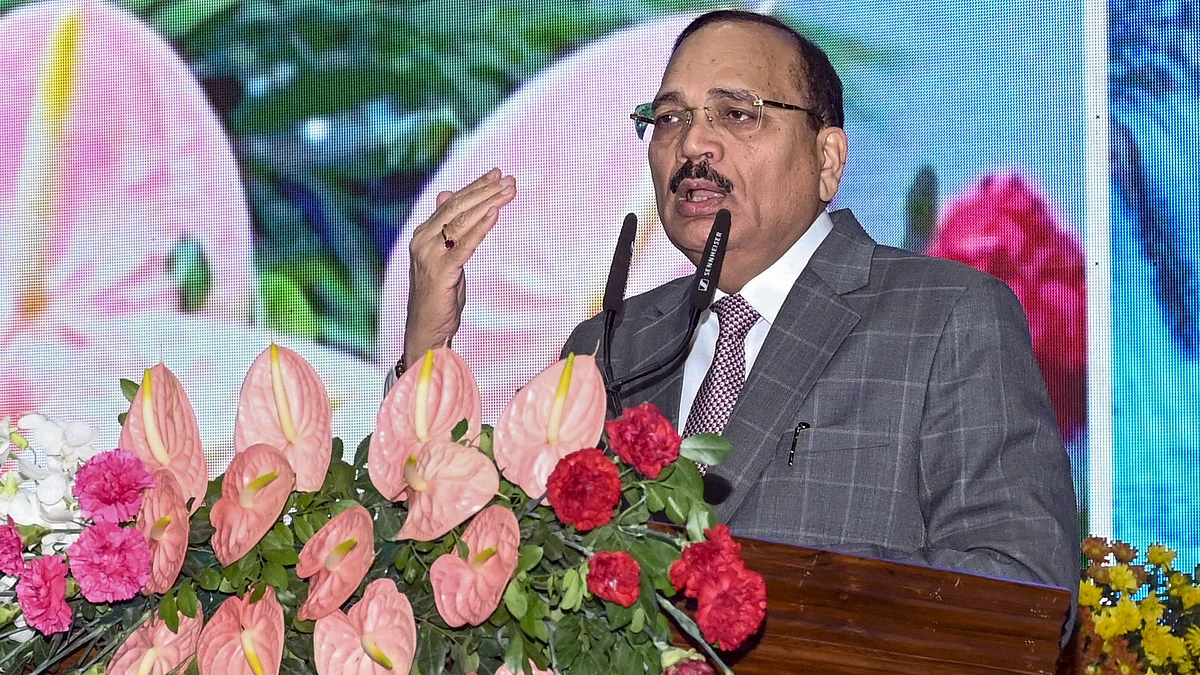


Chief Justice of India Surya Kant travelled to London to speak about artificial intelligence and the future of international law. What ended up generating the most interest, however, was a very human question that found no answer.
At an event hosted by Birkbeck College, University of London, audience members attempting to raise concerns about dissent and democratic freedoms in India found themselves swiftly informed that such matters were, apparently, off-topic.
The exchange has since gone viral online, not least because it landed the CJI in familiar territory: a controversy involving criticism, dissent and people asking inconvenient questions.
Videos circulating on social media show an attendee beginning what appeared to be a carefully framed question. Referring to the CJI's comments on India's democratic traditions, she noted that legal observers in India and abroad had expressed concerns about growing hostility towards dissent and suggested that some of the recent public remarks emanating from high offices seemed to reflect that trend.
Before she could actually get to the question part of the question, an organiser intervened. "With all due respect, I'm so sorry, I would not be able to take up that question since the topic is concerning artificial intelligence and international law," he said, apologising repeatedly before cutting her off.
The irony was difficult to miss. A lecture touching on technology, accountability, democracy and governance had apparently run into the one subject that could not be processed by the system.
The intervention did not go down particularly well with sections of the audience. Another clip shows attendees protesting the decision, with one voice ringing out: "Give us some respect please!"
The videos were widely shared by Saurav Das, chief spokesperson of the Cockroach Janta Party — a political movement that owes its unusual name entirely to the CJI himself.
Last month, while speaking about fake degree-holders and unemployed youth turning to activism, Kant had referred to some such individuals as "cockroaches" and "parasites". The remarks sparked outrage and, in a feat of political branding that would impress most consultants, critics promptly adopted the insult as a badge of honour.
Thus was born the Cockroach Janta Party, whose members seem determined to prove that if you call people cockroaches often enough, some of them may eventually start printing the membership cards.
The London episode also brought back memories of another recent encounter involving unanswered questions and visiting Indian dignitaries abroad.
During Prime Minister Narendra Modi's visit to Norway in May, a local journalist called out after a joint statement with Norwegian Prime Minister Jonas Gahr Store had concluded without any questions being taken. "Prime Minister Modi, why don't you take some questions from the freest press in the world?" journalist Helle Lyng asked as Modi walked away from the podium.
The prime minister did not respond. Indian officials later explained that the event had been scheduled as a joint media statement rather than a press conference, and therefore did not include a question-and-answer session.
In London this week, organisers offered a somewhat similar explanation: the topic was artificial intelligence and international law, not dissent, democracy or the public perception of India's institutions.
One could argue that the audience was merely attempting to test whether the conversation could handle unexpected inputs. The answer, at least on this occasion, appeared to be no.
That was unfortunate, because the question itself was arguably connected to the themes the CJI had spent much of his lecture discussing. Surya Kant warned that artificial intelligence posed one of the most significant challenges facing international law and stressed the importance of ensuring that technological power remained accountable to constitutional values, democratic legitimacy and human dignity.
"The central challenge before us is to ensure that, in an age of intelligent machines, humanity retains authorship of the principles by which it is governed," he said.
He also emphasised the importance of dialogue between courts, governments, universities and civil society during periods of profound technological change.
That dialogue, however, briefly became a monologue when the discussion turned towards dissent.
Join our official telegram channel (@nationalherald) and stay updated with the latest headlines