


Relaxed to anxious to playful: Rescued baby orangutans show range of emotions at Odisha zoo
Five orangutans rescued from Balasore receive round-the-clock veterinary care as officials probe suspected international smuggling racket
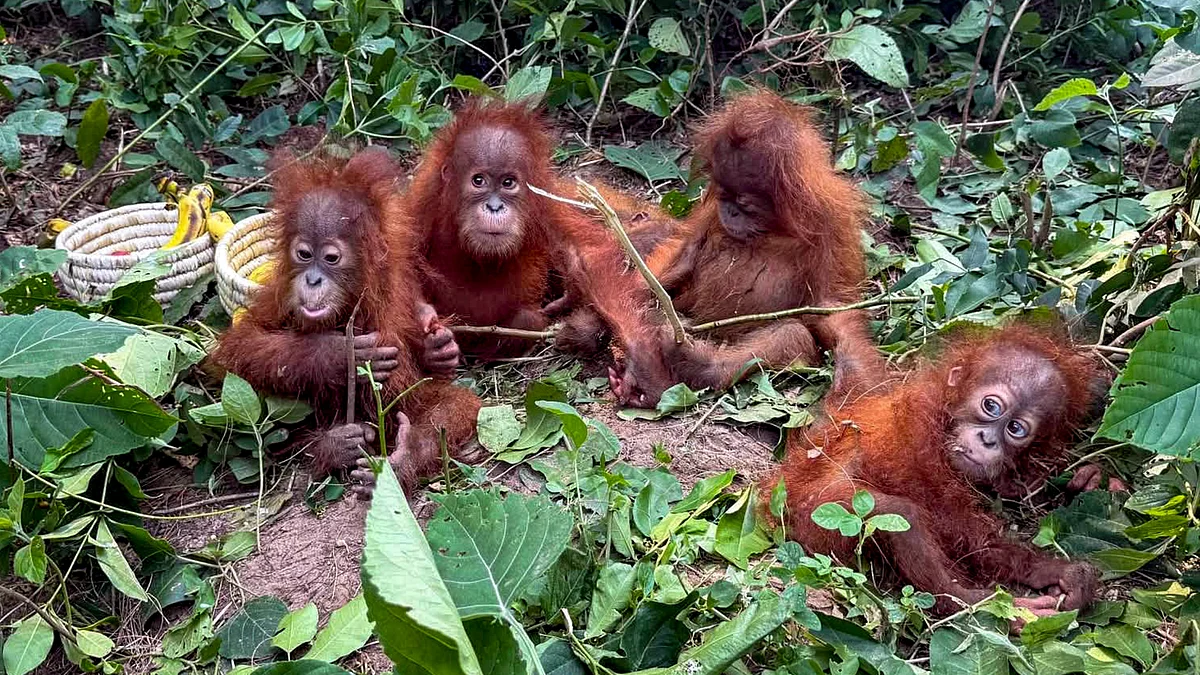


Five baby orangutans rescued from Odisha’s Balasore district are settling into quarantine at the Nandankanan Zoological Park in Bhubaneswar, displaying a range of emotions from relaxed and playful behaviour to anxiety as they adjust to being separated from their mothers.
The orangutans were rescued by forest department personnel on Tuesday and brought to the zoo that night. On Thursday, they were taken out of their quarantine enclosure for a morning sunbath to help keep them “stress free”, a senior zoo official said.
The animals, aged between six months and one year, have been observed behaving much like human children, the official said.
“Sometimes they appear to be relaxed, and in the next moment, they cling to each other, likely due to feelings of anxiety for being separated from their mothers,” he said.
The five have also been playing with teddy bear soft toys kept inside their quarantine unit.
Nandankanan Zoological Park Director Sanath Kumar N said the zoo was providing veterinary treatment while closely monitoring the animals’ mental condition. He said the babies had appeared scared when they were rescued and were being treated on the advice of the Centre for Wildlife Health (CWH).
Despite having adequate space in the quarantine room, the orangutans have been seen sitting and sleeping very close to one another.
Three animal keepers have been assigned to care for them, while a veterinary doctor is monitoring their health round the clock.
The animals are being fed infant milk formula, boiled and mashed apple, banana and oral rehydration fluids.
Health condition stable
The five orangutans comprise three males and two females. They are roughly one to one-and-a-half feet tall.
After their arrival at the zoo, one was found to have a fever, two showed symptoms of the common cold and another was found to have worms.
Their condition is now stable following medication, a zoo doctor said.
“They enjoy eating apple, banana, dry fruit and bottled milk,” the doctor said, adding that the animals also give signals when they are hungry or thirsty.
To minimise the risk of infection, staff assigned to the quarantine enclosure have been barred from working in other sections of the zoo.
The zoo has also constituted a health committee comprising veterinary experts from Odisha University of Agriculture and Technology (OUAT), who have conducted an initial examination.
The animals will first be allowed to acclimatise to their new surroundings. Their blood and oral swab samples will subsequently be collected and screened at the CWH, officials said.
“We are providing the best veterinary treatment available, and at the same time monitoring their mental condition,” Sanath Kumar said.
Probe into suspected smuggling
Odisha Forest and Environment Minister Ganesh Ram Singh Khuntia visited the zoo and said the health of the rescued animals was the government's priority.
“The health of the orangutan babies is priority for the government. The Nandankanan Zoo authorities are also in constant touch with officials of the Mysore zoo, where orangutans are housed,” he said.
Meanwhile, a joint investigation by the state police and the Wildlife Crime Control Bureau (WCCB) is underway to determine how the animals reached Odisha and whether an international smuggling racket was behind their sudden appearance in the state.
Orangutans are not native to India. They are found naturally in the rainforests of Malaysia and Indonesia, including the islands of Borneo and Sumatra in Southeast Asia.
The investigation is expected to establish the circumstances in which the five young animals were brought to Odisha and identify those responsible, if an illegal wildlife trade network is found to be involved.
Join our official telegram channel (@nationalherald) and stay updated with the latest headlines