


Sacking of Somnath Temple: What history tells us and newspapers don’t
Why did Mahmud of Ghazni wait 25 years to sack Somnath, persecute Muslims in Multan, and why was a mosque later built near the temple?
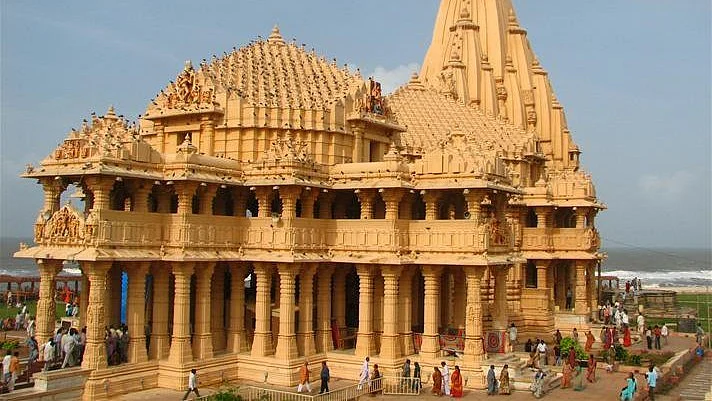


Inaugurating the three-day Somnath Swabhiman Parva on 9 January, Prime Minister Narendra Modi called for continuing the fight against anti-Hindu forces still engaged in dividing the Hindus. Around the same time national security advisor Ajit Doval called upon young Indians to avenge historical wrongs and mentioned the demolition of temples by successive Muslim invaders.
The event marked a thousand years since the Somnath temple was sacked by Mahmud of Ghazni and kicked off somewhat incongruously a year-long sequel of events to commemorate the ‘destruction’. In doing so Modi articulated a vision of the shrine as an eternal symbol of India’s indomitable spirit. His narrative — one of serial destruction by "foreign invaders" followed by a persistent Hindu resolve to rebuild — framed Somnath not merely as a site of worship, but as the epicentre of a civilisational trauma.
A closer look at the historical records reveals a more nuanced narrative than newspaper headlines may have suggested.
Why did Mahmud of Ghazni wait till 1026 to sack Somnath? Historical records confirm a series of raids of Mahmud of Ghazni (Afghanistan) into India from the year 1001. Textbooks in Pakistan since 1947 glorified the ruler as a great crusader for Islam, a Ghazi, while in India textbooks marked him out as a ‘barbaric’ invader. Although known predominantly for his sacking of the Somnath Temple in Saurashtra in 1026, it remains unexplained why he waited till 1026 to sack the temple even as his earlier raids took him as far as Mathura and Gwalior.
Were demolition of temples common in the medieval period? Historians Richard Eaton, Romila Thapar and more recently Ruchika Sharma have pointed out that between the year 1000 and 1707 there are documented records of the demolition of 80 temples in India by both Muslim and Hindu rulers. Neither Sanskrit nor Persian sources provide proof that temple demolitions were common or were carried out on a large scale. They have also debunked claims that the raids were prompted more by devotion and religious zeal and less by political reasons. While British historians framed the demolitions as part of a religious crusade, others have pointed out that demolition of temples were carried out by Hindu rulers too.
Wealth of Temples is what made them the targets of plunder, historians have concluded. Temples were not just places of worship but acted as a central bank to the rulers, hosting vast reserves of gold, ornaments and precious stones and jewellery. Rulers needed a steady stream of resources to keep a standing army and raiding territories for plunder was common for this purpose. Mahmud of Ghazni’s empire-building in Central Asia required a constant influx of gold to pay his standing army. His raids were targeted strikes on wealthy urban centers—including Somnath, Mathura, and Kannauj—where the concentrated wealth was greatest. Temples were also centres of learning and demolishing them were meant more to spite and humiliate the losing ruler. Crucially, Mahmud also brutally suppressed fellow Muslims, such as the Ismailis in Multan, indicating that his sword was guided more by the pursuit of resources and the consolidation of power than by a monolithic religious agenda.
Mahmud Ghazni’s campaigns against Muslims: To understand the motivations behind such raids, one must look toward the seminal work of Professor Mohammad Habib. In his analysis of the Ghaznavid expeditions, Habib argued that Mahmud’s primary impulse was not the proselytization of Islam, but the acquisition of vast wealth. In the medieval world, temples were not only spiritual centers but also the principal repositories of the state’s bullion and accumulated capital.
Mahmud’s state depended on the continuous influx of plunder to pay his army and sustain his court. Habib’s scholarship suggests that Mahmud acted as a "secular" plunderer in pursuit of resources to fund his Central Asian empire. His campaigns against fellow Muslims—including the brutal suppression of Ismailis in Multan—make it impossible to frame his actions as a simple war of Islam against Hinduism.
Muslims were valued business partners: For leaders today, Somnath may serve as a "beacon of indomitable spirit," a symbol used to link modern national resurgence to an ancient struggle. However, a 1264 AD inscription reveals that just two centuries after Mahmud’s raid, a wealthy Arab ship-owner, Nur-ud-din Firuz, was granted land to build a mosque right near the Somnath temple. This transaction was facilitated by the temple’s own administration and local Hindu elites. This suggests that for those living in the medieval period, the "Muslim" was often a vital business partner in a cosmopolitan maritime world, not a perpetual enemy.
The legend of "seventeen destructions": We often hear that the temple was destroyed and rebuilt seventeen times. Does the archaeological evidence support this cycle of perpetual ruin? The "seventeen destructions" is a powerful emotive trope, but it lacks credible archaeological and historical backing. Research by Satish Chandra and others suggests that while the 1026 raid was a significant event, it did not lead to a civilizational rupture.
Sanskrit inscriptions from the period following the raid barely mention the sacking of the temple, much less about any societal "trauma". In fact, by 1038, pilgrim records suggest the temple was functional once again. Periods of decline over the centuries were often caused by shifting maritime trade routes, natural erosion, or the waning of local royal patronage rather than a sequence of seventeen "barbaric" invasions. The narrative of constant destruction is largely a later construction, intended to amplify the theme of victimhood.
When history is mobilised for year-long celebrations precisely as major elections approach, the political intent is difficult to ignore. By framing historical raids as a current grievance, political parties can divert attention from contemporary governance failures — such as economic distress or unemployment—toward a more emotive "civilizational" struggle.
This helps keep the "communal fire" stoked, ensuring that the electorate remains focused on identity rather than policy or outcomes.
(Hasnain Naqvi is a former member of the history faculty at St. Xavier’s College, Mumbai)
Join our official telegram channel (@nationalherald) and stay updated with the latest headlines