


SIR questions that don’t go away
From Assam to Uttar Pradesh, data and ground reports suggest the SIR is excluding genuine voters
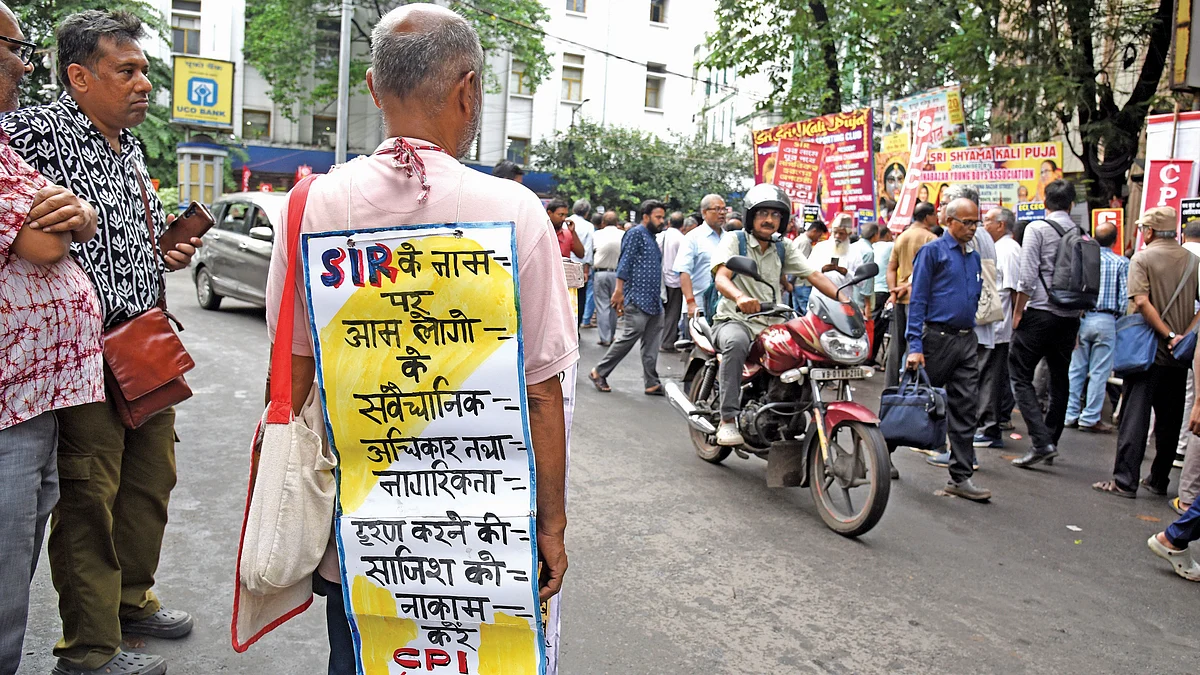


The Special Revision of electoral rolls in Assam is over. Curiously, it’s the only state—of the 11 states and Union Territories undergoing the SIR Revision—with zero exclusion from its rolls. This despite the deletion of 10.56 lakh voters who died or have permanently shifted.
The total number of voters in Assam remains 2.52 crore, the same as it was before the SR (not to be confused with the SIR). In contrast, the SIR has provisionally excluded 6.56 crore names. The SIR introduced two new elements not required in Assam’s SR or earlier revisions—enumeration forms and documents to prove citizenship.
These resulted in massive provisional deletions—97 lakh in Tamil Nadu, 73 lakh in Gujarat, 58 lakh in West Bengal and 90,000 even in the small state of Goa. Ground reports indicate that millions of eligible voters are being excluded due to errors, lack of documents or document mismatches (spelling variations or year of birth).
Do these two changes make a difference? They do. Rahul Shastri and Yogendra Yadav point out (Indian Express, 30 December) that a parallel exercise was being conducted in Uttar Pradesh by the State Election Commission (SEC).
The voter list for panchayat elections was being revised through door-to-door enumerations and was released on 5 December 2025. The result? In December 2025, Uttar Pradesh had an adult population of 16.1 crore. Before the SIR, the ECI’s list had 15.4 crore voters in UP. After the first phase of the SIR, this number dropped to 12.6 crore.
Curiously, the SEC lists the total rural electorate at 12.7 crore. Add 3.4 crore urban voters (declared by the SEC-UP in 2023) to this and you arrive at 16.1 crore, the estimated adult population in December 2025. Is there then a design-defect in SIR?
A fatal error made by the Election Commission was the presumption that every Indian citizen has documents that prove date of birth, marriage, domicile, land and property ownership… A large number of Indians are actually undocumented.
The South First cited the case of one Priya (25) of Irular colony in Tamil Nadu’s Narasamangalam (Tiruvallur). Pregnant with her third child, neither she nor her husband Chinna or any of their children have any documents that prove they are Indian. Since hospitals insisted on Aadhaar numbers, Priya gave birth at home.
The children therefore have no birth certificates. Priya and Chinna do not have ration cards, caste certificates or voter identity cards either. Even official data, while claiming that births at home are declining, estimated nearly a million such births took place in 2022 and 2023.
Also Read: The BJP's intent versus India's apathy
The government also lacks accurate data on migrants. The outdated 2011 census estimated 4.14 crore inter-state migrants, while a 2020–21 Periodic Labour Force Survey put the figure at 29 per cent of the population. Daily wage earners, construction workers and those constantly moving in search of work also go undocumented.
Meanwhile, voters in West Bengal are receiving notices due to discrepancies in the 2002 electoral rolls, originally prepared in Bengali and later translated into English. Distorted names and inconsistent spelling of names by BLOs have triggered mass hearings, making the process confusing and intimidating—especially for senior citizens.
Voters also lament the lack of clear guidelines and constantly changing rules. The combination of weak documentation, excessive administrative discretion and a rushed timeline have made SIR an error prone misadventure. The SIR versus no-SIR debate that began in June 2025 will undoubtedly generate more heat and dust in 2026. For now, we attempt to answer some key questions:
Will the SIR end universal suffrage guaranteed by the Constitution? Potentially, yes. While the Constitution guarantees voting rights to every Indian citizen aged 18 or above, the SIR threatens to exclude millions. Deletions arise from lack of citizenship proof, digital illiteracy, homelessness or work-related migration. Many are excluded due to inconsistent spellings or administrative errors.
The ECI made the big mistake of presuming that every citizen has proof of birth. But way too many Indians have no documents
How do we know genuine voters are being left out?
An inclusive electoral roll should pass three tests:
• The elector–population ratio (to include all adults)
• The gender ratio (to ensure women are not left out)
• The inclusion of all first-time voters of 18 and above Former election commissioner Ashok Lavasa has been vocal in asking why the Supreme Court has not instructed the ECI to clarify the purpose, process and principle of the SIR in Bihar. Was the objective to weed out infiltrators? If so, was it met? Has the principle of universal adult franchise been upheld?
Did SIR in Bihar fail the three tests?
Yes, says academic-turned-activist Yogendra Yadav. Bihar’s adult population stands at 8.22 crore in 2025. Post-SIR, this number is 7.45 crore—an exclusion of 77 lakh adults. Similarly, the gender ratio of 916 females per 1000 males fell to 894 after the SIR, suggesting the disproportionate exclusion of women. Software analysis of names by Yogendra Yadav and his team also suggests the omission of a disproportionate number of Muslims. The ECI has yet to make public the data before-and-after SIR.
Are Bihar’s electoral rolls now error-free?
No, says Yadav. After the final list was published by the ECI on 30 September, he drew the attention of the Supreme Court to 59 lakh ‘duplications’ (same name, age and father’s name). He also told the court that as many as 75,000 names had neither address nor father’s name. Names of voters in Bihar were written in Kannada and Tamil. None of these anomalies were disputed by the ECI in court. However, they were also not corrected in the revised rolls released on 28 October 2025.
How many infiltrators/foreigners were detected in Bihar?
The Election Commission is yet to officially declare the number. It has confirmed receiving 3.75 lakh objections, 1,087 of which flagged foreigners. As many as 390 voters self-admitted to being foreigners. Most of them were women from Nepal who settled in India after marrying Indians.
Has the Election Commission been transparent about the SIR?
No. Six months after the surprise announcement, the ECI has not named the agency claimed to have identified discrepancies in the electoral roll and recommended the SIR in Bihar. It is also not clear if the same agency recommended carrying out the SIR in other states. Field staff and voters faced frequent, confusing procedure changes. Although the ECI admitted in court that its de-duplication software was error-prone and had been discarded in 2022, it reused the same tool late in the second phase of SIR without issuing guidelines or updating stakeholders. Another software was deployed to detect ‘logical inconsistencies’ without transparency, fuelling suspicions of selective application.
Does the law allow ‘system-driven deletion’ of voters?
By law, only the Electoral Registration Officer (ERO) can add or delete voters. The law also provides for a notice period and reasonable time frame allowing claims by voters before deletion. In West Bengal, however, the ECI bypassed the EROs, deleted names en masse without serving notices, used automated ‘system-driven deletion’ citing death or migration (even when enumeration forms were not returned). The West Bengal Civil Service (Executive) Officers’ Association flagged these as both unlawful and confusing for the people.
Join our official telegram channel (@nationalherald) and stay updated with the latest headlines