


Can't bring everything to halt: SC on closure of Delhi Metro, train services
Court asks authorities to regulate services, publicise traffic restrictions and review road barricading to minimise commuter inconvenience
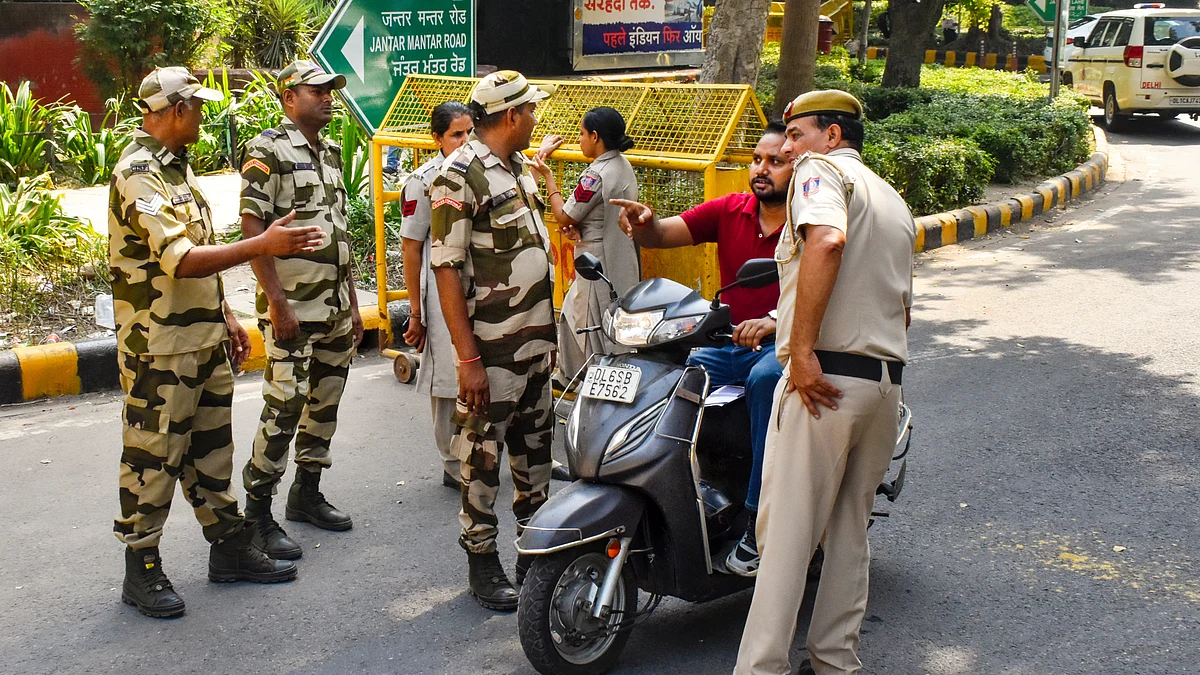


SC rules out complete halt to Metro and railway services ahead of CJP protest.
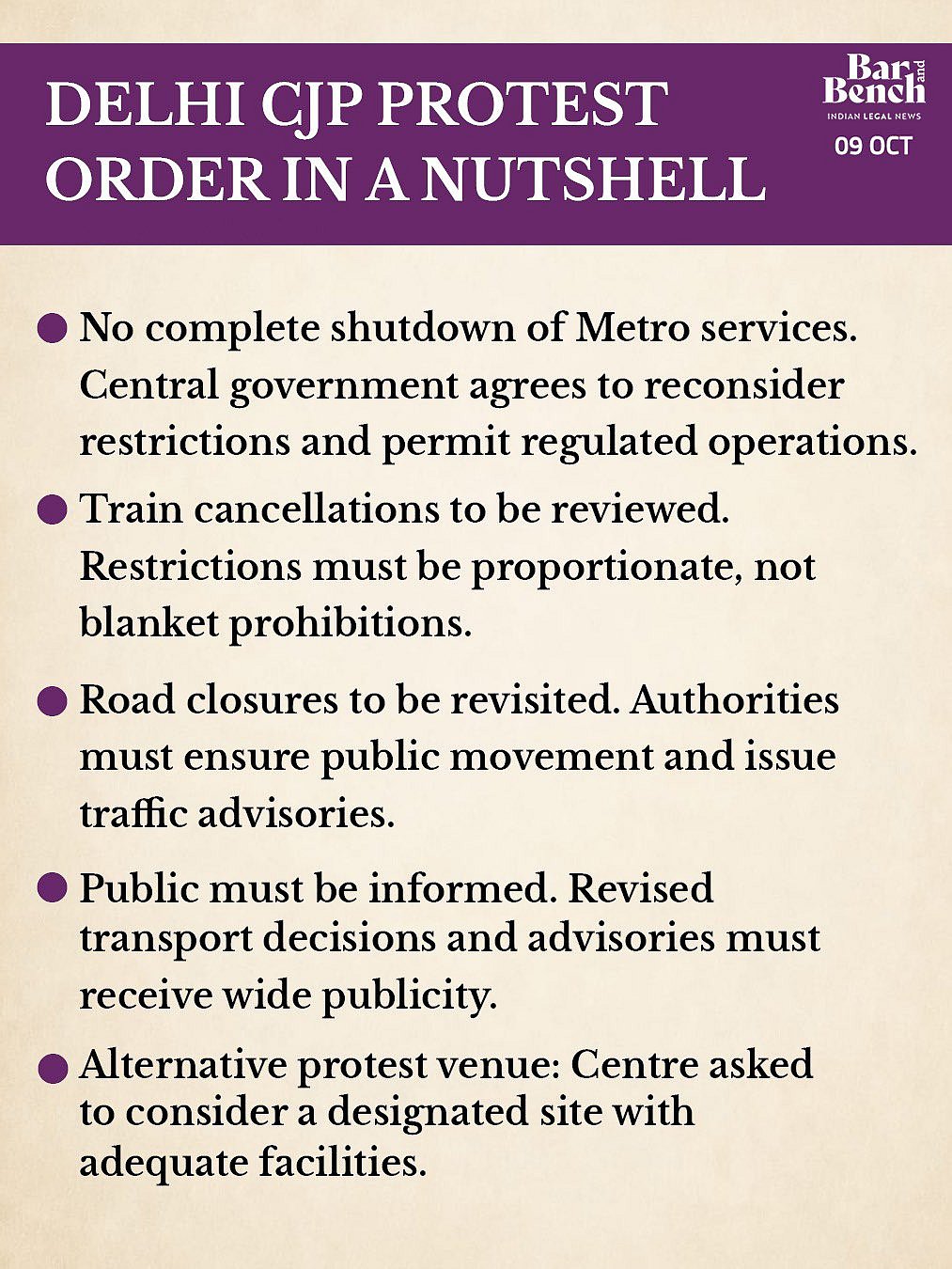
Centre asked to ensure regulated services and publicise transport restrictions.
Authorities directed to review road barricades and publicise alternative routes.
The Supreme Court on Friday, 9 October directed the Centre to ensure there is no complete prohibition on the movement of Metro trains ahead of the Cockroach Janta Party’s (CJP) planned protest in Delhi on 10 October, saying the city’s transport network could not be brought to a standstill in the name of maintaining law and order.
A bench comprising Chief Justice of India Surya Kant and Justices Joymalya Bagchi and V. Mohana said preventive measures were permissible but had to be proportionate to the anticipated threat and should not cause undue hardship to ordinary citizens.
The court was hearing petitions challenging the proposed closure of 57 Delhi Metro stations and the cancellation of trains scheduled to arrive at New Delhi and Hazrat Nizamuddin railway stations during specified hours on Saturday. The protest has been called by the CJP and student organisations demanding the resignation of chief election commissioner Gyanesh Kumar over alleged irregularities in the functioning of the Election Commission of India (ECI) and the revision of electoral rolls.
"The only issue before us is whether the complete stoppage of metro trains and railway services from certain stations requires reconsideration," the bench said.
Solicitor-general Tushar Mehta, appearing for the Centre, agreed to urge the authorities to reconsider the restrictions and allow Metro and railway services to operate in a suitably regulated manner.
"In terms of that assurance, we make it clear that there shall be no complete prohibition on the movement of metro trains," the Chief Justice said.
The bench directed the Centre to ensure that the authorities’ decisions on the movement of Metro trains and other railway services were given wide publicity. It said arrangements should minimise inconvenience to the public and adhere to the principle of proportionality.
The court also asked the authorities to review road closures and barricading, identify areas where restrictions were genuinely necessary and ensure the free flow of traffic wherever possible. It asked the Centre to consider designating an alternative venue with adequate facilities for peaceful and lawful protests.
‘One should not use a hammer to kill a fly’
At the outset, the bench expressed serious concern over the closure of entry and exit gates at 57 Metro stations, questioning the apparent contradiction between an advisory proposing reduced train frequency and a provision requiring station gates to remain shut from 9 am on Saturday until the situation normalised.
Justice Bagchi said such a measure would be difficult to accept when the same advisory referred to a reduction in train frequency.
The CJI stressed that the court’s concern was not with the protesters or any individual but with the thousands of commuters travelling daily from Gurugram, Greater Noida and other parts of the National Capital Region to Delhi for work, education and essential activities.
"They are students, employees and senior citizens who travel by public transport. We are speaking on behalf of the common citizens of this city," the CJI said. "Everybody does not have a car. Everybody does not have access to private transport. People depend on public transport. This cannot be done."
The bench said law enforcement agencies were entitled to take preventive measures against unruly movement but could not use those powers to bring the city to a halt.
"You have to prevent certain things. Take measures only to the extent necessary to prevent them," the CJI said, invoking the principle of proportionality. "One should not use a hammer to kill a fly."
The CJI also pointed to the difficulties court staff, clerks, canteen workers and other employees would face in reaching their workplaces if Metro stations were shut. He said the authorities had to consider the needs of women, children, senior citizens and patients who depended on public transport. "Citizens should not be unduly harassed. That is all we want," he said.
Centre cites earlier protest and security concerns
Mehta initially told the court that the advisory contemplated reducing the frequency of Metro trains passing through certain stations rather than shutting them completely. However, when he read out the provision requiring entry and exit gates to remain closed, the bench questioned the apparent inconsistency.
The solicitor-general assured the court that he would consult the government and that restrictions could be regulated and periodically reviewed according to the evolving situation.
He also defended the security arrangements by citing the experience of an earlier protest. Mehta said permission had been granted for a demonstration on 20 June for a single day, between 10.00 am and around 4.00 or 5.00 pm, on the understanding that the organisers would vacate the site afterwards.
The protest allegedly continued for 17 days in violation of the conditions imposed, he said. He further alleged that protesters subsequently attempted to march into a restricted area near Parliament, resulting in a confrontation in which more than 200 police personnel and some private individuals were injured.
Mehta said the government had a responsibility to protect the right to protest as well as the safety and rights of the wider public.
Lawyers flag train cancellations and road barricades
Senior advocate Kapil Sibal, appearing for CPI(M) general secretary M.A. Baby, raised concerns over the cancellation of long-distance trains scheduled to reach New Delhi and Hazrat Nizamuddin railway stations during specified hours on Saturday.
Sibal said trains were being cancelled at their originating stations because of anticipated congestion around the two railway stations, potentially disrupting journeys that began far from the capital.
He cited trains arriving from Kerala, many of which were scheduled to reach Delhi between 11.00 am and 1.30 pm, arguing that passengers with no connection to the protest would also be affected.
Senior advocate N. Hariharan raised concerns over extensive barricading across Delhi, saying even people travelling in private vehicles were finding it difficult to move between different parts of the city.
The bench said road restrictions, like those affecting public transport, should be limited to areas where they were genuinely necessary.
Allegations of police visits to mosques
During the hearing, senior advocate Nitya Ramakrishnan alleged that Delhi Police personnel had visited mosques to discourage people from participating in the demonstration. She told the court that the allegations had been made on oath and referred to a photograph and video submitted as evidence.
Mehta objected to the manner in which the issue was raised, describing it as an attempt at instigation rather than a genuine effort to seek justice.
The CJI declined to comment on the allegations without hearing the authorities concerned, saying the court could not reach a conclusion without giving the other side an opportunity to respond.
The solicitor general also addressed concerns about internet restrictions, submitting that the curbs were confined to areas around Rashtrapati Bhavan and Raisina Road, within an approximate radius of 4 km, and were being reviewed according to the prevailing situation.
With PTI inputs
Join our official telegram channel (@nationalherald) and stay updated with the latest headlines