


Honeymoon murder: SC hints at larger bench to review 'typographical error'
Apex court asks Meghalaya government to place arrest memo and related documents on record in murder case, defers bail hearing to 14 July
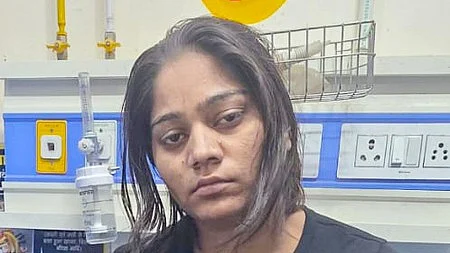


The Supreme Court is poised to confront a significant procedural conundrum: can a mere typographical error in an arrest memo invalidate an arrest and justify bail in a serious murder case? The answer holds implications for criminal jurisprudence, procedural discipline, and the balance between form and substance in justice delivery.
On Thursday, 9 July, the apex court said it might refer to a larger bench the legal question whether the mere mention of a wrong statutory section in an arrest memo, specifically a typographical error, was sufficient to invalidate an arrest and grant bail to Sonam Raghuvanshi in the Raja Raghuvanshi murder case.
It also asked the Meghalaya government to place on record the arrest memo and other documents supplied to Sonam Raghuvanshi at the time of her arrest, while deferring hearing on the state’s challenge to her bail till 14 July .
A Bench of justices Manoj Misra and Shree Chandrashekhar did not pass any interim order staying the bail granted to Sonam, the prime accused in the case, meaning she will continue to remain on bail for now.
On 3 July another apex court bench of Justices M.M. Sundresh and Sheel Nagu had refused to stay the high court order granting bail to Raghuvanshi.
The case relates to the murder of Indore businessman Raja Raghuvanshi, who had travelled to Meghalaya with his wife Sonam for their honeymoon in May 2025. According to the prosecution, Sonam conspired with her alleged lover and hired assailants to kill Raja during the trip. Police have since filed a chargesheet and the trial is underway.
The Meghalaya high court had granted bail on the ground that her arrest memo cited a non-existent Section 403 instead of the applicable Section 103(1) of the Bharatiya Nyaya Sanhita (BNS). The high court had criticised the police for “total non-application of judicious mind,” emphasising the procedural lapse as fatal.
Appearing for the Meghalaya government, solicitor general Tushar Mehta on Thursday called it a “very serious case” and added that written grounds of arrest had been supplied to the accused. The only discrepancy was the mention of Section 403(1) instead of Section 103(1). There had never been any dispute over whether the grounds of arrest were furnished to Sonam.
The error, he argued, was purely clerical and “should not outweigh the serious nature of the crime,” which allegedly involved conspiracy and financial motives.
The SC bench signalled the need to resolve this tension by potentially referring the matter to a larger bench. This recognition is critical as existing Supreme Court precedents on the necessity and timing of furnishing written grounds of arrest are inconsistent, leading to legal uncertainty. Some judgments have underscored the mandatory provision of detailed grounds to uphold the legality of arrests, while others have cautioned against elevating mere procedural lapses to grounds for bail or annulment.
By entertaining a larger bench, the Supreme Court aims to rigorously examine whether a technical clerical error in an arrest memo—without any evidence of mala fide intention or prejudice against the accused—should nullify the arrest. This issue is far from academic. If minor errors become automatic grounds for bail, it could dilute the deterrence effect of criminal law enforcement, especially in heinous crimes. Conversely, ignoring procedural safeguards might endanger fundamental rights.
No direct precedent squarely settles this debate; past rulings have varied based on context, severity, and nature of errors. This ambiguity underscores the urgency of a definitive ruling that balances procedural exactitude with substantive justice.
The Supreme Court’s insistence on scrutinising the original arrest-related documents before deciding signals a cautious approach, ensuring no miscarriage of justice from either procedural laxity or technical hyper-formalism.
In a counter-affidavit filed before the apex court, Sonam claimed she had been falsely implicated and said the prosecution case rested entirely on circumstantial evidence. She argued that she could not be presumed guilty solely on the basis of allegations.
She further said no recovery remained to be made from her, the chargesheet had already been filed, and she had been complying with the bail condition requiring her to stay in Shillong. She also maintained that there was no possibility of her tampering with evidence.
The Meghalaya government has challenged a 29 June judgment of the Meghalaya High Court, which upheld a Shillong trial court’s order granting Sonam bail.
With agency inputs
Join our official telegram channel (@nationalherald) and stay updated with the latest headlines