


Supreme Court to examine plea against Sonam Wangchuk’s detention
Bench seeks original recordings of activist’s speeches amid concerns over discrepancies in translated transcripts
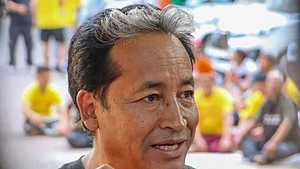


The Supreme Court is set to hear a petition on Thursday challenging the detention of Ladakhi climate activist Sonam Wangchuk, with the bench directing that the original recordings of his speeches be produced for scrutiny.
The plea has been filed by Geetanjali Angmo, Wangchuk’s wife, who has questioned the legality of his detention and sought his immediate release. She has argued that procedural safeguards were not followed and that her husband was not adequately informed of the grounds for his arrest.
Earlier this week, the apex court raised concerns over discrepancies between the original speeches delivered in Ladakhi and their English translations placed on record by the authorities. The court observed that while differing interpretations might be expected, the text itself should not vary.
A bench comprising justices Aravind Kumar and P.B. Varale noted what it described as a “variance” between the original material and the translated transcripts. The judges pointed out that one translation extended to seven or eight minutes, whereas the corresponding speech in Ladakhi appeared to last only about three minutes and included an appeal to halt violence.
Referring to the reliability of translations, the bench remarked that even in the age of artificial intelligence, precision may not be absolute. It stressed the need for an accurate and agreed transcript before proceeding further.
The court directed that the original pen drive provided to Wangchuk at the time of his arrest in September 2025 be produced before it by Thursday. The matter has been listed for further hearing to allow senior advocate Kapil Sibal, representing Wangchuk, to complete his submissions.
Sibal contended that certain statements attributed to the activist do not feature in the comparative chart submitted by the detaining authority. He described the detention order as unusual, arguing that it relied on material that did not exist in the form presented to the court.
The bench responded that it required an authentic transcript of the speeches, observing that there appeared to be inconsistencies between the text relied upon by the petitioner and that cited by the authorities.
During the hearing, the court also sought clarification on whether four video clips containing the allegedly objectionable speeches had been shared with Wangchuk at the time of his arrest. The issue gained prominence after Additional Solicitor General K.M. Nataraj, appearing for the Centre, informed the bench that the videos had been shown to the activist before he was taken into custody.
Wangchuk’s wife has further argued that his speeches over recent years have been mischaracterised to suggest that he incited violence in September last year, incidents that resulted in four deaths and injuries to hundreds.
The Supreme Court will resume hearing the matter on Thursday.
With IANS input
Join our official telegram channel (@nationalherald) and stay updated with the latest headlines