


Tamil Nadu: Benefit sans entitlement
While CM Vijay Joseph's new gold ring scheme is welcome, one needs to be clear that 'a gift is not a right' and the welfare schem spells patriarchy
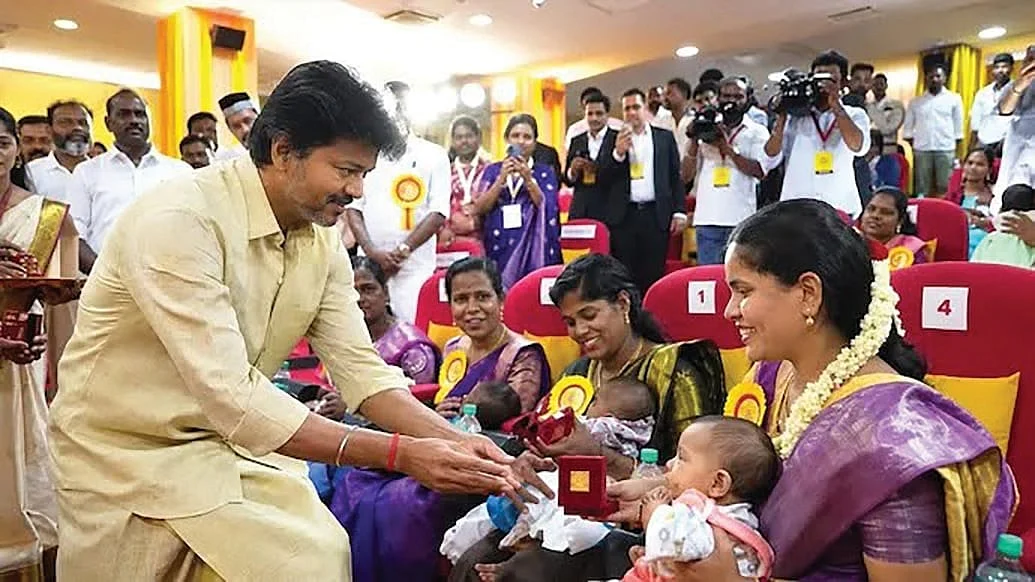


Tamil Nadu Chief Minister C. Joseph Vijay’s decision to play thaimaman (maternal uncle) to the state’s newborns just ahead of assembly bypolls is not exactly the warm and fuzzy welfare gesture his government has advertised it to be.
The Thaimaman Thanga Mothiram scheme, launched in Madurai on 28 September, provides a 1 gm, 22 carat gold ring to babies born on or after 22 June 2026 in state government hospitals or health centres.
The scheme was a pre-election promise of Vijay’s TVK (Tamilaga Vettri Kazhagam) party, but the rollout happened just days ahead of the 6 October bypolls to the Madurantakam and Dharapuram constituencies, inviting sharp reactions from the opposition DMK.
Since the gold ring scheme had been formally approved, budgeted for and gazetted by the cabinet on 23 June, it had the benefit of being treated legally as an ongoing, pre-approved policy rather than a pre-election inducement.
DMK MP Kanimozhi Karunanidhi has argued that women should be encouraged to be economically independent rather than count on ceremonial gifts from male relatives. “You have equal rights in property, education and income. Earn and stand tall,” she said, invoking the Dravidian movement’s emphasis on women’s self-reliance. In Tamil Nadu, that argument has many votaries. Critics are asking: should women’s welfare be framed as a gift from a benevolent male figure rather than as a right?
Kanimozhi has also questioned the Vijay government’s priorities, expressing concerns about committing public money to the gold ring scheme instead of shoring up availability of essential medicines and doctors in public hospitals.
*
The government order of 23 June allocated Rs 755.83 crore a year for the scheme for an estimated 4.42 lakh newborn beneficiaries. The rings are made of 22 carat gold and carry unique serial numbers.
Eligibility is linked to delivery in government health institutions, registration under the Pregnancy and Infant Cohort Monitoring and Evaluation (PICME) system and possession of a Reproductive and Child Health (RCH) identification number, alongside applicable residence requirements.
The financial commitment has prompted questions about competing priorities. Kanimozhi’s criticism centres on the need to strengthen public healthcare, while party colleague and Lok Sabha member Thamizachi Thangapandian (तमिलाची थंगपांडियन) draws attention to shortages in several government hospitals of life-saving medicines to treat respiratory distress in premature babies.
C. Lakshmanan, former faculty at the Madras Institute of Development Studies (MIDS), says “the challenge is to ensure that a new initiative complements the essential services on which vulnerable families depend rather than overshadowing those services.”
The thaimaman occupies a special place in Tamil kinship traditions. The mother’s brother often maintains a close relationship with his sister and her children after marriage, presenting gifts during childbirth and other family ceremonies.
Gold, clothes and money can express affection, reinforce ties with the maternal family and provide material support. For poor households, such gifts can have practical value. Gold may be retained as an asset or pledged during a financial emergency. A ring provided by the state can also relieve a family of the pressure to meet customary expectations.
At the launch in Madurai, beneficiary Mariselvi said she was not on speaking terms with her brother and saw Vijay as one. Despite the progressives’ lament, many poor people will appreciate the material assistance as well as the scheme’s emotional packaging.
Writing in The News Minute, development economist Dipa Sinha argues that maternity support should recognise women’s reproductive labour and economic vulnerability rather than present the government as a benevolent male relative.
Pregnancy, childbirth and breastfeeding involve physical labour, health risks and lost income. Women employed in informal work are mostly denied paid maternity leave and financial protection during this period. A gold ring may be welcome, but it does not compensate a woman for lost wages or guarantee adequate nutrition, postnatal care and childcare. She argues for stronger maternity entitlements linked to women’s economic circumstances and greater recognition of unpaid care work.
The distinction is important: a gift is not a legal entitlement. While a gift may receive gratitude, a legal right strengthens accountability. This does not mean the ring has no value or that families who welcome it are mistaken. It means that the material benefit and the social message conveyed by the scheme must be assessed separately.