


The extortion rackets of cow vigilantes
Anti-lynching laws that omit the word ‘lynching’ spell impunity for vigilante groups, writes Rashme Sehgal
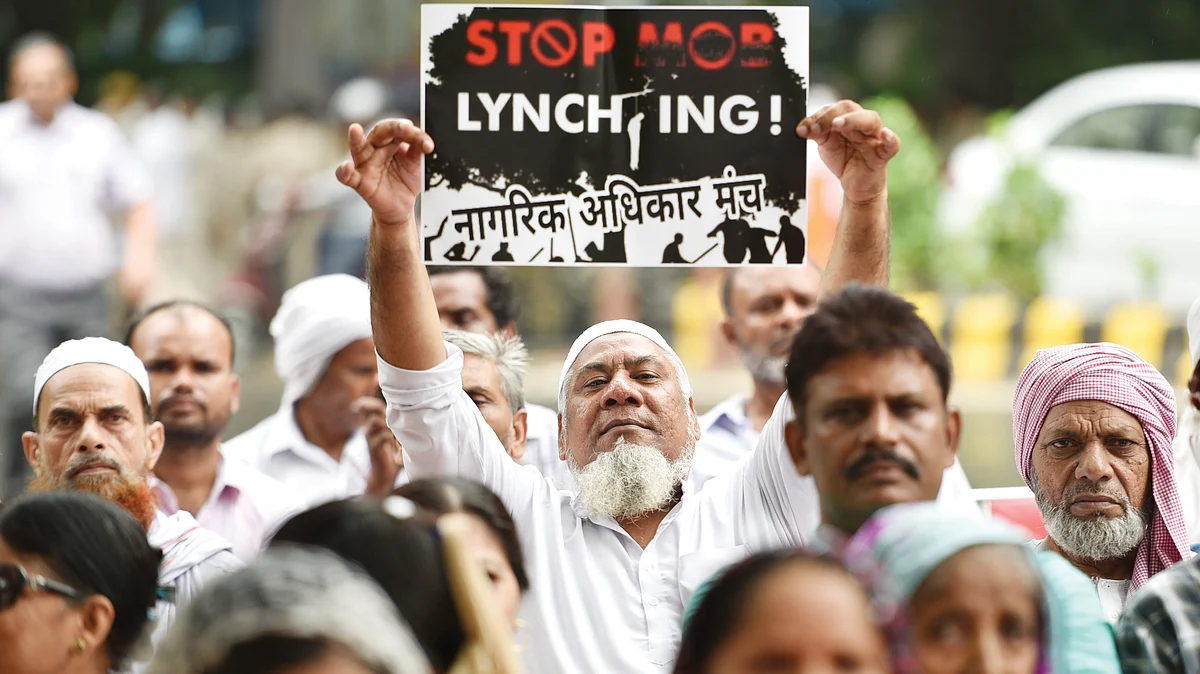


Over the last decade, India has witnessed a disturbing rise in incidents where Hindu vigilante groups use extortion, blackmail and even murder to settle scores with Muslims. The so-called gau rakshaks (self-styled protectors of cows) menace Muslims, especially in the Hindi heartland, and do so secure in the knowledge that the state administration and the police will wink at their vigilantism.
In early 2024, Monu Bishnoi, Moradabad district president of the Bajrang Dal, along with associates Raman and Rajiv Chaudhury, made one Shahabuddin dress in a burqa in order to implicate one Mullah Mohammad against whom Bishnoi harboured a personal grudge.
Shahabuddin later told the police that he had been paid Rs 30,000 to steal and slaughter a cow in order to frame Mullah Mohammad. A photo of Mohammad had been deliberately placed in a wallet at the scene of the crime. An investigation led by Moradabad senior superintendent of police Hemraj Meena resulted in the arrest of Bishnoi, his associates and Shahabuddin.
The latter confessed that the group had been involved in orchestrating multiple cow slaughter incidents between 16 and 28 January within the Chhajlet police station area. All four were charged with criminal conspiracy (120B) and under sections of the Cow Slaughter Act. All four were released on bail within a few weeks.
This case is significant because it highlights how cow vigilantism has become an excuse for extortion and blackmail, with the police as mute spectators in most cases.
On 8 April 2023, Bajrang Dal and Hindu Mahasabha activists led by Jitendra Kushwaha filed a police complaint in Agra against Mohammed Rizwan and his three sons. The accusation (false) was that they had slaughtered a cow.
Here too, the reason was personal — local Hindu leader Sanjay Jat held a grievance against Rizwan. On the eve of Ram Navami, demonstrations were held across the city to whip up communal tensions. Police investigations revealed that Rizwan and his sons were nowhere near the scene of the crime committed by Kushwaha’s followers. All the accused are out on bail.
Suraj Patel, a local Bajrang Dal leader had an axe to grind with the station house officer (SHO) of Kemri thana in Rampur. On 10 January, he entered the police station and dared the cops to arrest him — which of course they did not. Apparently, this was not the first time he had vented thus.
Although the new anti-lynching provisions under the Bharatiya Nyaya Sanhita came into effect in July 2024, the omission of the word ‘lynching’ enables the police to register such cases under general murder charges instead.
The new law has been used only once — when 19-year-old Aryan Mishra was shot dead by cow vigilantes on 23 August 2024 in Faridabad. They had mistaken him for a cattle smuggler. The police were forced to use the anti-lynching law only because of pressure from the national media who were following the case carefully.
Accurate figures on convictions of Bajrang Dal activists are not maintained by central agencies like the National Crime Records Bureau (NCRB), which does not track ‘lynching’ as a separate offence. Short jail sentences invariably result in early release.
The 2018 Ramgarh lynching case in Jharkhand stands out because it resulted in the first-ever conviction for cow-related lynching in India. Eleven Bajrang Dal activists and a local BJP leader were sentenced to life imprisonment for the hanging of Mazlum Ansari and twelve-year-old Imteyaz Khan. The mob responsible for the attack included Bajrang Dal activists and a local BJP leader.
In most cases, however, even when the evidence is unequivocal, Hindutva activists get away without so much as a reprimand. Consider the killing of Shahedeen Qureshi, a 37-year-old cart puller from Moradabad, who was lynched on 30 December 2024 by a Bajrang Dal mob led by Rakesh Saksena over allegations of cow slaughter.
The attackers filmed and uploaded a video of their assault. As they hurled abuses and beat Qureshi with sticks, a voice can be heard saying, “Arré, mar gaya (oops, he died).” According to Shahedeen’s brother Guddu, every part of his body had been broken — wrists, fingers, ribs, skull, nothing was left intact.
But such is the clout of the Bajrang Dal that, immediately after the murder, the cops arrested Adnan, a 25-year-old from Moradabad. He was accused of murdering Shahedeen for allegedly having an affair with his wife. Adnan’s family however maintain that the cops concocted this story to avoid registering the case as a mob lynching.
When lynchings occur, the State often responds not by filing FIRs against the perpetrators, but by registering cases against the victims, primarily under Gauraksha Adhiniyam, or cattle protection laws.
A brutal incident occurred in Mhasane, Maharashtra on 20 October 2024, when a group of cow vigilantes apprehended two Muslim cattle traders. The traders were stripped, brutally beaten and publicly humiliated before being handed over to the police. Their vehicle was vandalised, and the 52 cattle they were transporting were seized and sent to a local gaushala.
Most cow vigilante groups are known to operate as extortion rackets. Those who refuse to pay up are killed, often in the most gruesome manner. One such victim was Mohammed Bhura Habibullah, a 32-year-old meat trader from Mirzapur, Ahmedabad. The cow vigilantes demanded Rs 25,000, which he refused to pay.
Five days later, on 21 April 2025, his charred body was discovered inside his burnt vehicle. The Gandhinagar police filed a report of rash driving and over-speeding, but the post-mortem report revealed abrasions across his body and an ante-mortem skull fracture.
Few crimes can match the horror inflicted on SHO Subodh Kumar Singh of Bulandshahr, who was killed by cow vigilantes on 3 December 2018. His son Shrey Singh returned to Bulandshahr a few weeks later to collect his father’s belongings.
In an exclusive interview with this journalist, Shrey said, “A 400-strong mob had gathered near the chowki, armed with axes, knives and stones. My father sustained 25 wounds from stone-pelting. He had a sharp knife wound on his back and an axe wound on his right hand. His right thumb had been cut off, which meant he could not use his revolver in self-defence.”
It is obvious that these groups are neither short of funds nor are they deterred by the threat of jail. When Yogesh Raj and his accomplices — the principal accused in the killing of Subodh Kumar Singh — were released on bail in September 2019, they were welcomed with garlands and taken on a triumphal procession. Yogesh Raj has since gone on to contest and win a local municipal election, and is now preparing to carve out a political career for himself.
As a senior BJP politician pointed out on condition of anonymity, “The VHP (Bajrang Dal’s parent organisation) is cash-rich and funds these vigilante groups with alacrity. They are provided with phones, cars and money. They are also promised police protection and patronage and are seen as non-state actors of the government, used to keep the communal agenda on the boil.”
As one successful Lucknow lawyer who handles cow vigilante cases pro bono has publicly boasted, he is being amply rewarded for all the services he has rendered to these vigilante groups. He has been empanelled to become a high court judge and is expecting the announcement to be made very soon. Other lawyers have been promised similar rewards.
If this trend continues unchecked, it will not only deepen the communal divide, but completely undermine the rule of law across the country.
Join our official telegram channel (@nationalherald) and stay updated with the latest headlines