


Thiruparankundram case: Hilltop structure not temple lamp pillar, state tells Madras HC
Challenges single-judge order on Karthigai deepam, amid allegations of political mobilisation
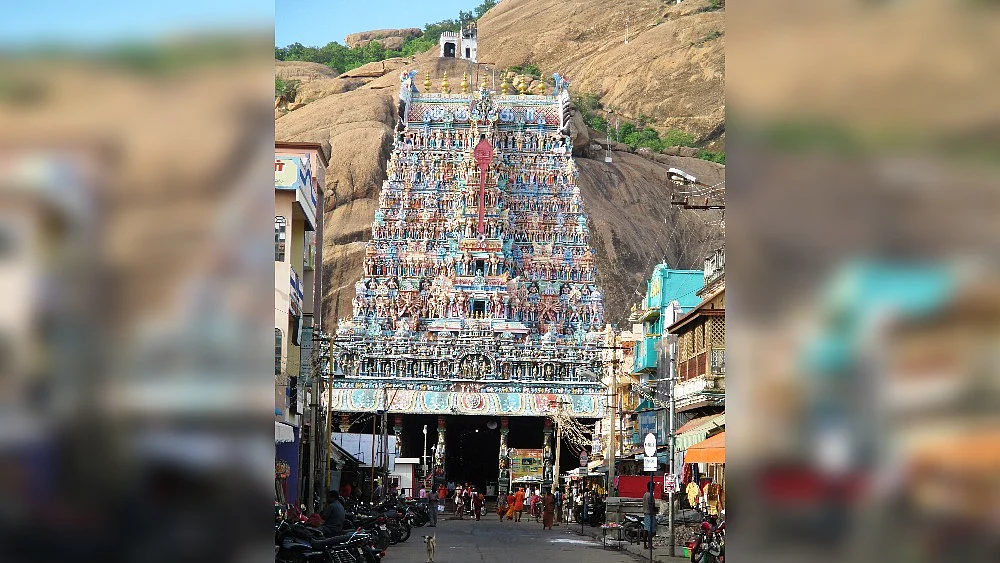


The Tamil Nadu Hindu Religious and Charitable Endowments (HR & CE) department on Monday told the Madras High Court that the stone pillar known as deepathoon atop the Thiruparankundram hill, near a dargah, was not a temple lamp pillar and could instead be a Jain structure, directly contradicting a recent single-judge order that permitted the lighting of the Karthigai deepam lamp at the site.
Appearing before a division bench of Justices G. Jayachandran and K.K. Ramakrishnan in Madurai, the department submitted that there was historical and archaeological evidence to show that the structure was a samana deepathoon, not a temple deepa sthambam traditionally used for Karthigai deepam.
The Bench was hearing a batch of appeals filed by the state authorities and temple administration against the 1 December order of Justice G.R. Swaminathan, which had allowed the lamp to be lit on 3 December at the disputed pillar.
Representing the Arulmighu Subramaniya Swamy Temple, Thiruparankundram, counsel argued that the authentic deepathoon associated with the temple was located near the Uchchipillaiyar temple and not at the hilltop structure adjacent to the dargah.
To support this claim, the HR & CE department placed before the court a 1920 book by scholar Bose, documenting the traditional location of the Karthigai deepam, as well as a 1981 publication of the Tamil Nadu Archaeology Department, carrying a foreword by noted historian R. Nagaswamy.
Senior counsel N. Jyothi told the court that religious practices and temple administration were governed by clearly prescribed procedures under HR & CE rules and could not be altered through individual petitions. Senior advocate T. Mohan, appearing for the dargah, cautioned that if individual devotees were allowed to impose their own interpretations of ritual practice, “there would be no end to it”.
Senior counsel S. Sridhar submitted that for over a century, Karthigai deepam had been lit only at the Uchchipillaiyar temple and that the petitioner was attempting to disturb a long-settled custom that did not constitute an enforceable individual right.
Also Read: The hill that never needed walls
Shared sacred hill, sudden legal flashpoint
The dispute relates to Thiruparankundram hill in Madurai district, a site of long-standing religious plurality that houses the Subramaniya Swamy temple, the Sikandar Badusha Auliya dargah, and remnants associated with Jain traditions. For decades, the hill functioned as a shared sacred space, with different communities practising their faith without formal contest over ritual boundaries.
The current controversy was triggered when a petition filed by a Hindu right-wing activist sought permission to light Karthigai deepam on the hilltop pillar near the dargah, claiming it to be a temple deepathoon.
Justice G.R. Swaminathan’s 1 December order allowing the request — following a site visit — marked a departure from long-established practice and immediately drew objections from the Tamil Nadu government, which cited law-and-order and communal harmony concerns and declined to implement the order. The lamp was eventually lit at the traditional Uchchipillaiyar location under heavy security.
Allegations of manufactured controversy
Civil-society groups, historians and political parties have since alleged that the dispute was deliberately amplified by right-wing organisations seeking to transform a historically shared religious site into a polarising issue.
According to this view, claims over the deepathoon’s ritual status and demands for legal recognition emerged not from local custom but through organised mobilisation, social media campaigns and political framing aimed at communal consolidation.
These allegations have been reinforced by the absence of historical evidence linking the hilltop pillar near the dargah to Karthigai deepam rituals, and by archaeological submissions now placed before the high court suggesting a Jain provenance.
Political fallout and impeachment move
The controversy has also spilled into the political domain. Opposition MPs have submitted a notice seeking the impeachment of Justice Swaminathan, arguing that his order had the potential to disturb communal harmony and raised concerns about judicial propriety in sensitive religious matters. Left parties and secular organisations have echoed these concerns, warning against the judiciary being drawn into politically charged disputes over shared religious spaces.
As the division bench continues to hear the appeals, the case now stands at a complex intersection of history, religious custom, communal coexistence, political mobilisation and constitutional accountability.
With PTI inputs
Join our official telegram channel (@nationalherald) and stay updated with the latest headlines