


The hill that never needed walls
How a shared ritual landscape in Madurai is being turned into a political and communal flashpoint
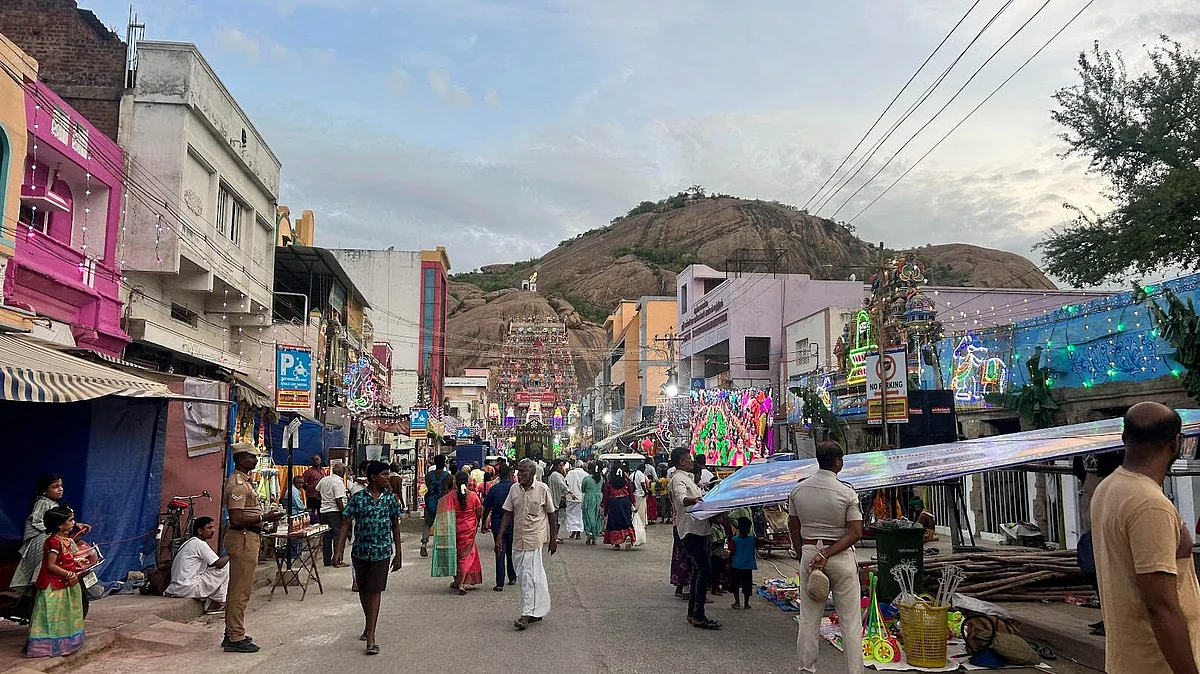


Thiruparankundram rises just 9 km from the centre of Madurai, close enough to city noise yet holding its own stillness. At sunrise, it appears as a long body of dark granite, a hill worn by countless monsoons. Temple towers in cream and red cling to its lower slopes. Higher up, green flags flutter at the Sikandar Badusha dargah.
Between rock surfaces lie thorn trees, narrow footpaths, patches of wild grass, and unreachable ledges where Jain carving marks remain preserved by neglect rather than protection.
For those who grew up here, this hill has always been a single shape. Something larger than stone holds the temple, the dargah, and the old inscriptions together. It is not geography. It is memory. All layers coexist without a division line.
The first thing one notices at the base is the Subramaniya Swamy temple. It occupies a cave-like opening in the rock. Inside, the air is thick with centuries of camphor and sandalwood smoke. Murugan devotees from across Tamil Nadu speak quietly as they climb the steps, their feet remembering where to turn, where to bow. Madurai children still call it the first of Murugan’s six sacred abodes. Priests say the hill itself is the deity.
Far above, on the north-facing shoulder, is the dargah of Sikandar Shah, also remembered as Sikandar Badusha. He was the last ruler of the 14th-century Madurai sultanate, which was destroyed in battle by the armies of Kumara Kampana of Vijayanagara.
His followers brought his body to the hill. They buried him where the breeze was strongest. A tomb became a shrine. Today, people call him a saint. They climb to tie threads for protection, whisper prayers for healing, and serve cooked food to strangers.
Deep in crevices away from stone stairways are traces of another presence. Jain rock beds cut into the hill mark ancient places of retreat. Tamil Brahmi inscriptions record the names of monks and patrons in letters older than the combined temple and tomb names. Local historians say these signs date back to the second century before the Common Era, when Jain ascetics used this hill as a refuge for meditation.
That mix of Jain, Murugan, and Sufi legacies never confused anyone here. The hill held layers without tension. Faith was not a competition. It was a neighbourhood.
In foothill lanes, when people speak of memory, they do not begin with grand declarations. They begin with smell and sound. They speak of the sandal paste applied with the fingertips before a festival march. They mention drums that sound like a heartbeat coming from parais and thappus in Mariamman season.
They remember jasmine vendors arriving before sunrise. They remember children carrying candle tins up the slope to light near stone markers. They remember rice cooked for Muharram nights and shared with families who had just finished worship at the temple.
A retired farmer named P.K. Karuppu told National Herald that, in his youth, rituals did not speak of religion. They spoke of time. When the Tamil calendar turned a page, they prepared what needed to be prepared. Steps had to be cleaned. Lamps needed oil. Flowers needed stringing. Water needed to be carried. Officers or committees did not assign these activities. They were inherited arrangements that passed through generations.
Ritual work here once formed a grassroots order. One caste prepared drums. One cleaned steps. Another kept oil lamps burning on festival nights. Another organised animal sacrifices and cooked meat dishes for a dargah celebration. Another distributed leftover food to houses of all castes. Nobody thought to ask whether crossing a threshold carrying meat from a dargah into a Hindu house would offend someone. It did not. It was routine.
Murugan worship on this hill carries the memory of Sangam poems. Murugan is the god of hills, bees, hunters, clay pots, and wind over ridges. Tamil literature teacher M. Rajagopalan, who lives on the slope, says Murugan belongs to Tamil memory before Sanskrit priests codified rituals. He explains that in the Sangam imagination, Murugan did not demand a uniform ritual. He accepted offerings from all hands. Attempts today to define a single correct form of ritual feel, to him, like attempts to remake Murugan.
Sikandar Shah’s presence adds another texture. For centuries, during the Santhanakoodu festival in Rajab, families cooked biryani in large pots and carried it up the hill to feed all who came. It was an act of gratitude and generosity. Local jamaat member A. Abutahir describes how people waited near the dargah with plates and cups, eating meat and rice without thinking about divisions.
Asked how biryani became controversial, he shook his head and looked away for a moment. He said they cooked only during festival days and never thought food could cause disputes. His eyes suggested fatigue more than anger.
The Jain presence, sometimes ignored in public debate, holds the oldest layer of memory. Small carvings of Tirthankaras remain hidden between rocks near the western edge. Tamil Brahmi letters, shaped with chisels two thousand years ago, remain untouched. The silence of that era lingers.
These relics show that a hill can hold faith without walls. They show that history does not choose one religion over another. It remembers everything at once. That idea of remembrance is what people fear is being lost now. The hill never needed walls. Now, political groups want to draw them.
Last year, Thiruparankundram saw its first visible rupture when animal sacrifice during a dargah celebration became a public issue. For decades, animal sacrifice was treated as a ritual act rather than a political symbol. The problem began in December and continued until February. It was not raised by long-time residents but by political organisers from outside who arrived with cameras and social media volunteers. That moment marked the first deliberate attempt to reinterpret the hill through religious hostility.
Henry Thiphane, a Madurai-based human rights activist, told National Herald that last year saw the introduction of a language that did not belong in the hills. According to him, this was not about devotion or dispute. It was about the agenda. He said the Sangh Parivar was attempting to implant communal framing into a landscape known for coexistence.
BJP’s then Tamil Nadu state president K. Annamalai came to Thiruparankundram last year, raising the issue of animal sacrifice as part of a larger cultural battle. His speeches acquired headlines. His supporters circulated recorded messages calling the hill “a site of religious insult”.
Activist S. Dileepan said Annamalai also attempted to drag an MP from Ramanathapuram belonging to the Indian Union Muslim League into a dispute in which the MP had no involvement. Dileepan believes this was an attempt to force a communal angle and turn a ritual issue into a community conflict.
Local families watched unfamiliar men declare what rituals were acceptable. They heard neighbours labelled outsiders in their own lanes. They saw festival food like biryani become a boundary line rather than a sign of sharing. That tension eased after February. Daily life returned to the hill. Jasmine vendors resumed their morning routines. Temple drums regained rhythm. Biryani simmered again in dargah courtyards.
But it did not last. The present controversy began last week, when the Madurai bench of the Madras High Court ordered that the Karthigai Deepam lamp be lit at a different stone pillar. For generations, local people lit the lamp at a location chosen by memory, not by decree. That location was not written on any map. It was passed along by repetition. A single judge changed that, correcting an earlier division bench order that had protected inherited practice.
The petitioner was a Hindu Munnani activist, aligned with Sangh Parivar groups that have been attempting to gain a foothold in southern Tamil Nadu. For them, Thiruparankundram is strategic. It is a Dravidian landscape known for coexistence. To turn such places into flashpoints is to demonstrate that conflict can be introduced even where memory resists it.
The DMK government has approached the Supreme Court to challenge the order. Officials say they want the court to understand that ritual placement in Thiruparankundram is a matter of lived tradition rather than legal coordinates. One officer told National Herald that the inherited custom must remain undisturbed until the Supreme Court decides otherwise. He said moving a lamp without understanding history is like changing part of a song without listening to the whole composition.
Meanwhile, tension has returned to foothill shops. Police checkpoints have appeared near stairways. Patrols walk through lanes where children once played without noticing uniforms. Audio messages circulate on phones telling people which side to support. Fear is being spoken where familiarity once ruled.
Local activists see a pattern. S. Vanchinathan of the Madurai Social Harmony Group says the Sangh Parivar wants to infuse communal poison into the southern Dravidian land because Tamil society has long resisted polarisation. In his words, there is no natural communal divide here, so outsiders must manufacture one. He believes the hill is being used as a testing ground for provocations that can later be extended to other regions.
Conversations around Thiruparankundram now carry words that did not belong here until recently: purity, defilement, ownership, dominance. Temple rituals are being described as property rights. Dargah food is being framed as a threat. People are being asked to choose sides.
Yet, daily life does not surrender so easily. Children still run up the slope with coins in hand. Families still prepare sweet rice for temple offerings. A Muslim woman still carries steel bowls of cooked food wrapped in cloth for festival nights. Barbers still wash their hands before offering neem leaves. The hill still holds Jain inscriptions that do not speak of conflict. The same wind blows across the temple tower and the dargah dome.
The questions that matter now are simple. Why is this a flashpoint now? Who benefits from introducing division onto a hill famous for shared rituals? What happens when courts decide where the light should fall rather than the families who have done it for decades?
Thiruparankundram has become a field on which Sangh strategy and Dravidian memory meet head-on. The strategy is to identify shared spaces, project them as threatened, and claim victory through polarisation. The memory is of coexistence, of ritual work done without argument, of living secularism not taught in textbooks but passed through daily routine.
Local voices repeat the same thing in different words. Could you let it remain as it was? Let the hill be itself. Let people climb, cook, light, and pray as they always did. Let the court recognise memory. Let politics stay away from ritual.
Because the hill remembers what people forget. It remembers Jain meditations before temples were built. It remembers Sufi prayers before microphones arrived. It remembers Murugan worship before slogans tried to define it. It remembers families cooking meat to share without being told to explain their choice. It remembers the steps cleaned at dawn. It remembers lamps lit at dusk. It remembers unity without speeches.
The real custodians of Thiruparankundram are not petitioners, judges, or political organisers. They are the ones who wake each morning and look up at the rock and know exactly what they must carry today. They carry memory in their hands. The hill is still watching.
Join our official telegram channel (@nationalherald) and stay updated with the latest headlines