


UGC-NET retest: NTA’s ‘fresh’ purge comes with an old number
Over 50 staff ‘removed’ includes 47 sacked after NEET row, while Opposition asks why exam failures keep recurring


The National Testing Agency (NTA) is once again promising a sweeping overhaul after three UGC-NET papers were found riddled with errors. But its latest claim that more than 50 'staff members' have been removed comes with a significant caveat: 47 of those had already been terminated in July amid the NEET-UG paper leak controversy.
The staffing figures add to the ambiguity. In July, the government announced that 47 NTA officials had been terminated following the NEET controversy. Yet data placed before Parliament around the same time showed that the agency had only 39 sanctioned regular posts, alongside 73 contractual and 124 outsourced personnel. The government did not publicly spell out the employment status of the 47 people whose services were terminated.
The latest action, therefore, is not a fresh purge of more than 50 staff, as the initial government communication appeared to suggest. It comes barely weeks after the agency announced sackings, specialist recruitment and other reforms following the NEET controversy — raising questions over how much has actually changed.
The latest crisis follows the UGC-NET examination, conducted between 22 and 30 June across 87 subjects. An NTA-appointed committee examining complaints found anomalies in the English, Commerce and Sociology papers and recommended fresh tests. English and Commerce will be held on 9 September and Sociology on 10 September.
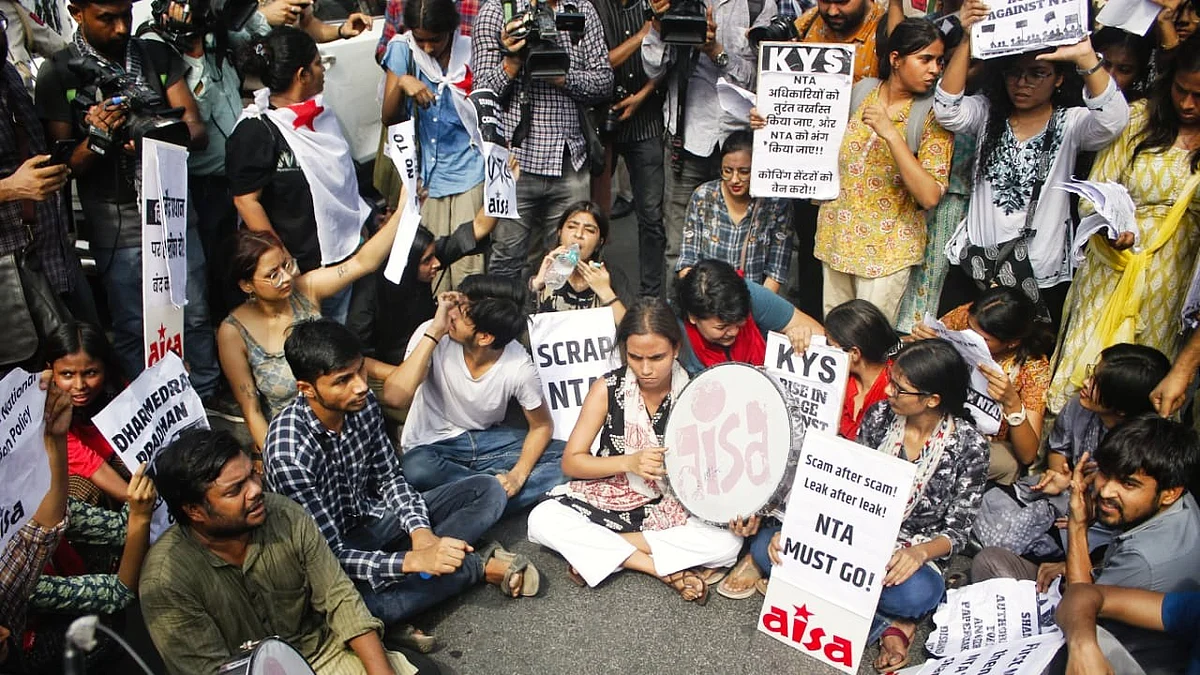
The re-tests have triggered protests by student organisations and renewed Opposition demands that the NTA be scrapped.
New Union education minister Pralhad Joshi has ordered a comprehensive audit of the NTA's examination processes and a review of its confidential operations. The agency is also filling 10 professional leadership positions, including chief technology officer, chief information security officer, general manager for test security, and general manager for research and development and psychometrics.
The government plans to bring in specialists in cybersecurity, psychometrics and question-paper design, while the NTA has been asked to strengthen safeguards around question papers, electronic devices and examination centres.
But several of these measures closely echo the response to the NEET-UG controversy, when the agency also announced specialist recruitment and an overhaul of its examination systems.
That has given fresh force to the question of whether the NTA's problem is simply individual lapses — or whether repeated crises point to deeper weaknesses in the way it conducts examinations.
The Opposition has used the latest controversy to renew its attack on the NTA and the government's handling of competitive examinations.
Lok Sabha Leader of Opposition Rahul Gandhi said the resignation of previous education minister Dharmendra Pradhan would be only the beginning and demanded accountability from the NTA leadership. In a post on X, he described the system as having become an 'extraction machine' rather than an education system.
Other Congress leaders accused the government of making students bear the cost of institutional failures and said they would continue raising the issue until Prime Minister Narendra Modi responded.
The Aam Aadmi Party similarly argued that examination failures were not minor administrative errors, given the time, money and opportunities students lose when tests are cancelled or repeated.
The criticism has also extended beyond Opposition parties. The RSS-affiliated Akhil Bharatiya Vidyarthi Parishad expressed concern over the re-tests, with its national general-secretary Virendra Singh Solanki saying students' futures could not be compromised and demanding accountability from the NTA.
Student groups including the NSUI, SFI, AISA and Krantikari Yuva Sangathan have held demonstrations in Delhi and announced further protests.
For students, another examination is not simply an administrative inconvenience. It means months of preparation have to be repeated, with additional financial and emotional costs and further uncertainty over admissions, fellowships and academic careers.
The NTA says its decision to identify the errors and order re-tests demonstrates that it is willing to acknowledge and correct mistakes. But that argument is increasingly being tested by the frequency with which the agency has had to make similar promises.
The NEET-UG controversy brought nationwide protests, a political storm and the removal of 47 personnel. It was followed by promises of stronger examination security and structural reforms. Now, barely weeks later, another examination controversy has produced another overhaul.
The question facing the NTA is therefore no longer just whether it can fix three flawed papers. It is whether repeated sackings, audits, specialist appointments and promised reforms can restore confidence in an examination agency whose credibility has been repeatedly tested.
With PTI inputs
Join our official telegram channel (@nationalherald) and stay updated with the latest headlines