


‘Women are not property, our freedom is not negotiable’: Shabnam Hashmi slams Kerala cleric
Activist condemns Mufti Kanthapuram A.P. Aboobacker Musliyar’s call for women to remain at home, invokes Constitution, Islamic history and Savitribai Phule
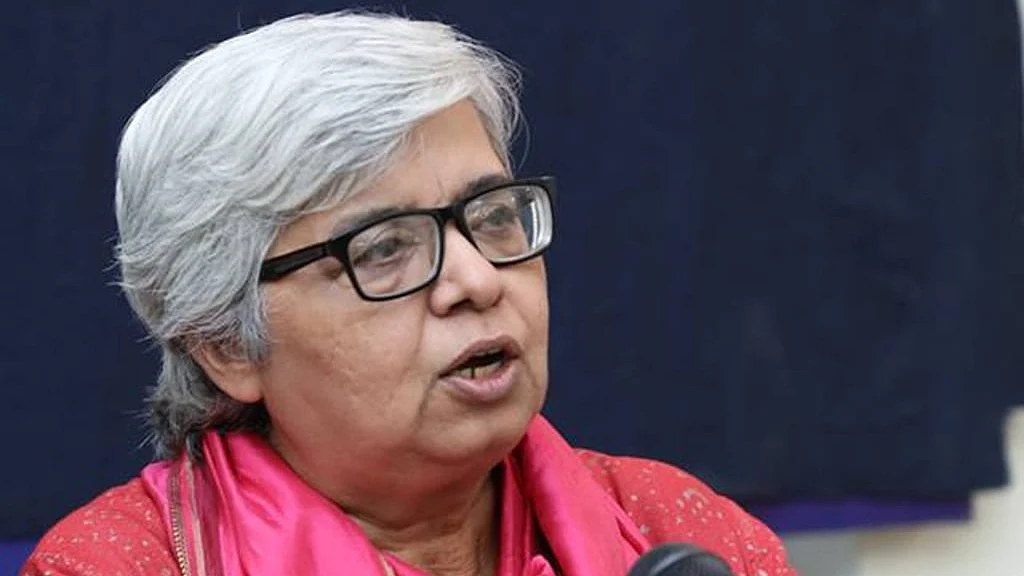


Social activist and human rights campaigner Shabnam Hashmi has condemned remarks by Mufti Kanthapuram A.P. Aboobacker Musliyar, general secretary of the Samastha Kerala Jam’iyyathul Ulama, calling for women to remain confined to their homes and questioning their presence on public platforms.
In a public statement released early on Tuesday, Hashmi described the remarks as “deeply regressive and unacceptable” and said they reflected patriarchal control rather than concern for women’s safety or protection.
“Women are not property. Women are not possessions. Women do not require permission from religious authorities to move freely, study, work, travel, speak, organise or participate in public life,” she said.
Hashmi said the remarks were “not about ‘protection’” but about “patriarchal control, feudal thinking and the attempt to regulate women’s lives by restricting their freedom”.
“When women are spoken of as objects who must not be ‘displayed’ in public, or as people whose presence itself is supposedly dangerous, it is not merely offensive. It is dehumanising,” she said.
The activist also questioned the authority of religious leaders to impose restrictions on women that, she said, run contrary to constitutional guarantees.
“The Indian Constitution guarantees equality, dignity and freedom of movement to every citizen, irrespective of gender, caste or religion. No cleric, religious institution or self-appointed guardian of morality has the authority to place itself above these constitutional guarantees,” Hashmi said.
She also challenged the use of religious interpretation to justify restrictions on women's public participation, arguing that Islamic history itself contains numerous examples of women playing prominent roles in society.
“And if Mufti Kanthapuram wishes to invoke Islam to justify his position, he should revisit Islamic history itself,” she said. “Muslim women have, throughout history, been scholars, educators, traders, writers, political actors, patrons of knowledge and influential participants in public life.”
Hashmi cited the work of Malayalam writer Khadija Mumtaz and Kannada writer, activist and lawyer Banu Mushtaq, whose book Heart Lamp won the International Booker Prize.
“These women have done something far more valuable than claiming authority over women: they have listened to women, written about women’s lives and questioned power,” she said.
“That is the difference between speaking about women and standing with women.”
Hashmi said Kerala’s history of social reform, literacy and women's participation in public life made the remarks particularly troubling.
“Kerala, with its extraordinary history of literacy, social reform and women’s participation in public life, deserves better than a return to feudal notions of female seclusion,” she said.
She referred to Justice Fathima Beevi, the first woman judge of the Supreme Court of India, as an example of the state’s contribution to women's advancement.
The activist also linked the controversy to the legacy of social reformers Jyotirao Phule, Savitribai Phule and Fatima Sheikh. She noted that the three were associated with the opening of one of the first schools for girls in India in Pune in 1848.
“They understood, nearly two centuries ago, that educating girls and taking women out of the confines imposed on them was essential to building a just society,” Hashmi said.
“It is a matter of shame that nearly two centuries later, we are still having to fight against voices telling women that they belong inside their homes.”
Hashmi framed the issue as a choice between competing visions of India.
“We must decide which India we want: the India of Savitribai Phule and Fatima Sheikh, who opened the doors of education to girls, or an India where clerics claim the right to close those doors again,” she said.
“There can be no going backwards.”
‘The politics of distraction’
Hashmi also criticised what she described as the political timing of statements concerning women’s clothing, mobility, morality and religion.
“What is particularly disturbing is the political timing of such statements,” she said, alleging that whenever the BJP comes under pressure, public attention is shifted towards “manufactured battles” over women, religion and tradition.
She argued that provocative statements by religious leaders could be used to deepen communal tensions.
“It is deeply unfortunate when religious leaders play into this politics by making provocative statements that can be weaponised to create another Hindu-Muslim confrontation,” she said.
Hashmi also pointed to the growing political engagement of younger Indians.
Also Read: The patriarchy of spices
“Gen Z and Gen Alpha are raising their voices across the country. Young people are questioning authority, demanding accountability and refusing to accept the politics of fear, control and silence,” she said.
Against that backdrop, she described attempts to restrict women's mobility, education and participation in public life as an assertion of patriarchal authority.
Hashmi further argued that such controversies risk diverting public attention from issues including unemployment, economic insecurity, education, social justice, democratic freedoms and accountability.
“Who benefits when such inflammatory statements dominate public discourse?” she asked.
“When the country should be debating unemployment, economic insecurity, education, social justice, democratic freedoms and the accountability of those in power, we are once again being pushed towards a manufactured argument about whether women should be allowed to appear in public.”
“We should refuse to be distracted,” she said.
‘Women will not be pawns’
Hashmi said women’s freedom should not be used as a bargaining chip by either religious or political forces.
“Muslim women are not pawns. Hindu women are not pawns. No woman is property,” she said.
“We reject both patriarchal control and the cynical politics that weaponises it.”
She also argued that religious authority should not be treated as a justification for denying women equality and autonomy.
“Religious authority is not a licence to violate constitutional morality,” Hashmi said.
Calling for greater space for younger voices, she said it was time for a generation that understood that faith and freedom could coexist and that women were equal citizens.
“It is time for such leaders to make way for a younger generation that understands that faith and freedom need not be enemies; that women are equal citizens; and that dignity and self-determination are not privileges to be granted by men,” she said.
Hashmi ended her statement with a direct rejection of attempts to restrict women’s lives.
“Women will not quietly accept attempts to push us back into the home. We will not take this lying down,” she said.
“Our freedom is not negotiable. Our equality is not negotiable. Our constitutional rights are not negotiable.”
“Women will decide where we go, what we study, how we live and what kind of future we want. No cleric. No politician. No patriarch will decide that for us.”
“There can be no going back.”
Join our official telegram channel (@nationalherald) and stay updated with the latest headlines