


When YouTube teachers did an autopsy of TV ‘news’
Nandlal Sharma reports on the confrontation between a TV anchor and a new class of influential online educators


A video from 2016, when India’s currency was demonetised overnight, is still being shared on social media. In it, a TV anchor claims that the newly issued currency notes contain nanochips that could be tracked by satellite, allowing authorities to detect hidden cash hoards. Similar claims were repeated by other prime-time anchors. The story was false, but it became emblematic of a media culture that spread misinformation instead of speaking truth to power.
Nearly a decade later, during Operation Sindoor in May 2025, mainstream TV channels sank to a new low. Several prominent anchors claimed on air that the Indian Navy had attacked Karachi Port. The fact-checking portal AltNews confirmed this was false, unverified and propagandist, like much of the ‘reporting’ across channels.
These two incidents confirm how television journalism has become a caricature of itself during the Modi era. They help explain why the younger generation are increasingly turning elsewhere for information, commentary, education, even advocacy.
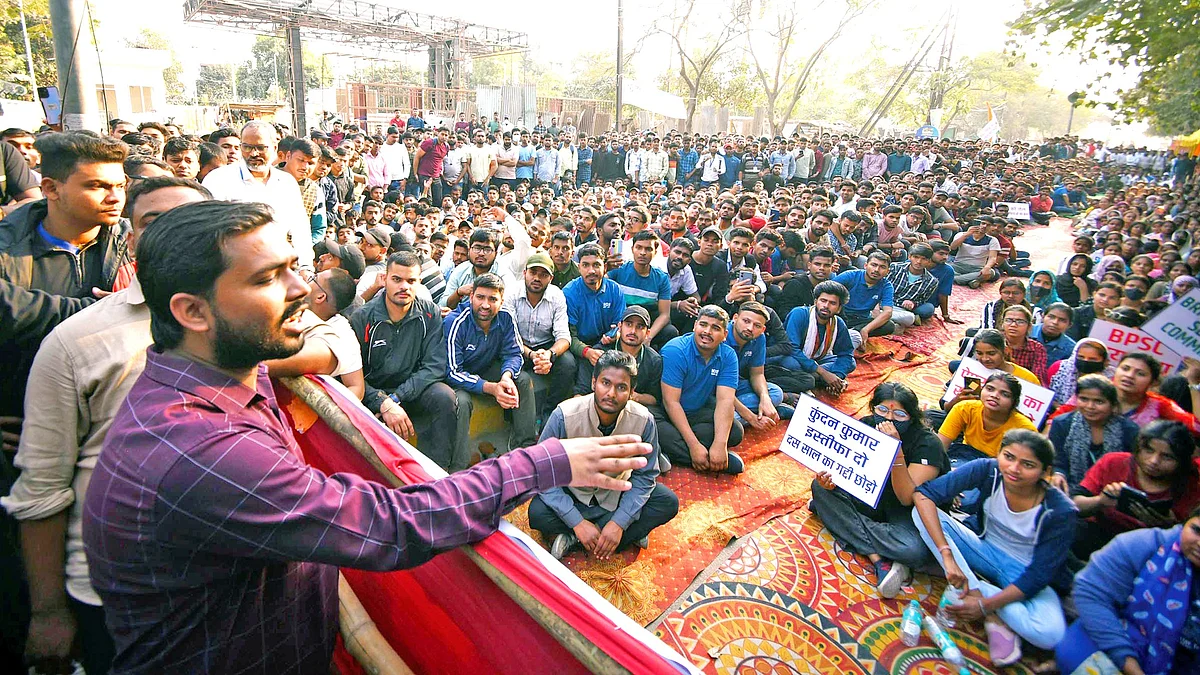
The youth’s distrust of mainstream media was in full public view in May 2026. Anger over the NEET paper leak scandal and the CBSE Class 12 online marking fiasco triggered nationwide outrage. Students demanded accountability from Union education minister Dharmendra Pradhan. While neither the government nor mainstream media adequately addressed their concerns, a social media war broke out between a well-known female anchor from a private television channel and coaching teachers, who she branded ‘worthless nobodies’.
The matter has now reached the Delhi High Court with the TV network and anchor filing a two-crore defamation suit on these ‘tuppeny teachers’ — “do kaudi ke teacher” — including ‘Khan Sir’, Abhinay Sharma, Babita Tyagi and others.
It all began on 31 May. In a post on X, Anjana Om Kashyap accused ‘celebrity teachers’ of being a ‘coaching mafia’ that exploited students and their parents while masquerading as public advocates.
Also Read: Put students ahead of political theatre
The reaction from online educators was immediate. Among the most prominent critics was Abhinay Sharma, a mathematics teacher for SSC aspirants (with 3 million+ YouTube subscribers). In livestreams that collectively attracted millions of views, Sharma called out the ‘godi media’ for shielding those in power instead of demanding answers.
He was joined by Faizal Khan, better known as Khan Sir of Khan Global Studies in Patna (6.1 million+ subscribers), and Sonipat-based Babita Tyagi who helps students prepare for UPSC and other competitive exams at ICS Coaching Centre (3.7+ million YouTube subscribers). In a video posted on 1 June, Tyagi said: “Our prime-time news consists of stories like what kind of oil is used in jhalmuri and how it smells.”
Referring to other reports by the female anchor, Tyagi added: “She once compared a buffalo in Bangladesh to Donald Trump because the buffalo had been named Donald Trump. Someone bought it so it wouldn’t be slaughtered. This is the level of journalism in our country.”
Soon, teachers across India were publicly asking: Why wasn’t the media talking about the NEET paper leak? Why was it not demanding accountability from the Modi government?
Their criticism came at a politically charged moment. Opposition parties led by Rahul Gandhi were demanding the resignation of education minister Dharmendra Pradhan over the NEET controversy. Students were protesting in cities such as Prayagraj over paper leaks and irregularities in recruitment and entrance examinations. Instead of addressing these issues, why were teachers being targeted?
Why, Tyagi asked, were media personalities who claimed influence with policy-makers not pressing for reforms in schools and examination systems? “If a paper leak happened once, shouldn’t we have learned from it? Why does the same ‘mistake’ happen repeatedly?”
According to her, teachers were targeted when they became uncomfortably vocal on students’ rights and institutional failures.
Aftab, a student of Khan Sir’s, says, “Students preparing for competitive exams are politically aware. We study the Constitution, history, current affairs. We know that ‘godi media’ defends the BJP government at the Centre. But when our interests are affected, we realise the media is not speaking up for us. This affects us psycho-logically. We see no future.”
He adds: “Teachers entered the fray only when their students’ distress peaked. Their support is genuine.”
Senior journalist Siddharth Kalhans notes that while online educators may not be professional reporters, their criticism cannot simply be dismissed. Some of them are public figures in their own right. If they question the conduct of TV anchors, those concerns deserve engagement rather than retaliation.
The rise of these educators has been enabled by the rapid spread of affordable internet across India, including small towns and rural areas. They are both teachers and influencers. Ankit Awasthi, known online as ‘Awasthi Sir’, is an IIT graduate. He reaches over 5.8 million students through his YouTube channel, where he explains current affairs, public policy and news events alongside educational content.
The growth of this eco-system accelerated dramatically after Covid-19. Before the pandemic, India’s coaching industry was dominated by physical classrooms. During the lockdown, teaching moved online, and educators who could communicate well on digital platforms acquired vast audiences. Many became trusted voices on issues beyond academics.
Khan Sir’s trajectory exemplifies this shift. Initially an offline teacher, he rose to prominence during the pandemic. Students loved his teaching style — some describe it as rustic — and his audience grew rapidly as the algorithm amplified his content. His fees were low. (Membership to the Khan Global Studies YouTube channel costs only Rs 59 a month. He also teaches through a mobile app.) Naturally, lower-income families embraced him enthusiastically.
Aftab says that he prepared for the BPSC examination through Khan Sir’s offline coaching programme, paying only Rs 2,600 (other coaching centres charge Rs 20,000). He studied for three months and received free access to the institute’s test series. He says Khan Sir is largely responsible for reducing both online and offline coaching fees.
Three years ago, coaching centres charged Rs 8,000–10,000 even for recorded lectures. Today, despite inflation, recorded courses are available for around Rs 2,000. The content is good, the fees are low and the teachers are effective.
“Khan Sir’s teaching style is so simple that even a rickshaw puller can understand it,” says Aftab. “For example, when explaining the Iran-Iraq War, he describes it as though two neighbours are fighting. He occasionally uses Bhojpuri. When he comments on something, it feels like an elder brother speaking.”
Today, he has private bodyguards, a devoted fan base and considerable media attention. After the recent shooting incident outside his coaching institute, Khan Sir became Faizal Khan in mainstream headlines. His tendency to speak loose and fast, or crack jokes about women have justifiably drawn criticism.
Student Arun Pandey says: “All teachers do it, to lighten the atmosphere... Some people dislike it, while others ignore it… In a one-hour video, there may be only a couple of minutes of comments about social or political issues. But when you have 300 videos, even one such segment from each makes 300 separate clips.”
Kajal Kumari, an offline student at Khan Global Studies, sees it differently: “There’s nothing uncomfortable about it. He makes such comments from time to time so students don’t get bored.”
Kajal is preparing for the BPSC prelims, mains and interview for a fee of Rs 15,000. She has multiple options, having already been selected for the Bihar Police, paramedical and firefighting services, and a position at the Bihar Legislative Council.
Kajal adds, scathingly: “If the media were doing its job properly, it wouldn’t be ranked 157th in the World Press Freedom Index.”
The real source of the backlash may be that for the first time, the failures of the Central government are reaching the homes of those affected through social media platforms, not mainstream media.
The question raised by this confrontation is simple: if mainstream media had fulfilled its watchdog role, would coaching teachers and YouTubers have become some of its most influential critics? Sure, students would still attend their classes and watch their lectures. But who would have imagined that one day they would remind mainstream media of its responsibilities — and perform an autopsy on its journalism?
Join our official telegram channel (@nationalherald) and stay updated with the latest headlines