


Being a woman in the heartland of ‘Viksit Bharat’
The slogan ‘activists in jail, rapists on bail’ is a fair description of what to expect from power, writes Rashme Sehgal


In the last week of December 2025, a chilling video surfaced from Satna, Madhya Pradesh. Rape-accused Ashok Singh, a BJP councillor’s husband, is heard telling a woman: “What will happen to me? Nothing will happen. Complain wherever you want.”
The woman, who filed a complaint after six months, says he recorded the rape and used the footage to blackmail her into silence. She threatened to expose him when he approached her again on 20 December. And she did. The police have now filed a case, but Singh has not been arrested. This brazen culture of impunity is the troubling new trend in the ninth most dangerous country for women. India.
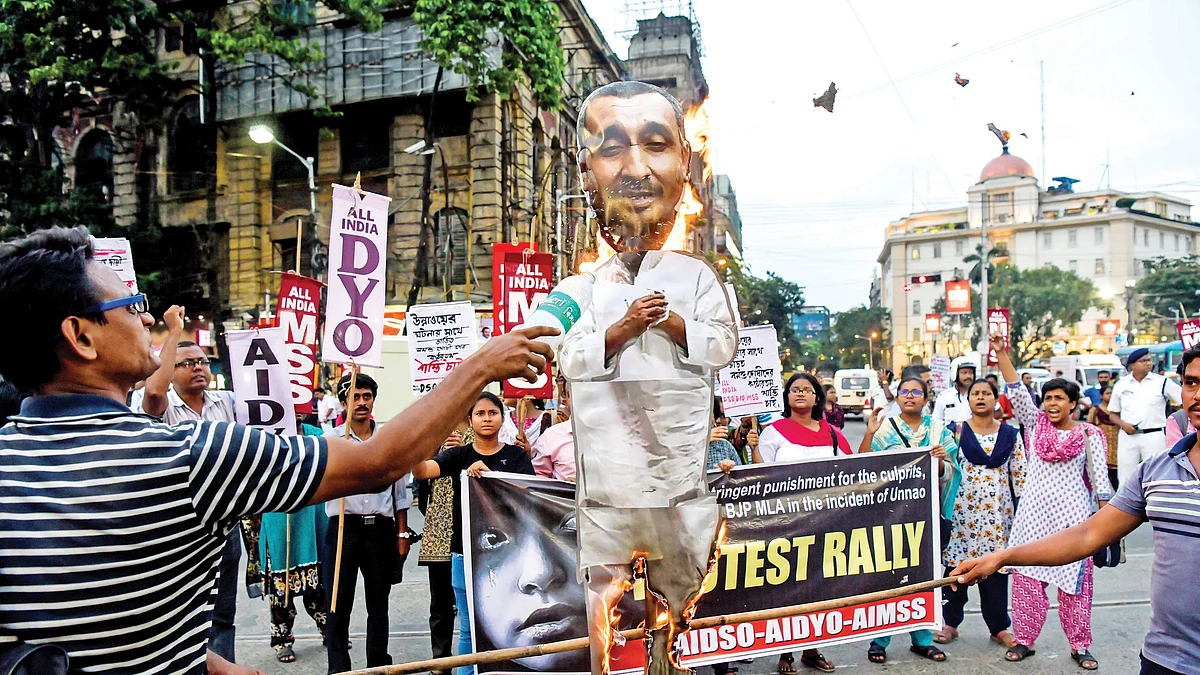
Where 88 rapes are reported daily (the actual number is at least three times that) and people in power not only perpetrate acts of violence on the bodies of women, but openly brag about them. When Unnao rape-accused Kuldeep Singh Sengar’s jail sentence was suspended by the Delhi High Court on 23 December 2025, the public erupted. Streets and social media were flooded with slogans: ‘Activists in jail, rapists on bail’.
The rape survivor, who was brave enough to call out her rapist in 2017, did what she has been doing for years: fought back. Women activists joined her in staging a protest in the bitter Delhi cold, and were removed by the police. The survivor approached LoP Rahul Gandhi and, with both media and people rallying around, a vacation bench of the Supreme Court stayed the order on 29 December.
Sengar stays in jail, pending further hearings. But, as the survivor’s lawyer advocate Mehmood Pracha put it, “We have got a moment to breathe, but that is not a victory.” The Unnao rape case was not a routine prosecution. The offence was registered only after sustained public protests by the victim, including an immolation attempt outside the chief minister’s residence in Lucknow.
Sengar was arrested in 2018 only after the intervention of the Allahabad High Court which observed, “The disturbing feature of the case is that the law-and-order machinery and government officials were directly in league with and under the influence of Kuldeep Singh.”
The survivor and her family faced brutal backlash for having named the powerful MLA as the rapist. Her father was assaulted by cops (48 injuries as per the medical report), framed in a false case in 2018, and died in custody. Mohammad Yunus, a grocery store owner who witnessed the assault, died mysteriously.
In 2021, a truck rammed into the cab in which the rape survivor was travelling to make her deposition before the court. Her lawyer and two aunts were killed in the ‘accident’. She was taken to Lucknow and subsequently flown to AIIMS, Delhi for treatment.
The 16-year-old girl who was lured by the promise of a job to Sengar’s office-cum residence where he raped her is now a married woman with two children. Her grit and gumption are extraordinary given how loaded the system is in favour of the powerful.
Take Ankita Bhandari’s case. In 2022, this 19-year-old girl was murdered by Pulkit Arya (and two accomplices) for refusing to provide ‘extra services’ to a VIP guest at the resort in Rishikesh where she worked as a receptionist. On 24 September, six days after she went missing, Ankita’s battered body was recovered from a barrage near Rishikesh. The owner of the resort was Vinod Arya, a BJP leader who was subsequently expelled. The murderers were arrested, and are in jail. The identity of the VIP was never revealed.
In the last week of December, however, new allegations surfaced. Former BJP MLA Suresh Rathore’s wife, Urmila Sanawar, claimed that the VIP who sought sexual favours from Bhandari was a senior leader nicknamed ‘Gattu’.
For the third consecutive year, Uttar Pradesh led the country in rapes and murders and accounted for 15 per cent of all kidnappings and abductions of women
She released an audio clip in which Rathore allegedly identifies him as BJP general secretary and party in charge of Uttarakhand, Dushyant Gautam. Gautam has denied it. Rathore has backtracked, accusing Sanawar of defaming the BJP.
The police have registered FIRs against Sanawar and Rathore. A petition seeking a CBI enquiry has been declined by the Supreme Court, despite being presented with overwhelming evidence of grave lapses by the local police. These include the failure to submit crucial CCTV footage, the failure to seize call records of resort staff and the use of a bulldozer to demolish the victim’s room on the very night of her disappearance.
Gautam took to Facebook to piously assert: ‘In my 27 years of social life, there has never been an incident questioning my respect for women or my conduct in the party.’ Women’s rights activists alleged that he has at least seven complaints of molestation against him.
While former Uttarakhand chief minister and Lok Sabha MP Trivendra Singh Rawat declared that no one would be spared, no matter how powerful, Congress leader Mumtaz Patel marvelled at the government’s hollow claims of women’s empowerment even as they suffered one atrocity after another.
“People connected with the BJP act with such impunity,” she said, “because they know they enjoy the government’s protection.” In all of this, perhaps the most heartbreaking voice is that of Ankita’s mother Soni Devi, who pleaded that the evidence be submitted to the courts, and justice be done.
The 2023 National Crime Records Bureau (NCRB) report on crimes against women was also released in December. It recorded 83,891 cases of assault against women and 29,670 rapes in 2023. The report does not list victims killed by their rapists and gang-rape as separate categories. While it claims only a marginal increase in crimes against women— from 4.45 lakh in 2022 to 4.48 lakh in 2023—the lived reality of women tells a different story.
Despite Prime Minister Narendra Modi’s public statements on women’s safety being a top priority, his government has failed to address systemic issues. Violence is normalised, marital rape is not recognised. With the Union government conveniently asserting that law and order is a state subject, it’s interesting to note that Uttar Pradesh, Madhya Pradesh and Rajasthan—all BJP-run states—continue to report shockingly high rates of crimes against women.
In March 2025, Madhya Pradesh Chief Minister Mohan Yadav admitted that 20 rape cases were being reported daily. Rape cases involving women from Scheduled Castes and Scheduled Tribes had gone up by 11.86 per cent. In Indore, rape cases surged by 103 per cent; in Bhopal, by 59 per cent.
For the third year running, Uttar Pradesh recorded the highest number of rapes and murders. In 2023, the state also accounted for 15 per cent of the total number of kidnappings and abduction of women, with Lucknow overtaking Ghaziabad and Kanpur.
“Rape in Uttar Pradesh is not new, and crimes against Dalit women are frequent. What is harder to explain is the huge increase in brutality and bestiality at the time of the rape,” says Neelam Chatuvedi, who runs the Kanpur-based NGO Mahila Manch.
“As far as women are concerned,” says activist and CPI-M politburo member Subhashini Ali bluntly, “Most parts of UP including Unnao, Hathras, Meerut and Bareilly are killing fields.” It’s hard enough being a woman in India. It’s that much tougher if you cross the paths of men in power.
Join our official telegram channel (@nationalherald) and stay updated with the latest headlines