


Bribery takes money. Corruption takes institutions
India spent decades building institutions that made democracy credible. The danger now is not their capture, but their decay


Corruption and bribery are two words that are often used interchangeably. Or are they?
Bribery, in the way we use the word today, dates to the 16th century and was defined as the ‘act of magistrates taking money for corrupted services’. Note that corruption is part of that definition. But corruption is a much older word, of Latin origin, whose meaning has little to do with the exchange of money for favours. It is defined as the ‘act of becoming putrid, dissolution, decay’.
Bribery is an individual act. Corruption, in addition to bribery, is the decaying and rotting of institutions. That is the distinction, and it is a major one.
The Economist Intelligence Unit, part of The Economist magazine, produces a crony capitalism index. It measures how large a part of an economy has been surrendered to making individuals rich by manipulating policy — what is called rent-seeking.
In 2016, crony capitalism accounted for 3 per cent of India’s GDP. By 2023, the last year for which this was measured, it had doubled. This may or may not involve bribery, but it is certainly corruption, because the power and legitimacy of the state are being eroded and misused to enrich chosen individuals.
The state can decay and rot in other ways. It is important to understand that for something to rot, it has to exist fully in the first place.
Indian democracy is a project that has taken a long time to build. Books have been written about what a monumental exercise universal adult franchise was and how the first electoral rolls were drawn up. Consider the effort made to include people who could barely be reached — including those who could only be found sleeping on footpaths at night. Innovations such as election symbols were introduced to encourage those who could not read to participate.
Credibility was built over time.
Parliament sought to curb defections by elected representatives. The Supreme Court’s 1994 judgment in S.R. Bommai v. Union of India significantly constrained the arbitrary dismissal of state governments under Article 356.
And, around the same period, India began to leave behind one of the most persistent problems of electoral democracy: booth capturing and ballot stuffing. Electoral reforms, including the introduction and eventual wider use of electronic voting machines, helped address these problems. The Election Commission itself traces the use of EVMs to the effort to curb booth capturing and other forms of electoral malpractice.
A short time before that — and older readers will remember this — the Election Commission became, for the first time, an institution that openly asserted itself against the government. This happened under a maverick individual, T.N. Seshan. His tenure began in December 1990, and he asserted the authority and autonomy of the Commission, rigorously implemented the Model Code of Conduct and took a tough line on electoral malpractice. The Commission became a three-member body again in October 1993, when two additional election commissioners were appointed.
Progress can be measured in the democratic institution becoming more efficient, more credible and more trustworthy.
Corruption is allowing that institution to rot and decay for individual benefit.
The progress has been undone on the questions of defections and the dismissal of governments. Today, entire parties are bought out, from the west of India to the east. No matter whom one chooses to vote for, the result can often be that the same people continue to control everything.
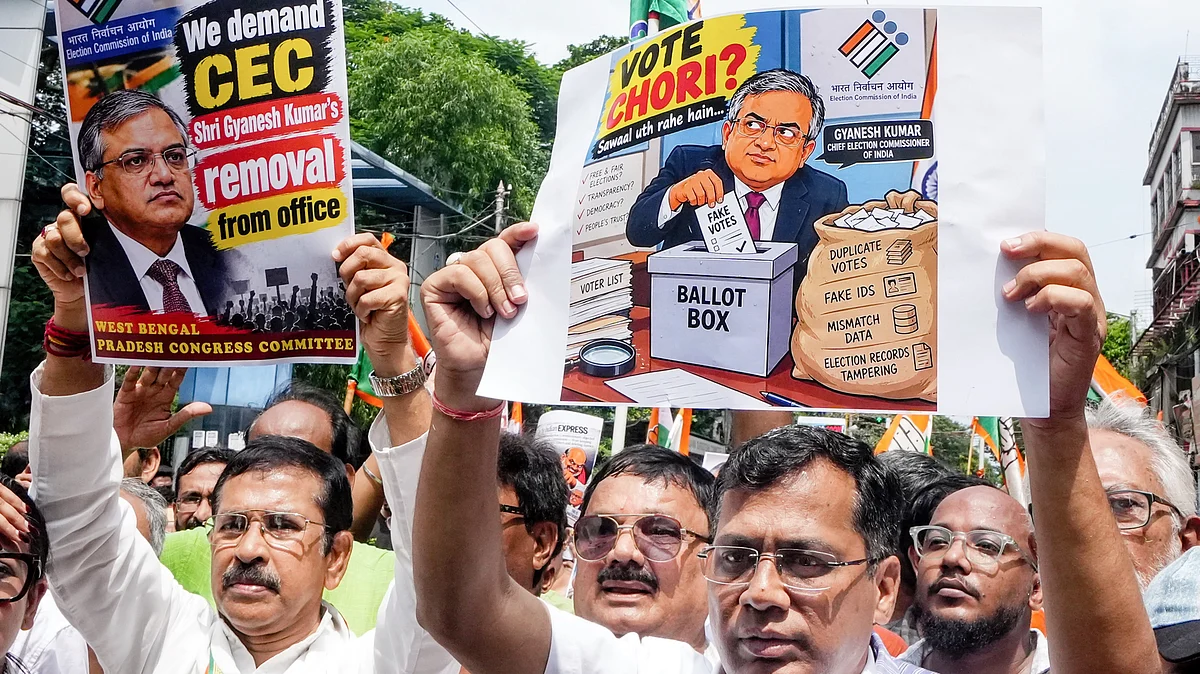
The damage done to the institution of the Election Commission is likely to be permanent, as is the harm inflicted on the electoral rolls. A future government, even if well-meaning, will have no easy way to undo what is unfolding before us and what has already been done.
Either the entire SIR process must be vitiated — in which case it would also call into question elections that have taken place after the assault on the voter rolls — or all the crores of individuals who have been erased must be added back after they personally and individually establish their credentials to the satisfaction of the state.
Under what rules can this happen?
Will those new rules mean that we have two tiers of voters — those who cleared SIR and those who came through another route?
This is a problem that is not going away.
Remember that it all began without a proximate trigger. Nobody had proved, or even claimed, that India’s voter rolls were damaged beyond repair and needed to be fixed with this blunt and disruptive instrument, requiring voters to prove their authenticity through ancestry.
This is a gratuitous exercise in which a hammer has been taken to our voter lists just as casually as it was taken to our currency a decade ago.
There is a saying in America: ‘If it ain’t broke, don’t fix it.’ This earthy line tells us that if something is functioning, it does not need to be meddled with.
But that does not accommodate the idea of malice. ‘If it ain’t broke, break it’ is the version we are living under.
Though it was imperfect — and we have looked at some of the ways in which it was — Indian democracy was our crown jewel when we engaged with the world. It was messy and chaotic, but it was real, honest and true.
We could confidently tell ourselves that we were a democratic state. One person, one vote, and so on. Can we now?
The decades of institution-building before the BJP secured a majority in 2014 constituted a giant crumple zone. The assault on institutions — courts, universities, the electoral system, pluralism, political culture and the media — took a whole decade because those institutions, some weak and others flawed, existed and worked.
They have been rotted, decayed and made putrid for the sake of making them so.
This is the essence of corruption.
Views are personal. More of Aakar Patel’s writing here