


SIR and the presumption of guilt in New India
The SIR process exposes a system in which citizens must prove their existence while the state remains unaccountable for its failures


'Attendance at the hearing is mandatory. Please treat this as urgent and make the necessary arrangements to attend without fail.'
I had meant to ignore the SIR notice which came over WhatsApp and had decided against going. But then my wife went the day before me. The notice-issuing official seemed upset, she said, that I hadn’t even responded to his WhatsApp message. Noblesse oblige, and so I appeared before him with the raggedy file of papers I have to prove that I exist and that I am qualified to elect those we euphemistically call public servants.
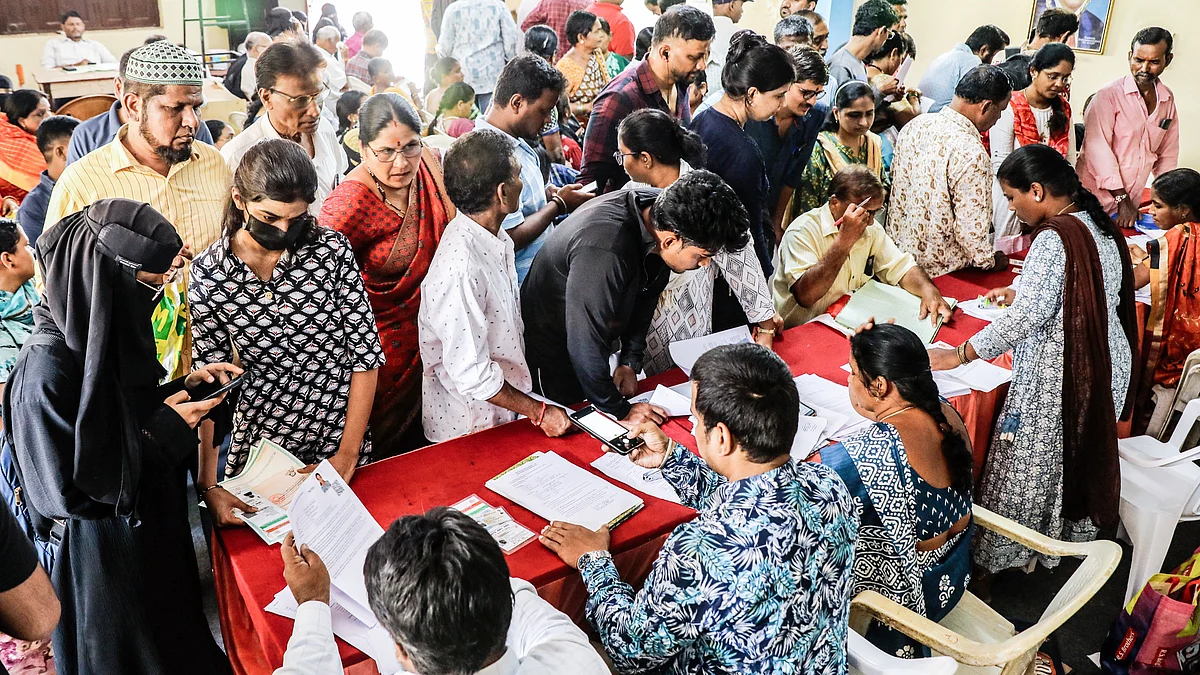
The place was overrun with anxious people, as is to be expected in a place where uncertainty and chaos are usually the norm and into which this government has gratuitously injected more uncertainty.
The tech set is fond of the word ‘disruption’ and use it in the positive sense, but it is actually a violent term. Disruption of whose lives and to what end? That is not considered, if it is thought of at all. The poor and the marginalised have no real vote in how their existence is unsettled.
Anyway, the official turned out to be a teacher who would be doing this well into October rather than teaching. He was pleasant, polite and competent and finished off the process in a few minutes.
This is often the case and I have found that those at the business end of government are like this, even when asked to do things that are absurd. I include many of the officials who have raided our office and been told to book me and so on. It is further up the chain of command that we have malice and incompetence and, as is the case in these present times, a certain absurdity.
Also Read: SIR and the politics of cruelty
My file of documents is raggedy because of acts of God and acts of man. More precisely acts of man who thinks he is God. The birth certificate (Nanavati Hospital in Bombay) and the school leaving certificate (Sir J.J. English School) were washed away in the Surat flood of 2006. Minimum governance had allowed water to accumulate in the dam upstream and then maximum governance released it without warning or preparation, flooding the banks of the city. My parents spent four days on their terrace, alone and without assistance, losing most of what they had.
What else is there to produce? My passport, of course, is with a court, impounded. It occurs to me that the state insists I am Indian when taxing me and filing cases against me, but suspects I am not when it comes to voting. I wonder how my fellow criminals around the country are dealing with this paradox.
Anyway I still had some documentation — bank statement, property papers etc — to submit and these were accepted. Perhaps they will be sufficient, perhaps not. We shall find out. It would be more exciting to be struck off the rolls and be moved along the line of torture. In Assam, those unable to prove citizenship to the satisfaction of the malevolent state have been jailed in addition to being disenfranchised.
Consider what happens to people who are told one day that their bank accounts, licenses, passports are no longer valid. Then, of course, there are all these deportation stories. I am hoping to be sent to some civilised nation, perhaps in Southeast Asia. I would not mind China either, the rising star of humanity, though in all honesty it is in another South Asian nation that I would be really at home by way of culture and diet.
Also Read: From universal franchise to voter selection
Knowing my luck, and knowing this government, that will likely not happen. I will instead be kept here, disenfranchised but told to stand through six stanzas of Vande Mataram.
The mother of democracy demands respect and adoration but it is a one-sided relationship. You have to prove you are her child, which is a strange position if we think of it.
The presumption of guilt has been baked into many laws in New India. It existed for the laws on terror and narcotics. In 2015, it was extended to the possession of beef. In 2018, it was extended to the 'love jihad' laws. Assam showed us the way to do it on citizenship, and here we are.
Wasn’t the BJP only some time ago talking of passing a law on compulsory voting? Wonder what happened to that and why the position went from ‘everyone must vote’ to ’nobody can vote unless they pass this purity test’. To expect consistency of principle from them is the same as to expect humanity or civility.
In an earlier time, I would be deeply upset by both this process and the thought of being deprived of the right to vote (I used to queue up at the booth at the crack of dawn). Now I am more relaxed about it, and frankly I don’t care.
I have great affection for the people who comprise this nation; I have little and perhaps none for the rest of what comprises it. The New York city mayor in his magical campaign last year spoke of meeting a constituent for whom all romance about home had vanished. “I used to love New York,” she said to him, “now it’s just where I live.” Precisely.
Views are personal. More of Aakar Patel’s writing here