


SIR and the politics of cruelty
The lessons from Assam's NRC remain unlearned as SIR expands across the country, writes Aakar Patel
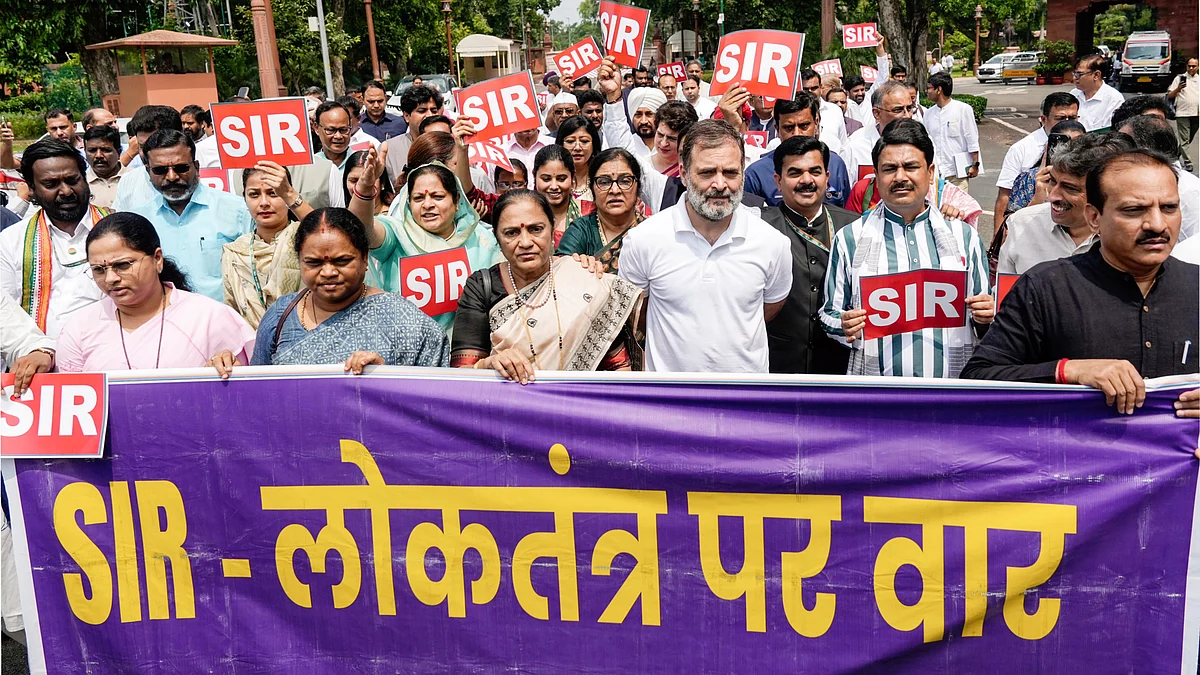


One common trait in lawless nations is high levels of anxiety against arbitrariness. Medieval texts tell us this has always been the case in our parts. Cruelty is couched as process and millions put through torture. Special Intensive Revision forms are being handed out across India. It is impossible, on a first reading of this form, no matter how educated the reader, to understand what one is required to do, even though it is a single page.
We are told by the executive and the judiciary that putting us through this is not only reasonable but required and necessary. Of course, we have been down this road before.
In 1998, the governor of Assam, a retired military man named S.K. Sinha, sent a note to then president K.R. Narayanan in which he referred to the situation in alarming language: 'Large-scale illegal migration from East Pakistan/Bangladesh over several decades has been altering the demographic complexion of this state. It poses a grave threat both to the identity of the Assamese people and to our national security. Successive governments at the Centre and in the state have not adequately met this challenge.'
Sinha demanded action 'to avert the grave danger that has been building up for some time … If not effectively checked, (Bangladeshis) may swamp the Assamese people and may sever the Northeast land mass from the rest of India. This will lead to disastrous strategic and economic results'.
Sinha acknowledged that he was not basing this assessment on any data. He added: 'Unfortunately, today we have no census report on the basis of which we can accurately define the contours of trans-border movement. Thus, we have to rely on broad estimates of theoretical extrapolations to work out the dimension of illegal migration that has taken place from East Pakistan/Bangladesh.'
In short, he had no evidence to prove this theory, but he felt strongly enough about it just the same to raise it with the president officially.
In 2005, Sarbananda Sonowal, who later became the BJP chief minister of Assam, went to the Supreme Court to make the laws governing the identification of individuals suspected to be foreigners harsher. The Supreme Court leaned on S.K. Sinha's speculative note in this case to conclude that Assam was facing "external aggression", which threatened a constitutional breakdown.
Also Read: Prove again that you belong
This was reckless and unwarranted use of extremist language that reflected the prejudices and bigotry existing against Muslims which exist even in India's highest court. The judiciary reversed the burden of proof for the residents of Assam, a feature it regularly condones, as we have seen in this column before.
Normally, it is the State that must prove wrongdoing or criminal activity, and it must provide the evidence that someone should be punished. This is the meaning of the term 'innocent until proven guilty'. However, the onus of proving they were not foreigners (and, for those born after 1971, that their parents or grandparents were not foreigners) was thrust by the judiciary onto the Assamese. They were all guilty until they could prove themselves innocent.
In a nation where many, if not most, are poor and many, if not most, are not fully literate; where documentation is weak; and in a state where flooding is not rare and the total loss of property quite common, this reversal of the burden of proof on such an important matter was cruelty.
The other thing that the State did was to have almost no safeguards.
The foreigners' tribunals, which would determine whether someone should be set free or sent to jail, were staffed by people given four days of training. They were advocates and retired civil servants hired on two-year contracts. It was before such people that individuals would have to present their case.
The Assam government, run by the BJP, told the tribunal members what it wanted them to do by not extending the contracts of those who had a low rate of declaring individuals as foreigners.
This was revealed in an affidavit that the government itself submitted to Gauhati High Court when some of the tribunal members moved court, saying they had been let go from their jobs without any reason.
Also Read: The BJP's intent versus India's apathy
This was not so, the government said, and claimed that all tribunal members had been given a performance appraisal. In 2017, it submitted a note which showed the names of the individuals, a column showing the 'percentage of foreigners declared', the 'general view of the Government upon the member' and 'whether may be considered for further retention or may be terminated'.
Individuals who had marked fewer than 10 per cent of the total number of people coming before their tribunal as foreigners were deemed to be 'not satisfactory' and shown to be 'terminated'.
The state government was effectively incentivising its tribunal officers to mark more people as foreigners, and punishing those officers who were not doing so. Such injustice did not receive nationwide, much less global, notice, and the matter was limited to the Assamese media.
The crisis snowballed when an Assamese, Ranjan Gogoi, was appointed Chief Justice of India. The state, which was under the BJP, drew up a first list excluding over 40 lakh people and then a final list of those whom it was satisfied met the criteria it had laid out. This was the so-called National Register of Citizens (NRC).
The list excluded 19 lakh people, who would now have to line up before the foreigners' tribunals with their papers and prove their citizenship. The majority of these 19 lakh turned out to be Hindus. This was unexpected because the BJP had believed its own narrative and governor Sinha's theory of a state overwhelmed by illegal immigrants, when there was no evidence to show this was the case.
The BJP government then decided to scrap the Assam NRC that it had forced India to spend so many resources and so much effort on, and had forced Indians themselves to expend so many resources and so much effort on.
We are now again upon a similar exercise, this time nationwide. Reports of entitlement benefits being scrapped, passports being denied and forms being too confusing have begun coming in. The population is gripped by anxiety against arbitrariness and the cruelty of a state that sells its actions as minimum government.
Views are personal. More of Aakar Patel’s writing here
Join our official telegram channel (@nationalherald) and stay updated with the latest headlines