


“Education can only be transformed collectively”
Education is a secular question. Everyone needs it, and it can only be transformed collectively
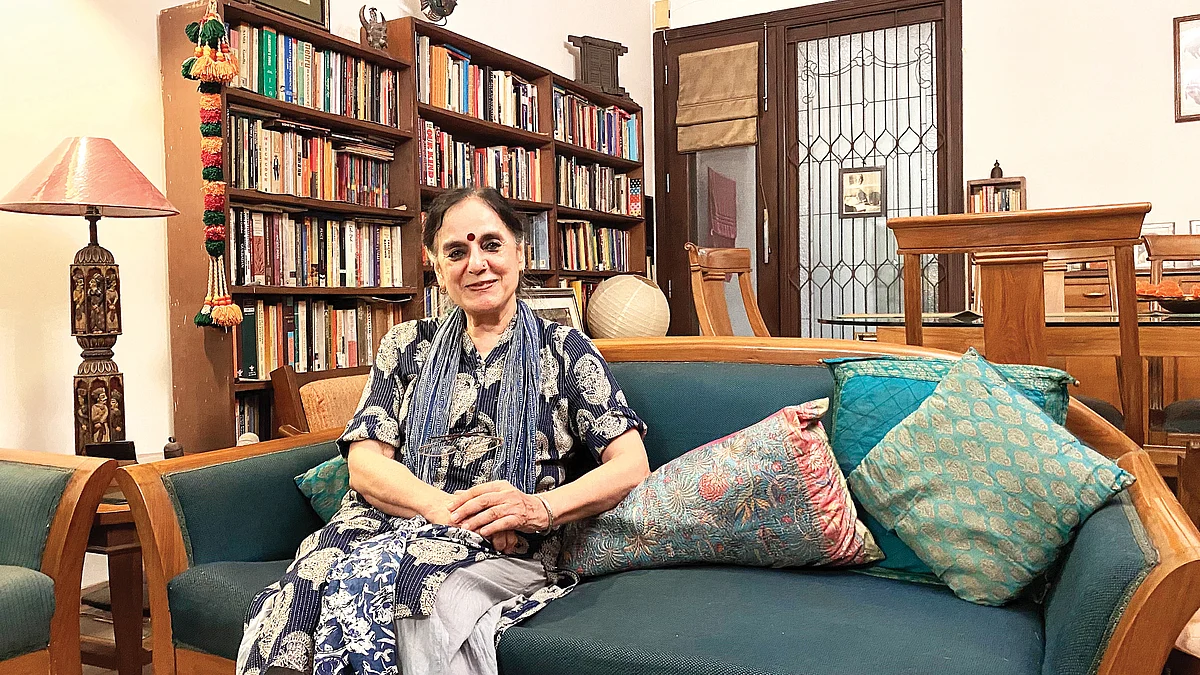


The recent Gen Z and Gen Alpha protests have put the spotlight on India’s broken education system. Just two bits of data give a sense. Education in India is a booming industry (est. market size: 11–14 lakh crore rupees or $115–152 billion) and yet, as educationist and former Delhi University faculty dean Anita Rampal tells Nandlal Sharma, only 22 per cent of Indian children complete Class 12.
That market size tells you that education is a great business to be in, money is being made hand over fist, and yet 7,000 schools in India’s most populous state Uttar Pradesh have one teacher! The ongoing protests over basic amenities in government schools have refocused public attention but are we asking the right questions?
Gen Alpha seems to have no fears. What do you make of this?
It’s very encouraging. For years, students have been made to feel that if they fail, the deficiency lies in them. We rarely ask what role the system has played.
When girls tell journalists, “The board exams are four months away. If there is no teacher, what are we supposed to do?” that’s a perfectly legitimate question. In Delhi, Class 10 students who had no Maths teacher and failed said, "Give us a teacher and test us after three months; don’t fail us now, because failing Class 10 can mean being pushed out of school."
Government data suggests that, on average, only about 22 per cent of children complete Class 12.
Have the Central and state governments failed to fulfil their responsibilities?
Yes. Our Constitution places education in the Concurrent List precisely because states have a responsibility. That space is increasingly being constrained.
There are more protests in north India partly because some southern states have demonstrated that things can be done differently. Tamil Nadu, for instance, has repeatedly questioned centralisation as seen in the National Education Policy and [National Testing Agency (NTA)-administered] common admission tests like NEET and CUET. It has argued that introducing vocational education as early as Class 6 could deepen inequality because such courses are seen as ‘low status’.
According to UDISE+ data, Uttar Pradesh has over 7,000 single-teacher schools. Nationwide there are more than a lakh. How can we talk about quality education when millions of children are effectively being taught by one teacher?
Also Read: How not to bring schools back on track
The Right to Education Act came into force in 2010. What happened to that promise?
The Right to Education came after a very long struggle. It promised a neighbourhood school, qualified teachers, right assessment. Much of that has been turned upside down.
Governments have repeatedly tried to cut corners. At the village and panchayat level, teachers are paid a pittance. Stop-gap arrangements like ‘Shiksha Mitras’ are common. We also have enormous inequality among government schools. In Delhi, there are Kendriya Vidyalayas, Sarvodaya Vidyalayas, Pratibha Vikas Vidyalayas... the poorest child often gets the weakest school. Why shouldn’t every child have access to the same quality?
There’s also a problem with the way we teach. In many classrooms, the teacher stands at the blackboard and children copy what is written. That’s not education. Children need to work with their hands, investigate, experiment. Knowledge is created when we talk and think together; it’s not simply information that goes in and comes out. Our textbooks are not interesting; they do not stir curiosity. Why can’t we write books that children want to read?
Look at the NTA examinations. The questions are so absurd we should ask why students are spending six or seven years preparing for them. Parents even sell land or cut household budgets to pay for coaching.
We have reduced education to ticking the right box. But if you want to become a doctor, teacher, journalist or filmmaker, you need to develop your own way of thinking. You cannot acquire that through an answer key.
What needs to happen now?
I don’t expect much. Committees will be formed, surveillance will increase and people will talk about preventing the use of unfair means. But education does not flourish through policing.
We need to ask: What are we testing? What kind of knowledge do we value? It’s great that students are demanding teachers, but we must also ask how prepared those teachers are. Are they teaching children to memorise because the exams are designed that way?
The government must also be willing to admit its failures. When the Right to Education was being developed, the principle was: do not fail the struggling child, provide support. No educational principle says holding a child back for a year will magically make them a better learner.
The understanding of ‘learning outcomes’ needs to change. If your performance reveals that you are poor, from a remote area or from a particular socio-economic background, then the system has failed to create equitable learning.
What do you think about the increasing centralisation of education?
It should not happen. Education has to grow from the grassroots, from knowledge that exists among local people, from what children see, observe, know. Whether in Manipur, Delhi or Kerala, education should emerge from the local context. Curriculum cannot be imposed from above.
Does the idea of a Gen Z or Gen Alpha obscure the huge differences in children’s individual circumstances?
Absolutely. Only around 20 per cent of students who finish school go on to higher education, and roughly 80-85 per cent of those students are first-generation learners whose parents never attended university. We cannot ignore their circumstances.
In some places, children don’t even have a school building. A little girl in Uttar Pradesh made a heartbreaking video saying, “Look at us studying in the rain and the heat, at least give us a building.”
We say, “Take examinations online.” But how many families have computers? A computer-based examination may exclude precisely those who are already disadvantaged. And if the student is a girl, and the school is far from home, parents may worry about safety. If we want children to enter higher education, we must create a system that enables them to get there.
Do you see the current school protests as an expression of civic consciousness?
Yes. When you demand something not merely for yourself but for everyone, you are demonstrating empathy and collective thinking. That is where citizenship begins.
What is striking about the current protests is that caste and religion seem irrelevant. Everyone wants teachers. In Rajasthan, when Muslim teachers were wrongly suspended, students — particularly girls — protested and demanded their reinstatement.
Education is, in itself, a secular question. It is everyone’s need, and it can only be transformed collectively.
What are the most immediate priorities?
The Right to Education provides a framework: there must be a school near the child’s home, qualified and trained teachers, learning materials, a library and an appropriate environment for learning. A building is not enough. You can build a marble building and still have no education. Children need books — not just textbooks, but different kinds of books. Research shows that children who grow up with books have very different learning experiences from those who have none.
Teachers also need proper orientation, to create an environment where children learn rather than memorise.
What can we learn from Kerala?
Kerala has a long history of schooling and secular education. About two decades ago, it recognised that even with teachers and facilities, the children weren’t learning. And so, it changed its curriculum and examination system.
The language of instruction became the Malayalam that children spoke. The curriculum became activity-based. Parents started saying marks weren’t everything. What mattered was whether children understood and could express themselves. Children began writing creatively, regardless of background.
Teacher orientation made a big difference, and districts where reforms were implemented showed better learning. If this can happen in one state, why not in others?
We now hear ‘online, online’ everywhere, including proposals to train teachers online. But teacher education, like education itself, requires interaction, discussion, reflection and experience. We cannot transform education simply by putting everything on a screen.
After years of neglect, education has once again become an issue of public accountability. Does that give you hope?
Absolutely. When I hear the voices of these young girls, it gives me courage.
But we need many more voices. A school building may be constructed, facilities may be improved, roads may be repaired, but that alone is not the change we need. The protests are the beginning of a larger civic demand: a level playing field for all children to learn.
Join our official telegram channel (@nationalherald) and stay updated with the latest headlines