


Electoral storm gathering over Trump
The landslide victory that returned Trump to the White House reflected a wave of popularity that has since steadily receded


Ever since US President Donald Trump realised that bombarding Iran would not result in the Islamic regime in Tehran caving in, he began looking for a face-saving exit. Six weeks into the conflict, he agreed to a ceasefire. The first round of talks between the US and Iran in Islamabad was inconclusive; but a truce wasn’t beyond reach. Moreover, it was imperative for Trump to arrest the economic hardships the hostilities had created at home.
State-by-state primaries for the US midterm elections began on 3 March and will conclude on 15 September, determining the final Democratic and Republican candidates. The mid-term elections — for state governorships, senators and law-makers in the House of Representatives — will be held on 3 November.
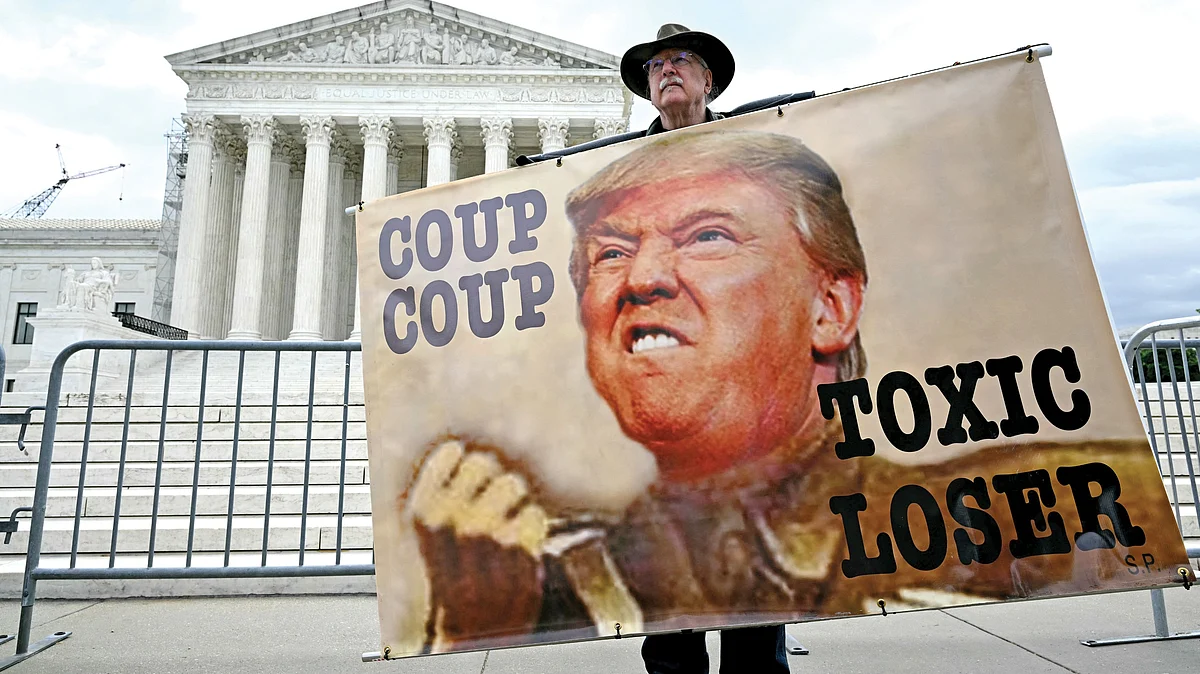
The landslide victory of November 2024 that returned Trump to the White House after an interval of four years reflected a wave of popularity that has since steadily receded.
Indeed, despite his Republican party enjoying majorities in the Senate and the House — normally a boon for an American president — he has failed to pass a number of legislations through the two chambers because of pushback from Republicans themselves, who have been concerned about such enactments upsetting their constituents and consequently injuring their chances of election or re-election.
Thus, Trump has resorted to a plethora of executive orders, which have finite validity and, in some cases, limited acceptability.
Majorities in the House and Senate have, though, enabled him to bypass Congress on military operations abroad. These include the unlawful kidnapping of Venezuelan president Nicolás Maduro and his wife and renditioning them to New York in January, and the unprovoked attack — with Israel — on Iran. Since the first strikes on 28 February, at least 3,300 people have been killed, many of them innocent civilians, nearly 25,000 injured and over 3 million displaced.
Also Read: Has Donald Trump met his Waterloo?
The US saw mass mobilisations as part of a nationwide ‘No Kings Day of Action’ — signalling Americans want democratic checks in the presidency. On 28 March, more than 9 million people rallied across America against Trump, his administration and his war on Iran.
According to a YouGov opinion poll carried out on 8-10 April and published by the New York Times, Trump’s approval rating was down to 39 per cent, with 61 per cent of Americans disapproving of him. Few citizens were taken in by his daily rants on Truth Social claiming triumph over Iran. Most were increasingly frustrated by rising inflation pinching their pockets.
GDP growth in the US has slowed in 2026, consumer prices have risen sharply, job creation is at its weakest since the Covid-19 pandemic and the cost of energy has gone through the roof. From February to March, petrol prices soared by 21.2 per cent, the highest monthly increase since figures started being tracked in 1967. According to the American Automobile Association, in California a gallon of gasoline cost $5.93 — up from around $3.
Analysts quoted by the BBC forecast food prices may rise in the months ahead, as the impact of higher transportation and agricultural input costs begin to bite. The Strait of Hormuz, choked by Iran as a counter strategy to the US–Israeli assault, provides passage to vital supplies of crude oil, natural gas, fertiliser, aluminium and helium for all continents.
Trump maintains energy inflation will be short-lived and dismisses any risks to the wider economy. Price stabilisation through the international supply chain may not happen, though, for another 4–5 months. This has Republican aspirants to public office worried about their prospects in November.
Furthermore, Trump’s run-in with US-born Pope Leo XIV, the elected head of the influential Catholic church, has been completely off the wall. He accused the pontiff of being ‘terrible for foreign policy’, adding, ‘I’m not a fan of Pope Leo.’ The pope responded, “I have no fear of the Trump administration… I do believe in the message of the Gospel, as a peacemaker.”
Also Read: Why Trump’s America is a lonely superpower
Such a standoff is unlikely to be taken lightly by America’s Catholics, who constitute 20 per cent of the country’s population, and won’t be lost on Protestants, either. Besides, 36 per cent of Catholics are Hispanic, who may have noted that Spain and other Spanish-speaking nations have unequivocally condemned the US and Israel’s aggression.
What this means is that Republicans could lose control of the House and perhaps even the Senate. A Democratic majority in the House will almost certainly result in Trump’s impeachment, although a conviction in the Senate — which unseats a president and requires a two-thirds majority — is likely to be harder to achieve.
A legislature ranged against a president can, unless skilfully handled, render him a ‘lame duck’. Yet, Trump could still embark on forays overseas. The only way to curb such excesses would be for the Democrats to amend the 1973 War Powers Act. As of now, this law requires a president to notify Congress within 48 hours of deploying forces and mandates their withdrawal within 60–90 days unless Congress authorises the action. So far, Trump has consciously complied with both.
British Prime Minister Keir Starmer ruled out joining the US in a blockade of Iranian ports, another sign of the special relationship between Washington and London fraying. Instead, on 17 April, the United Kingdom and France co-hosted a summit of more than 40 nations to discuss a defensive naval mission to reopen traffic in Hormuz and restore ‘freedom of navigation’.
Europe is now more united after far-right former Hungarian Prime Minister Viktor Orban’s crushing defeat in the general election following a controversial 16-year reign. Iran, meanwhile, has resumed energy supplies to Spain and France through the Strait in an attempt to diplomatically divide the West and isolate the US.
If agreed to by the international community, Iran’s desire to impose a toll on vessels sailing through the Strait on a long-term basis would set a slippery precedent. It would also violate the universally accepted United Nations Convention on the Law of the Sea, which defines territorial waters as no more than 12 nautical miles from a country’s coast. At least nine other straits in other parts of the world could then voice similar demands.
These include the Strait of Malacca in south-east Asia, which is 1.7 miles at its narrowest point near Singapore and handles 25 per cent of the global seaborne trade; the Strait of Gibraltar which connects the Atlantic Ocean to the Mediterranean Sea; and the Bab-el-Mandeb, which joins the Red Sea to the Gulf of Aden and serves as a gateway to the Suez Canal.
Opinion aired on media about the first face-to-face talks between the US and Iran in 48 years — held in Pakistan last weekend — ranged from doubt (about the dialogue taking place at all) to optimism to writing it off as a ‘failure’. Given the decades-long distrust between the parties, exacerbated by Trump’s bellicosity, it was ridiculous to expect a breakthrough after a solitary round of negotiations, even if they lasted a marathon 21 hours.
There was reason to believe that agreement in principle had been reached on a number of issues, though not on the modus operandi of Iran abandoning its nuclear programme. This was underscored by Omani foreign minister Sayyid Badr Albusaidi, who mediated in indirect talks between US and Iranian representatives in Geneva on 26 February, and spoke of ‘significant progress’.
Le Monde reported, ‘The Gulf nation (Oman) says Iran has agreed to zero stockpiling of uranium and to convert existing enriched material into fuel, calling it an unprecedented breakthrough in nuclear negotiations.’ For Trump to unleash bombs and missiles on Iran just two days later was in awfully bad faith.
So, a deal, as Trump likes to put it, will undoubtedly be a relief for Republicans; but it may not be enough to wholly overcome the electoral challenges ahead. And meanwhile, who know what Trump will do next?
Ashis Ray was formerly editor-at-large of CNN. He is the author of The Trial that Shook Britain. More of his writing can be found here
Join our official telegram channel (@nationalherald) and stay updated with the latest headlines