


Of sugar highs and water lows
For Maharashtra’s drought-stricken villages, nothing can sweeten the ethanol deal
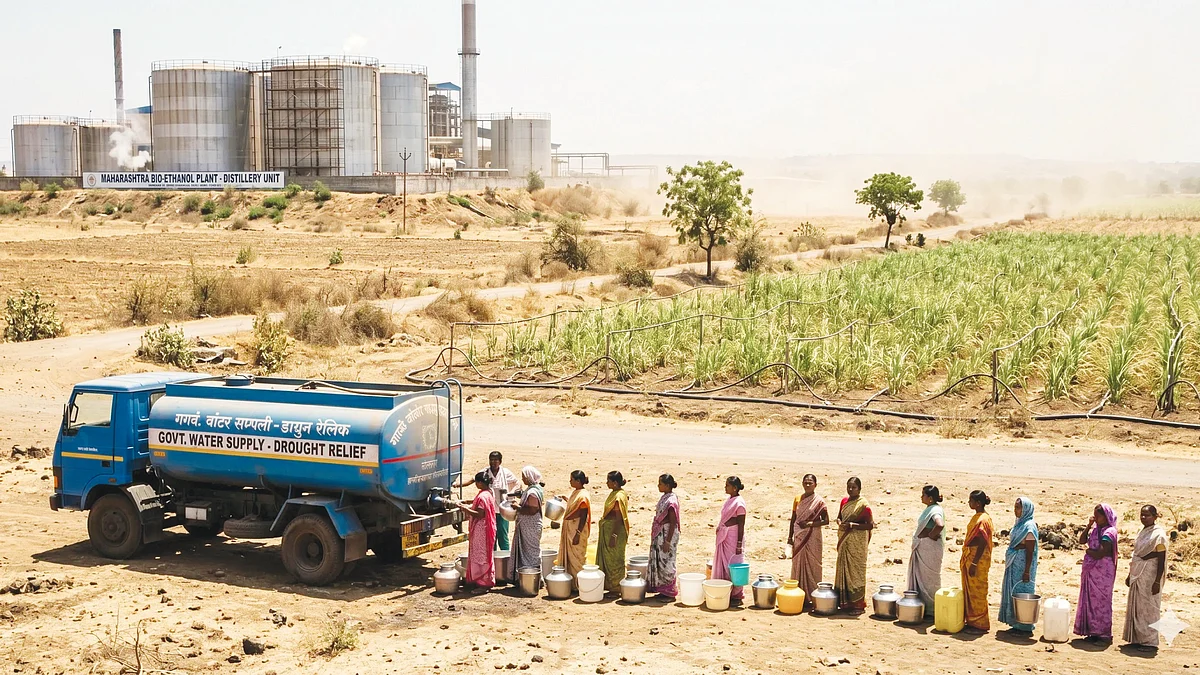


Think one day at a time. This was the strategy of farmers to stay afloat in Takwiki village, in Maharashtra’s drought-prone Dharashiv district in the summer of 2013. A crippling water scarcity devastated its economy, driving people out in search of work and water.
Three more devastating droughts have since ravaged Marathwada region in which Takwiki falls, and each time, some of its people left the village and translocated to other places.
That year, Maharashtra crushed 80 million tonnes of cane to produce 8 million quintals of sugar. Sugar mills in Dharashiv crushed over 25 lakh tonnes of sugar-cane — a record.
In my successive trips to this village and tens of others in this rain-shadow, low-rainfall, arid region of the state, one paradox stood out: villages that clamour for tankers to supply drinking water grow tonnes of water-guzzling sugarcane for the state’s sugar daddies. This, in a changing climate.
Year after year, they dig deep borewells to extract groundwater to irrigate cane crops, feeding factories that produce millions of tonnes of sugar and now ethanol, while a large section of people, especially in summer, are crying themselves hoarse for drinking water during drought years.
A few years ago, a geologist at the Maharashtra government Groundwater Surveys and Development Agency (GSDA) told me that Marathwada was sucking water from the palaeolithic age to grow orchards and cultivate sugarcane. The crisis is that serious.
In 2013, when the harangued district collector wrote to chief minister Prithviraj Chavan pleading for the suspension of the Diwali-to-March crushing season to preserve water for drinking needs, the entire political class was up in arms against him. He was snubbed, and transferred. People went without water, were forced to buy cans and packaged water by shelling out astronomical sums, but sugar mills worked round the clock, using millions of litres of water to produce the sweetener.
Cut to 2026. The water crisis has worsened, yet the Centre wants to push for vehicles to run on 100 per cent ethanol — produced by sugar factories — to tide over fuel shortages in the aftermath of the war in West Asia. It intends to amend the regulatory framework for mills, bringing ethanol into the framework in addition to sugar, molasses and other byproducts. This year, more of Maharashtra’s sugarcane will not become sugar, but ethanol — fuel for India’s vehicles.
The shift is part of India’s aim to achieve, over time, 100 per cent ethanol blending in petrol. Oil marketing companies are expanding procurement and sugar mills across Maharashtra are rapidly adding distillation capacity. What was once a by-product — molasses — has now become a central economic driver.
For five years, the Centre and states have, through policy tweaks, incentivised private and cooperative sugar factories to invest heavily in ethanol production. But in a state where water is already contested, the ethanol story is not just about energy. It is about how water is being used — and who decides.
Last week, the Modi-government took a step toward enabling cars in India to run entirely on ethanol. Under normal circumstances, such a move would be welcome. But these are not normal times. Ongoing geopolitical tensions in West Asia have disrupted global oil supplies, raising fears of fuel shortages. Reducing dependence on petrol and diesel is therefore understandable.
Early in April 2026, the ministry of consumer affairs, food and public distribution released the draft Sugarcane (Control) Order 2026 that aims to replace the 1966 order, to ‘modernise the sugar sector’. Aside from what it will achieve and why, among the 14 key proposals in the draft is the move to expand the regulatory scope to include ethanol production from sugarcane juice, syrup and molasses, formally integrating ethanol into the regulatory framework.
Also Read: Time for India to go solar
In principle, this seems like a forward-looking decision. But implementing it now is akin to digging a well when thirsty. Energy demand is predictable and should have been prepared for in advance. This policy carries two serious risks.
The first concern is impending water scarcity.
This year’s forecasts by multiple agencies including the IMD suggest that the 2026-27 monsoon may fall short by around 8 per cent due to the looming shadow of El Niño. Governments — right from the Centre down to municipalities — are already preparing for water shortages. Cities like Mumbai have announced water cuts.
Against this backdrop, accelerating ethanol production begs a critical question. Ethanol manufacturing requires enormous quantities of water. Using conventional methods, producing one litre of ethanol can require up to 10,000 litres of water. Even when produced from grains like rice or maize, efficiency is limited — one tonne yields about 475 litres of ethanol. So how economic and ecological is the decision to harp on higher ethanol blends?
In India, ethanol is primarily derived from sugarcane. In Maharashtra alone, nearly 350 sugar factories have invested heavily in ethanol production. Yet from a tonne of sugarcane juice (about 1,000 litres), only 70 litres of ethanol is produced. The process is doubly water-intensive: first, to grow a crop that guzzles vast quantities of water, and then, to expend further energy and resources to extract ethanol from it.
Just as you need to spend money to earn money, producing energy also consumes energy. The question is how much and at what cost.
If water itself is scarce, as in the regions that cultivate sugarcane, should it be used for drinking, farming and essential needs — or diverted toward fuel production? The answer is obvious. That is why pushing ethanol production at this moment appears deeply problematic.
The second concern is overcapacity and policy distortion.
Before the current energy crisis, the government had strongly incentivised ethanol production. As a result, India’s ethanol production capacity has increased dramatically — from about 518 crore litres a decade ago to nearly 2,000 crore litres today. However, current demand is only about 1,100 crore litres. In other words, capacity far exceeds demand.
Even within ethanol production, there is a hierarchy. Ethanol made from sugarcane is now being overshadowed by ‘new’ ethanol derived from grains like rice (also a water-guzzling crop) and maize. Government procurement policies appear to favour these newer producers, spelling uncertainty for traditional sugar-based ethanol producers — mainly sugar mills.
In Maharashtra and elsewhere, around 350 such producers have invested heavily, encouraged by earlier policies. But oil companies are now procuring only about half of their output, which leaves these producers struggling to recover their investments.
If India moves from 20 per cent blending to 85 or 100 per cent ethanol, demand will rise dramatically. But ethanol has lower energy density than petrol or diesel. This means vehicles require more ethanol to travel the same distance. Higher consumption will therefore drive even greater demand for ethanol production. And that, in turn, means even greater demand for water.
At present, India’s cropping patterns can support ethanol blending up to around 30 per cent. Moving to 85 or 100 per cent would require a massive expansion in ethanol-producing crops.
This raises other concerns. Sugarcane and rice — both water-intensive crops — are already under scrutiny. Yet they continue to receive policy support due to political considerations and food security needs. This has led to growing pressure on water resources. In addition, excessive irrigation brings risks like soil salinity and land degradation, as seen in Satara.
Ethanol has altered the financial logic of the sector. Instead of being trapped in cycles of sugar surplus and low prices, mills now have an alternative market.
Industry voices argue that ethanol has effectively stabilised the sector — indeed, Union minister Nitin Gadkari, a strong advocate for and player in the sugar sector and biofuels, recently claimed that without ethanol, a majority of mills in western Maharashtra would have shut down. There is little doubt that ethanol has revived the mills. But its mindless expansion rests on sugarcane and water, disregarding concerns about water availability and food security.
At the heart of Maharashtra’s ethanol turn lies a familiar political economy, now reconfigured rather than replaced. The cooperative sugar mill — once the backbone of rural patronage — has evolved into an increasingly private agro-industrial hub that converts cane into sugar, power and fuel.
Control over mills meant control of credit societies, transport contracts, labour networks, subsidies and ultimately electoral influence, particularly in western Maharashtra. Ethanol deepens this nexus. By improving cash flows through assured procurement by oil companies, it strengthens both cooperative and private mills, linked to political families across parties.
The beneficiaries are layered: mill owners secure new revenue streams, political actors consolidate influence through financially viable institutions, and relatively larger cane-growing farmers gain from more reliable payments.
The costs, however, are more diffuse — borne by regions like Marathwada, where groundwater is overdrawn to sustain cane, and by smallholders locked into a water-intensive crop because mills dictate local cropping patterns.
In effect, ethanol has not democratised the sugar economy; it has shifted its centre of gravity from a cooperative-led model to a hybrid regime of cooperatives and private mills, tightening the nexus between water, capital and political power while expanding it into newer, more fragile landscapes.
As Amey Tirodkar notes in Frontline, ‘sugar built Maharashtra’s cooperative power structure’, a structure now under strain. The traditional cooperative model, once the backbone of rural political control, is being reshaped by debt, rising costs and uneven access to ethanol capacity.
Mills with capital and political backing are adapting — investing in distilleries and securing new revenue streams — while weaker cooperatives struggle with unpaid dues running into thousands of crores. The result is a reconfiguration: from a broad-based cooperative network to a more uneven landscape where private mills and politically aligned entities consolidate control.
In this transition, ethanol acts as both stabiliser and filter — rewarding those who can invest, marginalising those who cannot. The benefits accrue upward, to mill owners and political actors, while the risks — water depletion, crop dependency and income volatility — are pushed onto farmers and labour.
In Maharasthra, sugarcane is not just a crop but a system of power. From Kolhapur and Sangli to Ahmednagar and Solapur, the geography of sugar overlaps with the geography of political influence. Cooperative mills historically anchored local economies, shaping access to credit, employment and electoral mobilisation.
Ethanol reinforces this system. By strengthening mill finances, it increases the institutional leverage of sugar networks. It also locks farmers into cane cultivation. Studies show that in Maharashtra, expansion in sugarcane production has been driven more by increase in area than productivity, indicating a steady spread of the crop across regions. That expansion has increasingly moved into drought-prone regions like Marathwada, or parts of western Maharashtra, where the ecological costs are far higher.
The impact of this transition is not the same across Maharashtra. Western Maharashtra — with canal irrigation systems and relatively higher rainfall — has historically supported sugarcane cultivation. Regions like Kolhapur, Sangli and Pune form the core of the sugar belt.
But Marathwada and parts of Vidarbha tell a different story. Here, sugarcane depends on groundwater extraction. Repeated droughts have already exposed the fragility of this model. Despite this, cane acreage has expanded into these regions, driven by the economic pull of mills. Ethanol risks accelerating that trend.
The shift also has implications for cropping diversity. As more land is committed to cane, less water is available for millets, pulses and oilseeds — crops that are both nutritionally and ecologically more suited to dryland agriculture. In effect, ethanol may be narrowing the state’s agricultural choices and aggravating the water crisis even as it expands its energy options.
Jaideep Hardikar is a senior Nagpur-based journalist and author of Ramrao: The Story of India’s Farm Crisis. Read more by him here
Join our official telegram channel (@nationalherald) and stay updated with the latest headlines