


Fire and patience: How V.D. Satheesan fought through Kerala’s political maze
From battling lottery mafia to leading a Congress revival — a rise built on discipline, setbacks and relentless legislative politics
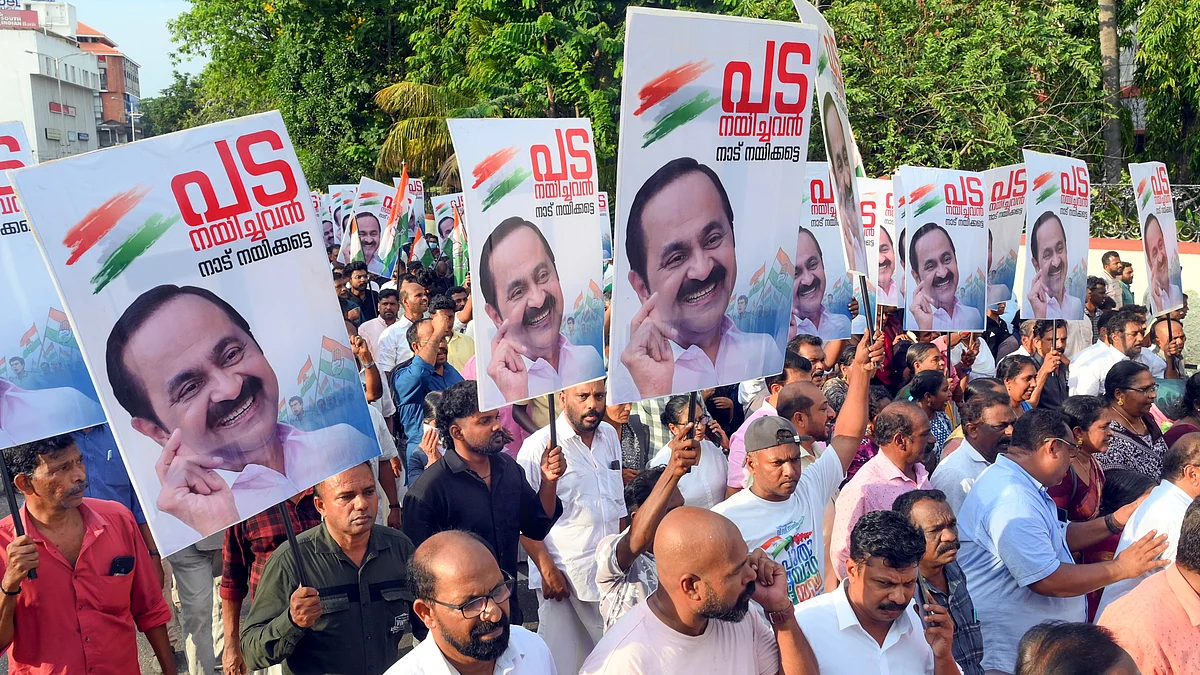


There was a time when Kerala’s political class feared uttering the words “lottery mafia” too loudly. The network was believed to be too wealthy, too politically connected and too deeply embedded within the system. By the mid-2000s, the interstate lottery business had grown into one of Kerala’s most shadowy underground economies, thriving on desperation, poverty and false hope.
Daily wage earners across villages, coastal settlements and working-class neighbourhoods spent precious earnings on lottery tickets sold through sprawling networks that critics alleged operated beyond effective regulation.
Allegations surfaced about fake Bhutan lottery tickets, forged printing systems, benami operations, tax evasion and money laundering linked to Tamil Nadu-based lottery baron Santiago Martin. Politicians spoke privately about the syndicate’s influence over sections of politics, media and the state machinery, but few were willing to confront it openly.
It was during this period that a young Congress MLA from Paravur, V.D. Satheesan, began relentlessly pursuing the issue inside the Kerala Assembly. Armed with documents, financial records and painstakingly collected evidence, Satheesan transformed what many considered a politically dangerous subject into one of Kerala’s defining public confrontations.
He alleged that the lottery business had evolved into an organised exploitation racket that preyed upon the poor while corrupting public institutions. He demanded investigations into fake Bhutan lottery operations, questioned the legality of interstate lottery mechanisms and repeatedly highlighted the nexus between business interests and politics.
Unexpectedly, Satheesan found an unlikely ally in Kerala’s then chief minister, V.S. Achuthanandan. Though ideological warmth across political lines was rare in Kerala, the veteran Marxist appeared to recognise in the young Congress legislator a seriousness that transcended party divisions.
Achuthanandan, who had built his own political career fighting entrenched interests, understood that Satheesan was not merely performing outrage for television cameras. He genuinely believed the lottery network represented a dangerous political and financial menace.
The relationship between the two remained politically adversarial, yet marked by unmistakable respect. Achuthanandan had already initiated strong action against illegal interstate lottery operations and supported investigations into alleged irregularities involving Bhutan lotteries and forged tickets. Satheesan’s interventions strengthened that campaign.
Political observers at the time described the anti-lottery movement as a rare bipartisan moral confrontation against organised financial exploitation — an unusual moment in Kerala’s deeply polarised political culture, where a communist chief minister and a Congress opposition MLA effectively reinforced each other’s battle.
Also Read: How the deep south was won
That confrontation altered Satheesan’s political trajectory permanently.
It transformed him from a promising legislator into one of Kerala’s most respected political figures, a leader whose credibility rested not merely on rhetoric but on preparation, persistence and legislative rigour.
Today, as Satheesan joins the ranks of Kerala chief ministers alongside leaders such as E.M.S. Namboodiripad, C. Achutha Menon, E.K. Nayanar, K. Karunakaran, Oommen Chandy and Achuthanandan himself, what distinguishes his journey is the absence of inevitability.
His rise did not follow the familiar route of dynastic inheritance, factional entitlement or organisational patronage. For years, Kerala politics described his career using the Malayalam expression 'between cup and lip', because power repeatedly appeared within reach only to slip away at the final moment.
To understand Satheesan’s political personality, one must return to the social and emotional landscape of his childhood. Born in 1964 in Nettoor near Kochi, he grew up in a middle-class family shaped by discipline, modesty and the values of education. His father worked in the public sector, while the family remained deeply connected to ordinary Kerala life, where social mobility depended heavily upon education, reading and hard work.
Unlike many future politicians who inherited visible political capital from influential families, Satheesan grew up without the aura of political privilege. What his upbringing offered instead was seriousness and aspiration.
Friends and contemporaries remember him as intensely curious, observant and deeply drawn to reading. He was interested not merely in electoral politics but in ideas themselves. Literature, constitutional debates, economics, political history and social theory attracted him early. That intellectual curiosity later became one of the defining characteristics of his public life. Even ideological rivals would eventually admit that Satheesan rarely entered a debate without studying every possible dimension of an issue.
His educational journey reflected that temperament. He studied at Sacred Heart College, Thevara, before pursuing a Master’s degree in Social Work from Rajagiri College. Later, he studied law and practised in the Kerala High Court.
The combination of social work training and legal education shaped his political approach significantly. Social work exposed him to questions of inequality, marginalisation and public policy, while legal training sharpened his argumentative precision and documentary discipline. Together, they produced a politician capable of combining emotional politics with constitutional and legal clarity.
Politics entered his life through student activism rather than privilege. During his years in the Kerala Students Union and later the NSUI, Satheesan developed a reputation not only as a fiery activist but also as a meticulous organiser. He became chairman of the Mahatma Gandhi University Union during 1986-87 and gradually emerged as one of the articulate young faces of Congress student politics in Kerala.
Those years shaped traits that still define him. One was discipline. Another was democratic instinct. Satheesan never evolved into the feudal-style Congress politician insulated by sycophancy and distance. Party workers often speak of his accessibility. Young leaders could disagree with him. Journalists could question him sharply. Grassroots workers could approach him directly.
Yet behind that accessibility lay strict expectations regarding preparation, seriousness and organisational discipline. He demanded hard work not only from himself but from those around him.
His personal life too remained relatively grounded despite his political ascent. Those close to him describe a family-oriented man deeply attached to his wife and daughter, someone who maintained emotional balance even during turbulent political phases. Friends often remark that his family environment helped preserve stability in a profession marked by insecurity, betrayal and exhaustion.
Unlike several Kerala politicians who consciously cultivate flamboyance, Satheesan’s public style remained restrained and understated.
Interestingly, his electoral journey began with defeat. He first contested from Paravur in 1996 and lost. But the setback neither embittered nor discouraged him. Five years later, he returned stronger, winning the constituency and eventually transforming it into one of the Congress party’s safest strongholds.
Across six consecutive victories, Satheesan steadily built the image of perhaps Kerala’s most research-driven MLA. His Assembly speeches drew attention not merely because they were aggressive but because they were layered with data, audit references, documentary evidence and legal scrutiny. He possessed a rare ability to simplify highly technical subjects for ordinary public understanding.
His interventions covered some of Kerala’s most difficult public questions. He repeatedly raised the suffering of Endosulfan victims in Kasaragod, foregrounding human tragedy rather than administrative language. He intervened forcefully on coastal erosion, fisherfolk rehabilitation, wetland destruction and hill cutting. Long before environmental politics became fashionable within mainstream parties, Satheesan had already begun framing ecology as a democratic and livelihood issue.
His opposition to the SilverLine semi-high-speed rail corridor became especially significant. Satheesan recognised early that the project was not merely about infrastructure but also about debt, ecology, displacement and democratic consent. He travelled extensively across affected regions, met families facing displacement and converted scattered anxieties into a broad political movement.
The anti-SilverLine campaign eventually became one of the defining struggles that helped revive the Congress-led Opposition after years of drift and demoralisation.
Yet throughout this rise, power inside the Congress repeatedly eluded him.
When the Congress-led UDF returned to office under Oommen Chandy in 2011, Satheesan was widely regarded as among the most deserving younger legislators for cabinet entry. But factional calculations, caste-community balancing and entrenched organisational structures denied him ministership. The episode became symbolic of his political journey: admired publicly, resisted internally.
For decades, Kerala Congress politics revolved around entrenched factions and delicate community equations. Satheesan never fully belonged to those traditional structures. His independence strengthened his public credibility but complicated his organisational prospects. Several senior leaders admired his intellect while simultaneously remaining wary of his bluntness and assertiveness.
Even his eventual elevation as Opposition Leader after the Congress defeat in 2021 came only after intense internal resistance. Senior leaders were reluctant to yield space to a younger generation. But once Satheesan assumed leadership, the emotional climate within the Congress changed rapidly.
He transformed the Opposition from a defensive coalition into an aggressive political force. Congress workers who had psychologically collapsed after repeated defeats suddenly rediscovered confidence and energy.
Well-known academic and political observer Prof. M.N. Karassery believes Satheesan’s democratic instinct distinguishes him from many contemporary politicians. “Kerala respects leaders who can take clear positions despite pressure,” Karassery says. “Satheesan earned hostility from influential communal and caste leaderships because he refused to reduce politics into appeasement management. That gave him moral legitimacy.”
Satheesan’s confrontations with influential social figures such as Sukumaran Nair, Vellappally Natesan and Kanthapuram A.P. Aboobacker Musliyar strengthened his image among younger voters seeking leaders willing to move beyond old identity vetoes.
His rise also cannot be understood without examining his complicated but ultimately important relationships with Congress organisational general-secretary K.C. Venugopal and senior colleague Ramesh Chennithala. Both were rivals at different moments. Both also became crucial to his eventual ascent.
Chennithala represented organisational continuity and grassroots networks. Venugopal represented national influence and Delhi access. Satheesan represented issue-based politics, public credibility and generational transition. The Congress ultimately needed all three. Their collective involvement helped deliver the UDF’s landslide victory in this election.
K.P. Noushad Ali, the newly elected Congress MLA from Ponnani and one of Satheesan’s strong supporters during the chief ministerial contest, believes workers identify emotionally with Satheesan’s struggles. “He never behaved like power was his birthright,” Noushad Ali says. “Even when repeatedly sidelined, he continued working with the same intensity. That resilience inspired younger Congress workers.”
Lakshmi Subhash, social activist and assistant professor at an aided college in Palakkad, sees in Satheesan a rare combination of intellect and empathy.
“Students and younger professionals connect with him because he reads seriously, studies deeply and prepares thoroughly. But he is also emotionally accessible. That combination is uncommon in contemporary politics.”
Congress leader Soya Joseph from Thrissur believes Satheesan restored emotional confidence within the party itself. “After repeated defeats, many workers had psychologically surrendered. Satheesan changed that mood completely. He convinced the party that survival itself required unity, clarity and fighting spirit.”
Perhaps that is the central meaning of Satheesan’s rise. He arrives at Kerala’s highest office not as a leader manufactured smoothly through patronage systems but as the product of a long political struggle shaped by exclusion, delay, resilience and recovery.
Like Achuthanandan before him, he discovered that political integrity can command respect even across ideological boundaries. Like Oommen Chandy, he cultivated accessibility. Like Achutha Menon, he developed a reputation for intellectual seriousness and administrative engagement.
But fundamentally, Satheesan’s authority emerged through legislative politics itself: through research, argument, democratic confrontation and relentless public engagement.
For a state that takes immense pride in political literacy, that may be the most significant aspect of his story.
K.A. Shaji is a South India–based journalist who has chronicled rural distress, caste and tribal realities, environmental struggles and development fault lines. More of his writing here
Join our official telegram channel (@nationalherald) and stay updated with the latest headlines