


A pariah in its own neighbourhood?
Ashok Swain on India’s dangerous isolation and its diplomatic encirclement by China
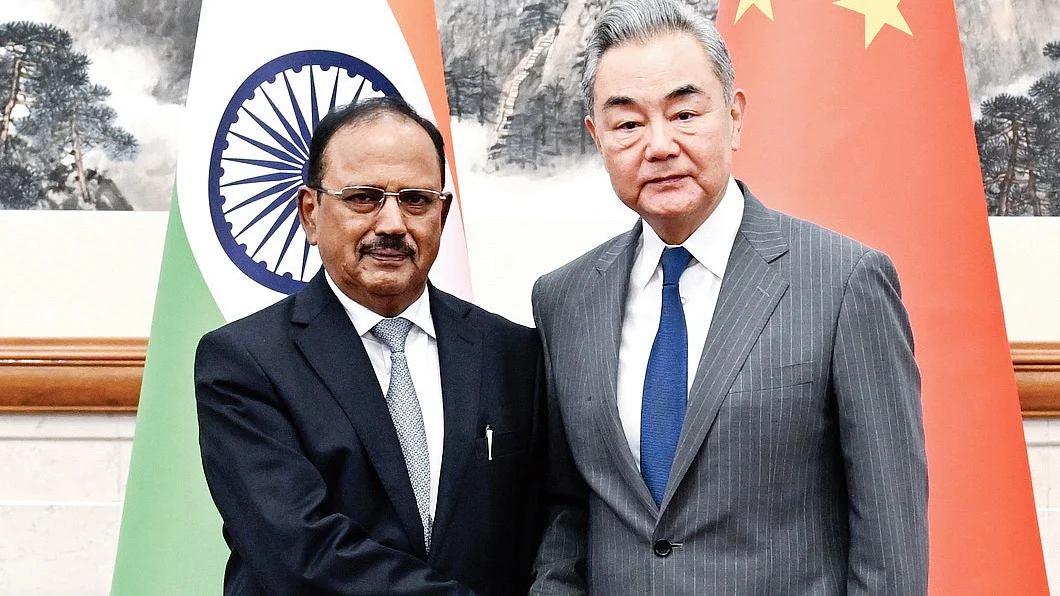


National security advisor Ajit Doval’s visit to Beijing to hold ‘boundary talks’ with Chinese foreign minister Wang Yi is diplomatic groundwork ahead of the upcoming BRICS summit in Delhi on 12-13 September. The summit will be a damp squib without President Xi Jinping and India doesn’t yet have a confirmation that he will attend.
Six years after China made coordinated incursions into Indian territory to reshape dynamics along the disputed Himalayan border, India has been trying to normalise relations while skirting the border issue, which makes a sorry international spectacle and exposes the failure of the Modi government’s China policy.
While the brag at home has been about Modi’s muscular leadership, India has been remarkably timid vis-à-vis China. After the Galwan clash in 2020 — during which China made new incursions in Galwan Valley, Pangong Tso and Gogra–Hot Springs in eastern Ladakh — Modi declared that nobody had entered Indian territory. The denial, a barefaced lie, weakened India’s case and gave Beijing political and diplomatic cover for its hostile action. China continues to pressure the frontier.
The rhetoric of self-reliance also stands exposed. India depends heavily on Chinese machinery, electronics and industrial inputs. The bilateral trade deficit was $112.16 billion in FY2025-26, and it is widening ($67.1 billion in the first half of calendar 2026.
India’s Operation Sindoor strikes in Pakistan in May 2025, after the Pahalgam terror attack on 22 April, revealed an even more dangerous reality — the operational character of the China–Pakistan partnership. Pakistan used Chinese aircraft, missiles and air defence systems. India’s deputy Army chief later said China had provided Pakistan with live inputs on important Indian positions. Beijing was quite openly supporting Pakistan even while officially maintaining diplomatic distance.
The two-front threat that India’s foreign policy was supposed to prevent has become vividly real. While Pakistan has gained better weapons, intelligence and diplomatic protection from China, the Indian government has been busy managing media headlines.
Also Read: An idiot’s guide to diplomacy
The danger of Chinese encirclement extends beyond Pakistan. China is now the largest trading partner of Pakistan, Bangladesh, Sri Lanka and the Maldives, while Nepal increasingly seeks Chinese investment and connectivity. Countries in India’s neighbourhood are increasingly counting on China for capital, infrastructure, markets and diplomatic leverage. Their predilection for China is also a verdict on India’s management of its neighbourhood.
Modi announced a ‘Neighbourhood First’ policy with great fanfare upon assuming office in 2014. Twelve years later, the neighbourhood seems to have slipped to the rock bottom of his government’s priorities. The current SOP seems to be to pressure less friendly governments and offer assistance when relations worsen. Smaller neighbours desire respect, sovereign space and a predictable policy framework; they do not like to be treated as dependents or punished when their choices displease India.
Bangladesh is the clearest example. Modi tied the relationship almost entirely to Sheikh Hasina, overlooking — if not appreciating — her authoritarian tendencies because she protected Indian security interests. When the 2024 uprising forced her to flee the country, India gave her refuge. Delhi mistrusted the interim government that replaced her. Newly elected Prime Minister Tarique Rahman initially sought better relations, but his India visit has stalled.
Dhaka was angered when Hasina addressed a press conference in New Delhi even as India was sitting on requests for her extradition. Border-fencing, forced deportations and anti-Bangladesh rhetoric from BJP leaders have deepened resentment. Rahman now insists on sovereign equality. Bangladesh is showing a new openness towards Pakistan even as it explores an expansion of ties with China, a corollary of which is India’s diminishing influence.
Nepal’s new Prime Minister Balen Shah is also resetting his country’s default settings. Shah has not visited India yet, and he avoided standalone meetings with foreign envoys for more than 100 days after taking office. Nepal is also seeking Chinese investments in agriculture, health, tourism and technology. Memories of the 2015 border blockade and Modi’s paternalism linger, and the current Indian government cannot expect history and geography to guarantee loyalty.
Also Read: Presiding over its own irrelevance
On to Sri Lanka. In 2025, Prime Minister Harini Amarasuriya visited China and India within days of each other. In Beijing, she praised Chinese support for Port City Colombo, a multi-services special economic zone in Colombo, Hambantota Port and other infrastructure. In Delhi, she spoke of India as a partner in education, technology and institutional reform. Sri Lanka’s ‘dual diplomacy’ is aimed at balancing strategic and economic ties between China and India, but China’s economic weight is increasingly shaping its choices.
The Mohamed Muizzu government in the Maldives, which came to power on the back of an ‘India-out’ campaign, has improved ties with China and its Parliament has approved the plan to join the Saudi-led Multinational Maritime Defense Alliance alongside Pakistan and Bangladesh. India is absent from this emerging security framework, another sign that Malé is building strategic options beyond Delhi.
China has acquired significant structural advantages in the last decade. Its economy is far larger and its financial resources and military power much greater. It can deliver large projects and sustain engagement with countries even as they go through political changes. Its foreign policy appears in sync with the reality of many smaller states in the region — Beijing speaks the language of sovereignty and non-interference.
On the other hand, the moves of the Modi government at home and its foreign policy choices have made China’s sales pitch more attractive to India’s neighbours.
The majoritarian agenda of the Modi government, its attacks on minorities, the attempts to forcibly deport alleged illegal immigrants in Bengal and Assam are watched closely in Bangladesh, the Maldives and elsewhere. The divisive rhetoric targeting Indian Muslims and the trope of framing Pakistan and Bangladesh as their havens has tarnished India’s image and narrowed diplomatic space.
The Doval delegation returned from Beijing on 25 August with some assurances on border management, but there is no confirmation yet that President Xi will grace the BRICS summit. Even if Xi turns up with a large delegation, it will still not alter the underlying balance of diplomatic power. China has learnt that it can pressure India in the Himalayas, profit from the Indian market, strengthen Pakistan’s military and deepen ties across South Asia at the same time. Modi’s foreign policy has helped China surround India strategically.
Ashok Swain is a professor of peace and conflict research at Uppsala University, Sweden. More by the author here
Join our official telegram channel (@nationalherald) and stay updated with the latest headlines