


Trade deal or death warrant?
Ashis Ray spells out the consequences of a one-sided trade deal with Trump’s America
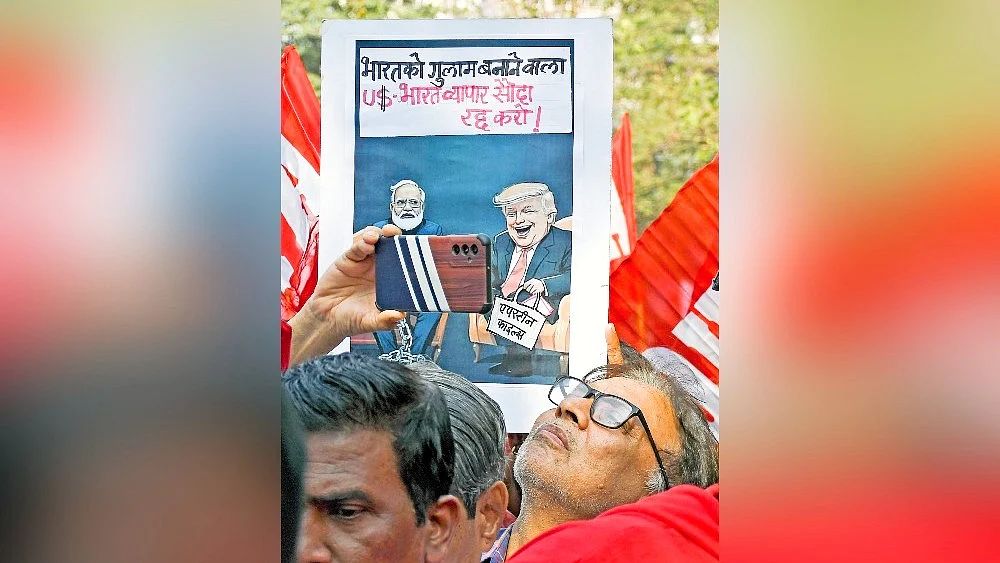


If a country secures an advantageous trade agreement with another, one might chuckle. However, if a distinguished scholar from the beneficiary issues a warning to the victim nation that the contract is a ‘death warrant’, it would be foolish not to take notice.
John Mearsheimer is an eminent American professor in political science and international relations at Chicago University. He described the recently announced framework for an interim trading arrangement between the United States and India as ‘a death warrant for a nation’s strategic autonomy signed by the hubris of a hegemon and the ruthless submission of a rising power. What we are actually watching is a massive superpower stripping away the core sovereignty of another state right in broad daylight… It is the complete and utter surrender of self-determination’.
He defined the pressure on India to buy $500 billion worth of goods and services from the US over five years as ‘a direct, violent siphoning of India’s industrial base and foreign exchange reserves… you have absolutely no choice but to strangle your own domestic producers, you destroy the very engine of national self-reliance, you turn your entire economy into a captive consumer market, utterly dependent on the supply chains of the stronger power’.
He continued, ‘This is not free trade, this is weaponised mercantilism designed to ensure permanent economic subordination… Washington has systematically broken the geopolitical spine of New Delhi’s foreign policy…. An India that abandons its neutrality to fall completely into America’s lap is an India that has lost its strategic flexibility.’
‘Meanwhile in Moscow,’ he added, ‘they are taking notes on a bitter lesson in betrayal. When you sever your energy lifeline with a massive military power just to appease a hegemon located halfway across the globe, you automatically turn yourself into a collateral target in their future strategic calculation. You isolate yourself on the world stage with the illusion of American protection; and if you think the surrender on the foreign policy front is not catastrophic enough, look at the geopolitical suicide happening right now inside India’s borders.’
Also Read: A trade deal and a $500 billion question
He did not stop here. ‘The White House document,’ he said, ‘sneaked in a seemingly innocuous clause: opening the market for American agricultural goods, specifically squeezing in the words “certain pulses”… in material reality those dried seeds of legumes are the foundation of dal, they are the primary source of protein for hundreds of millions of Indians in the national diet… they are the very lifeblood of tens of millions of farmers clinging to arid land… The small-scale Indian farmer cannot possibly compete with the massive agricultural conglomerates of the United States.’
He argued, ‘Any nation that forcibly anchors its security and economic policies to a single hegemon voluntarily surrendering its core strategic autonomy is simply writing its own death warrant. India is walking down the primrose path led by the false promises of Washington; and that path leads straight over a cliff.’
India’s foreign and trade policies are indeed in an extraordinary mess. It began with a fundamentally misguided abandonment of multi-alignment in favour of a tilt towards the United States after Narendra Modi seized power at the centre in 2014. This has now culminated in an all-round calamity.
India’s foreign policy was founded on a sound principle of Nehruvian non-alignment. The wartime unity of Allies — the United States, Britain, the Soviet Union and the French resistance to Nazi Germany — dissolved into a Cold War between the capitalist West and the communist East. Newly independent India wisely rejected getting sucked in to the cauldron of this unhealthy rivalry.
Countries like Pakistan sided with the West. India stood firm. Prime Minister Jawaharlal Nehru steadfastly maintained that India would not support the East or the West in the conflict between them. This was cast in stone as India’s basic position in external affairs.
Then came 1991 and the disintegration of the Soviet Union which had, since August 1971, been India’s staunch ally in the face of an antagonistic US, especially during India’s efforts to liberate East Pakistan, where the West Pakistani-dominated Pakistan armed forces were committing genocide. Ten to twelve million East Pakistanis had come to India as refugees.
The West, particularly Washington, couldn’t care less about India’s plight. New Delhi checkmated the intimidation of the US Navy — with Soviet assistance — and successfully transformed East Pakistan into a sovereign Bangladesh.
Years later, India, now under the prime ministership of P.V. Narasimha Rao, deftly adjusted to the inescapable new realities of a unipolar world by revising its policy of non-alignment to multi-alignment. Not getting involved in big power confrontations remained a pillar of the new pronouncement. But an endeavour towards an equitable engagement with all became the new mantra.
The Indian government’s landmark July 1991 budget, signalling curtains for the ‘licence raj’ and ushering in liberalisation, privatisation and globalisation, had already softened the US and its allies, who were generally uncooperative during the Cold War. India upgrading its relations with Israel to full diplomatic status in 1992 further disarmed Washington and western Europe.
Then came India’s 1993 Peace and Tranquillity Treaty with China, defrosting 31 years of a freeze in ties between the neighbours. This had in fact been preceded by an initiation in 1992 of a ‘Look East Policy’ intended to improve ties with ASEAN and East Asia.
Post-independent India, stewarded by Nehru, was at the forefront of opposition to apartheid rule in South Africa. It backed the multi-racial African National Congress’s quest for democracy, equality and freedom and stoutly refused to recognise the racist regime in Pretoria.
India unwaveringly adhered to this stance until South Africa’s white supremacists began dismantling segregation and subjugation in February 1990 and released ANC leader Nelson Mandela, who had suffered imprisonment for 27 years. In short, with India opening a high commission in Pretoria in 1994, implementation of its multi-alignment was fairly complete.
Between 2010 and 2014, suppliesfrom Russia comprised 72 per cent of India’s defence imports. In such a situation, Modi thoughtlessly fastened India to the US’s mast, thereby annoying a strategic partner Russia and converting the relationship with Moscow from one of relative trust to transaction.
There was no longer a guarantee that, if for instance India faced an awkward challenge on Kashmir at the United Nations Security Council, Russia would use its veto powers automatically to extricate India.
Indeed, a ‘reset’ (code for smoothening of troubled ties) summit was required in 2018 to assuage Russian President Vladimir Putin. In the same year, India placed a further order for S-400 missile delivery system batteries — a price extracted by Moscow.
The advent of Donald Trump 2.0 in January 2025 undoubtedly introduced an upheaval in world affairs. India was wholly unprepared for this. Modi and his ‘Man Friday’ at the foreign office Subrahmanyam Jaishankar fancifully dreamt of better times for India with Trump’s return to the White House. They never perceived that he did not like Modi, only tolerated him. The two are poles apart culturally, and no matter how much Modi is on the same page as Trump ideologically, the twain can never meet.
America’s trade deficit being a bugbear for Trump, India was his target. No amount of appeasement by Modi could change that. As a matter of fact, the timidity and weakness which Trump sized up in Modi, made him more contemptuous. Nations who have stood up to him, including neighbours Canada and Mexico, not to mention China, even Britain, have done better with damage control — forcing Trump to back off.
Trump’s hostility towards India is on a par with US President Richard Nixon’s in 1971. The former’s is ballistic economic warfare compared to the latter’s threat of using the US Navy’s Seventh Fleet to prevent India from giving birth to Bangladesh.
A combination of brilliant diplomacy on the part of then Prime Minister Indira Gandhi and her refusal to bend to Nixon’s coercion not only outwitted the US, but conjured for India its greatest military triumph.
In contrast, Modi’s capitulation before Trump could — as Meirsheimer put it — result in India paying a fatal price.
Ashis Ray was formerly editor-at-large of CNN. He is the author of The Trial that Shook Britain. More of his writing can be found here
Join our official telegram channel (@nationalherald) and stay updated with the latest headlines