


Is the RSS above the law?
Priyank Kharge’s letter to RSS chief Mohan Bhagwat is exactly on point, writes Shamsul Islam
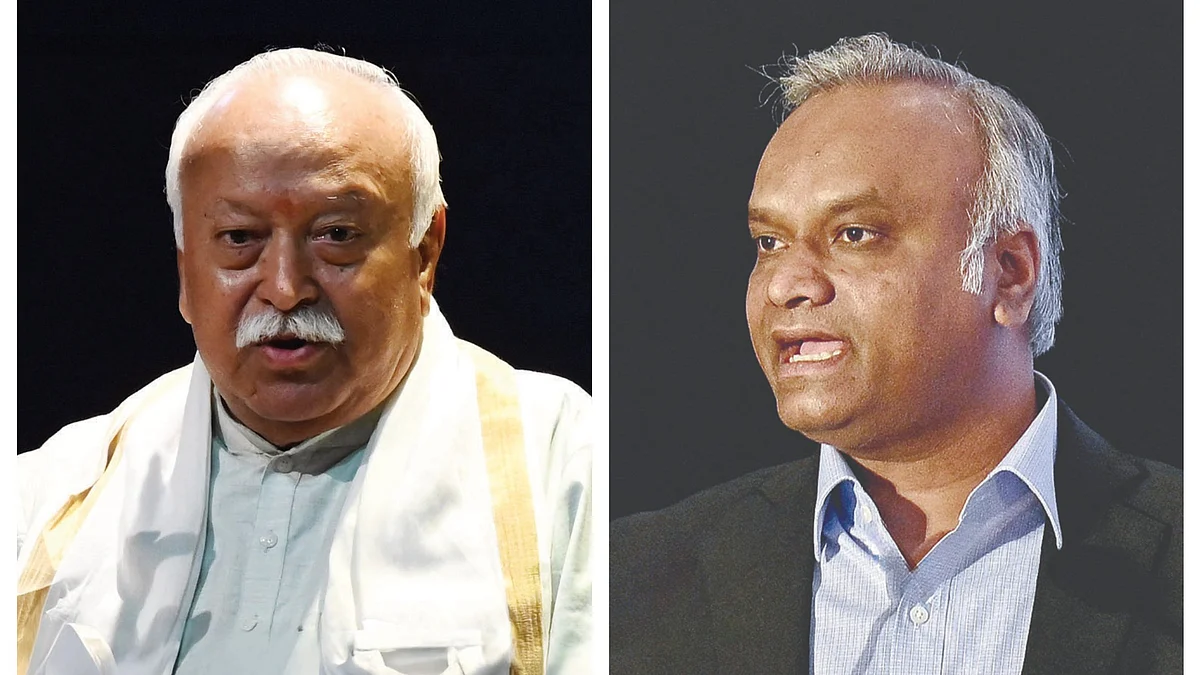


Karnataka home minister Priyank Kharge has decided to take the RSS bull by the horns. In a letter to Sangh chief Mohan Bhagwat dated 13 June 2026, he writes: ‘An organisation that regularly [invokes] nationalism, discipline and duty must also demonstrate these values through transparency, compliance and respect for the Constitution of India.
‘The RSS cannot ask ordinary Indians to follow rules while exempting itself from the same standards. If workers, small associations, religious institutions, NGOs, trusts, companies and citizens are expected to register, disclose, [face] audits and pay taxes, then the RSS too must set an example by abiding by the rules of the land.’
It’s a monumental decision to question the extra-constitutional powers the Sangh enjoys by demanding that it disclose its legal status, its sources of funds and most importantly, why it should be exempt from the laws of the land.
The RSS officially claims it has over 60,000 shakhas and crores of cadre across India and abroad. Kharge writes: ‘It is precisely because of this scale, influence and reach that the RSS must be held to the highest standards of transparency, accountability and constitutional compliance.’
Speaking at an RSS centenary outreach event in Kerala, Bhagwat dismissed the letter as a “political gimmick”, declared he did not “need to respond”, that “Hindu Dharma is not registered”, that many other entities function without formal registrations and other such equivocations. The RSS claims to be a ‘body of individuals’, not registered under any statute, as a society, trust, NGO, company or political party.
The RSS has always maintained the fiction of being a voluntary ‘cultural organisation’. As per an editorial in its English mouthpiece Organiser (6 February 2000): ‘The RSS is not a political party. … It does not take part in elections nor [are] its office bearers supposed to become office bearers of any political party. … It is a social-cultural organisation trying to inspire all national activity [sic].’
****
While it claims it to be a cultural organisation, the RSS worships weapons on its foundation day! This hydra-headed NGO has many many tentacles. Param Vaibhav Ke Path Par (The Road to Eternal Glory) by Sadanand D. Sapre, a title published in 1997 by Suruchi Prakashan, a big publisher of Sangh literature, details more than 40 affiliate and subsidiary organisations created by the RSS for different tasks (see full list above).
The BJP features prominently, alongside the ABVP (Akhil Bharatiya Vidyarthi Parishad), Hindu Jagran Manch, Vishva Hindu Parishad, Swadeshi Jagran Manch and Sanskar Bharti. It’s germane to remember that the current prime minister of India and nearly all Union ministers, BJP chief ministers and governors publicly declare themselves as RSS cadre. So much for being a ‘cultural organisation’.
Sapre’s book is quite a revelation and essential reading for anyone who wants to learn how the RSS functions. Its myriad satellites and subsidiaries are part of a cunning strategy to sow confusion about their activities. These front organisations also provide the RSS cover as well as room to dissociate itself when expedient. For instance, it used the Hindu Jagran Manch (HJM) to attack Christians in the late 1990s, and when the tide of public opinion turned against it, the RSS denied any ties with HJM.
Whenever the criminal activities of the VHP, Bajrang Dal or ABVP are exposed, the RSS declares them independent organisations.
****
Sapre writes that for the ‘Hindu awakening project’, forums like the HJM are active in 17 states under names like ‘Hindu Manch’ in Delhi, ‘Hindu Munnani’ in Tamil Nadu, ‘Hindu Ekjut’ in Maharashtra… These are forums, he writes, not associations or organisations, so no membership or registration or election of office-bearers is needed. [Param Vaibhav Ke Path Par, p.64]
It’s quite clear that this mafia-style set-up is designed to avoid legal/ administrative scrutiny, and working through these front organisations provides the RSS the cover it needs to distance itself from the occasional blowback when things get out of hand.
About a case in Delhi soon after Partition, Sapre writes: ‘Swayamsevaks posed as Musalmans to gain the confidence of the Delhi Muslim League to learn about their conspiracies.’ [Ibid, p.86]
What these swayamsevaks, impersonating Muslims on the eve of Independence, were doing was made clear by Dr. Rajendra Prasad, who later became the first President of the Indian republic.
In a letter to the first home minister of India, Sardar Vallabhbhai Patel, on 14 March 1948, Prasad wrote: ‘I am told that RSS people have a plan of creating trouble. They have got a number of men dressed as Muslims and looking like Muslims who are to create trouble with the Hindus by attacking them and thus inciting the Hindus. Similarly, there will be some Hindus among them who will attack Muslims and thus incite Muslims.
'The result of this kind of trouble amongst the Hindus and Muslims will be to create a conflagration.’ [Rajendra Prasad to Sardar Patel (14 March 1948), cited in Neerja Singh (Ed.), Nehru–Patel: Agreement Within Difference—Select Documents & Correspondences 1933-1950, NBT, Delhi, p.43].
****
Mohan Bhagwat says the RSS does not accept government funds. That’s a barefaced lie: they receive money not just from the Indian government but also international agencies like the World Bank. Last month (21-25 May), the Akhil Bharatiya Vanvasi Kalyan Ashram held a big all-India event in Delhi for which the RSS and the BJP government played hosts. (As reported in The Telegraph, 24 May 2026).
According to an investigative report in the Indian Express (18 May 2026), crores were siphoned off from the NSDF (National Sports Development Fund, which finances well-known sports missions like the Target Olympic Podium Scheme for elite athletes) to facilities for senior bureaucrats and two RSS-linked institutions in Rajasthan and Chhattisgarh.
Many similar cases do not come to light because the RSS is not registered and its finances are beyond the pale of scrutiny. The RSS does not have bank account/s despite collecting hundreds of crores of rupees from India and abroad and hiring lakhs of employees for its overt and covert activities.
Lalan Singh, a daily wage labourer from Nagpur and a true Indian patriot, has been knocking on the doors of the judiciary to get a simple answer — under what Indian rules are the RSS chief provided Z+ VVIP security and the RSS headquarters CISF protection that costs hundreds of crores of taxpayer rupees? This, for an unregistered ‘body of individuals’?!
Shamsul Islam is an author, academic and activist. More by the writer here
Join our official telegram channel (@nationalherald) and stay updated with the latest headlines