


It’s not simply ‘ethnic violence’
Nandita Haksar explains the persistence of violence in the northeastern state of Manipur
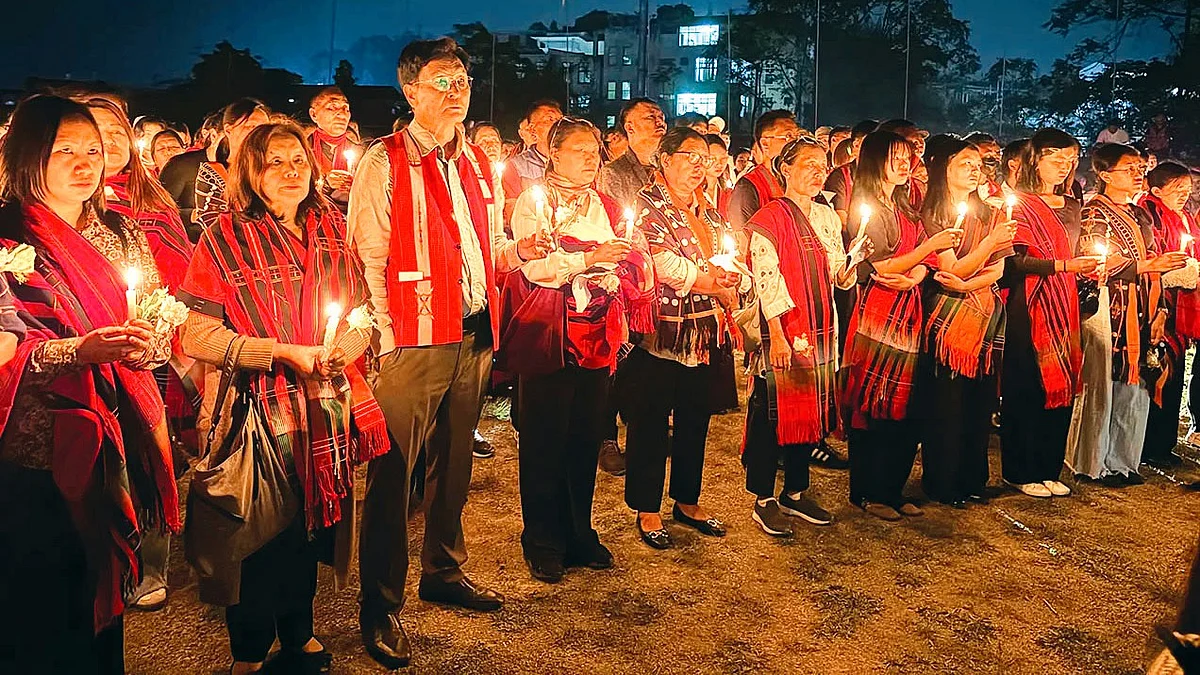


The violence in Manipur is escalating at an alarming rate. People are being killed, including children. Bomb attacks, firing and buffer zones with armed men guarding their communities. The Geneva-based Internal Displacement Monitoring Centre (IDMC) reported that violence in Manipur accounted for 97 per cent of displacements in South Asia in 2023.
Three years on, we are witnessing the spectre of more killings, more clashes and more displacements within the state.
On 18 April, a convoy of Nagas was travelling along the Imphal-Ukhrul road under escort. The escort had been provided after earlier attacks on Nagas in Ukhrul district. Shortly after the escort left, the convoy was attacked by Kuki militants; two Nagas died.
In its statement, the Tangkhul Naga Long, the apex body of the Tangkhul Naga tribe, described the incident as a “brutal and inhuman attack”, alleging that militants used long-range weapons and opened fire on multiple vehicles carrying women, children and sick persons just after the security personnel withdrew.
Civil society organisations in Tangkhul questioned the effectiveness of current security arrangements along the NH-202, stating that repeated attacks on civilians have eroded public confidence. They also pointed out that the incident occurred shortly after chief minister Yumnam Khemchand Singh visited Ukhrul and gave assurances that highway security would improve.
The Voice of Naga Youth has written to the prime minister demanding an enquiry into the alleged lack of neutrality of central security forces in Ukhrul and Kamjong districts.
****
Is this just another clash between two communities? In a way it is, but to look at these incidents simply as communal clashes between two communities is to miss the larger context in which violence continues unabated in Manipur.
One of the major local factors for the escalation of violence is the number of weapons still in the hands of militants, insurgents and vigilante groups. In 2023, there were reports of arms being looted from state armouries and police stations in the early months of the conflict.
Also Read: Managing conflict, not resolving it
While there were attempts to recover the arms, it was only when the state was under President’s Rule that a large number of these were recovered. These included looted weapons and weapons smuggled from across borders besides the longstanding stash of illegal arms in the state. This explains why counts of recovered weapons exceed the counts of looted weapons in later reports.
Media reports do not reflect the full extent of weapons available in Manipur with insurgent groups, village defence groups, community militia, armed volunteers, criminal groups and private individuals. Analysts highlight the availability of weapons looted from police armouries and the emergence of armed vigilante outfits (like Arambai Tenggol and Meitei Leepun) as security threats in and of themselves.
An inflow of weapons has been reported from Myanmar, where the Myanmar military (now a civilian government) is engaged in a bitter war with various armed ethnic groups who have links with insurgents in India.
The National Investigative Agency (NIA) recently arrested seven foreigners allegedly going to Myanmar to train the ethnic armed groups in drone warfare. The foreigners included six Ukrainians and one American. Not much is known about the Ukrainians but the American, VanDyke, has an interesting background.
According to Matthew Aaron VanDyke’s personal website, he participated in the Iraq War and Libya’s civil war. He is the founder of Washington-based consulting firm Sons of Liberty International, whose website says it ‘provides free security consulting and training services to vulnerable populations to enable them to defend themselves against terrorist and insurgent groups’. The company also ran operations in Ukraine between 2022 and 2023, when it provided training and advice to Ukraine’s military in using non-lethal equipment.
There are credible reports that China has interests in northeast India. For instance, analysis by the Daniel K. Inouye Asia-Pacific Center for Security Studies indicates that India fears China is using instability around Myanmar and Manipur to weaken India’s influence in the northeast and deepen its foothold in Myanmar. There are even reports that China is supplying arms to armed groups and providing refuge to some of the insurgents.
Manipur has no political leader who is respected by all communities. In the absence of an alternative politics, the communities are captives of their narrow identities and trapped in a deadly cycle of identity politics. This also means that they depend on their own armed groups to defend them in case of attacks and feel increasingly alienated from the state and its security forces.
There is no space for real discussion of the situation in Manipur because anyone seen as critical will be intimidated into silence. Armed groups can even turn on their own people if they perceive someone as a traitor who dares criticise his or her own community.
Complicating the already volatile situation is the presence of intelligence agencies and vested interests, both foreign and Indian. The Indian State has enough and more information from its intelligence agencies on both internal and external security threats. Why, then, is it not addressing the deep-rooted problems that have festered for so long? External actors can take advantage of Manipur’s fault lines.
We need to inform ourselves of the complex situation and then act, not in the interest of one community or another but for Manipur and for India.
The writer is a human rights lawyer and an author, most recently of Shooting the Sun: Why Manipur was Engulfed by Violence and the Government Remained Silent. More of her writings here
Join our official telegram channel (@nationalherald) and stay updated with the latest headlines