


Making room for the other’s faith
Media appetite for sensation has produced a landscape where right and wrong, trivial and consequential, all blur into shrill spectacle


The media’s appetite for sensation — and the nourishment it gets from social media — has produced a landscape where right and wrong, the trivial and the consequential all blur into shrill spectacle. Nothing can remain what it is; it must be turned into clickbait.
Our city Bareilly — usually known for its easygoing, peaceable temperament — hasn’t escaped this churn. For the past few days, a tiny village called Mohammadganj, near Bisharatganj, has been in the headlines. Both the mainstream media and what passes for ‘social’ media have plenty to say. This time, it’s about Friday prayers.
The incident dates back to 16 January. A few residents had gathered inside an empty house belonging to one Haseen Khan to offer Friday prayers. According to accounts, a man named Tejpal barged into the house, filmed the people praying, uploaded the video on social media, and complaints were then lodged with the police claiming that a makeshift madrasa was being run there.
Sub-inspector Anees Ahmed later identified the individuals from the video, registered a case against fifteen people, and arrested 12 of them. Those arrested were produced before the SDM in Aonla and released on bail.
Mohammadganj is a hamlet attached to Bhindaura village. Its population is under a thousand, and only twenty-odd households there are Muslim. People who have lived together here for generations may not know this, but it is astonishing that even the media’s seasoned operators seem unable to tell the difference between a place of worship and a school.
Television debates and newspaper reports are all busy peddling the same narrative: that an empty house was forcibly occupied and turned into a madrasa.
The campaign against madrasas in the state over the past few years has had a predictable effect on the public consciousness — madrasas are no longer seen as places of learning but as sites of suspicion and fear.
In Mohammadganj, the trail goes back a month, during the construction of Tariq’s house. On 21 December, a cart driver delivering bricks from a kiln asked for directions and said he had to drop the bricks “where the madrasa is being built”.
That stray remark was enough to set off murmurs in the village. Some residents took the matter to the SDM in Aonla. The very next day — 30 December — the SDM sent a ‘lekhpal’ and a law enforcement officer to inspect the site.
Tariq submitted a written statement saying he was constructing a hall to store livestock and fodder, not a madrasa. He also put it in writing that if the hall were ever used for any religious purpose in the future, he himself would be responsible for any legal consequences.
The village has seen this before. Thirty years ago, in 1995, a dispute arose over prayers being offered during the month of Ramzan on public land belonging to the gram sabha. After objections were raised, Shakeel Khan, Rehmat Khan, Sharafat Khan, Intezaar and others assured the villagers that prayers would not be held there after Eid. The matter was settled by mutual consent.
On 15 March that year, villagers submitted an application to the DM and SSP, stating that some people were still offering prayers — despite objections — on vacant gram sabha land. Appealing in the name of communal harmony, they requested that any new religious activity without permission be stopped.
Also Read: The end of secular pretence
That dispute from three decades ago was about the use of a public space. The recent incident, however, concerns what happens inside a private home. Haseen Khan’s sister-in-law even told the media that people had come to offer prayers with her consent.
The outcome of the 1995 compromise is that the village still has neither a temple nor a mosque. Imam Naushad says he has been leading Friday prayers for the past 22 years. Since Friday prayers are performed in a congregation, villagers have long sought permission to use someone’s vacant house. Permission was taken this time as well — though not by those who barged in to film the prayers.
Many people from my generation, and those younger, will still remember that if someone was travelling by road or train and a namazi happened to be among the passengers, they would rise when it was time for prayer, perform ablutions, spread a cloth in the narrow space between two berths, and sit down to pray.
Fellow passengers would draw in their limbs, sit patiently, and do everything possible to ensure the prayer was not disturbed. If the journey was on foot, a prayer mat would be spread under a tree or in an open patch, while others rested and waited for the prayer to end.
Often, under the same tree, one might find a vermillion-smeared stone, a few flowers and unlit lamps. This easy consideration was not reserved for a Khan sahib or a miyanji — if an elderly person sat fingering prayer beads, chanting softly during a journey, they too were treated with the same respect. Travel was one thing, a traveller’s faith was another.
This was normal behaviour, the social graces we were raised with. Perhaps this is the difference between social mores and political conditioning.
A few years ago, when controversies erupted in Delhi, Gurugram and elsewhere over prayers being offered in public spaces, it is worth remembering that Sikhs offered their gurdwaras, and many Hindus their homes, to those who needed a place to pray. This was not extraordinary — just an extension of a shared way of life.
In her documentary work The Many Lives of Syeda X, Neha Dixit records the story of the takeover of the only park in Shriram Colony, in Delhi’s Karawal Nagar area. That park had long been used for weddings, birthday celebrations, Ramlila performances during Dussehra, the burning of Ravana effigies — and during Ramzan and on Eid, for prayers by residents.
Some politicos found all this unbearable, and on Eid in 2015, decided to stage a large political event here. The message didn’t need spelling out.
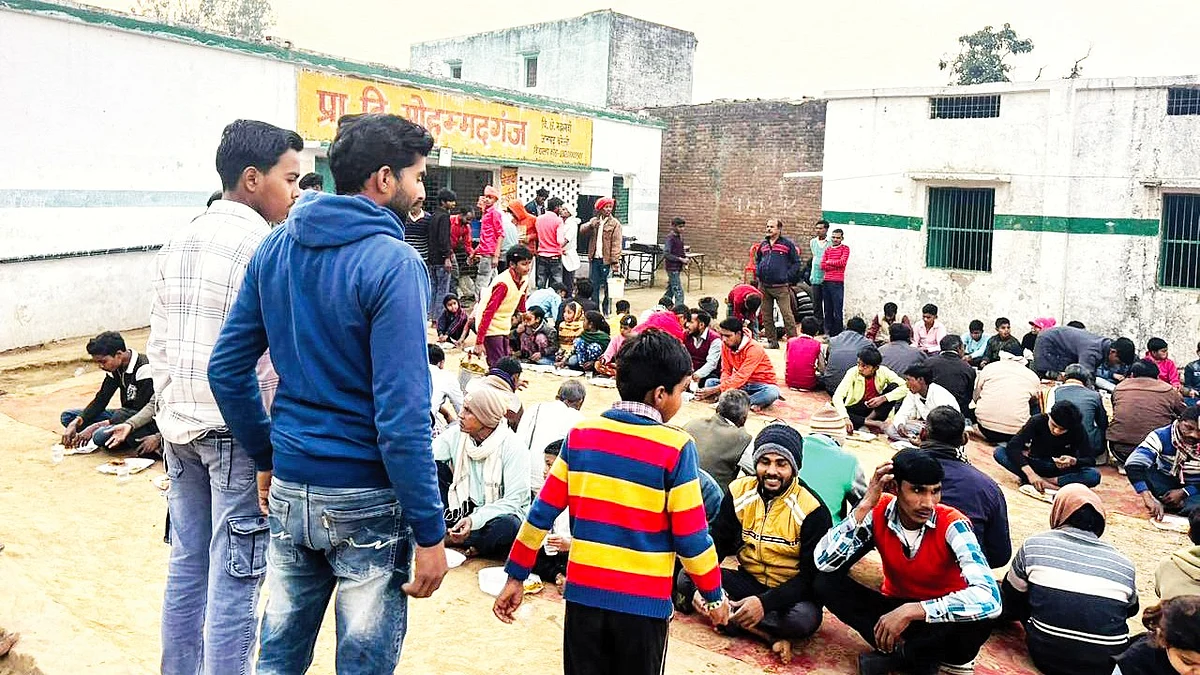
Mohammadganj village has no temple, no mosque, no madrasa — but it does have a primary school. On 21 January, tents were pitched on the school grounds, for an uninterrupted recitation of the Ramayana. After the reading concluded the next evening, a community feast was organised. Villagers and people from nearby areas gathered to partake of the prasad.
Dr Raghavendra Sharma, the BJP legislator from Bithari Chainpur, also attended the feast. Villagers met him to complain about sub-inspector Anees Ahmed, who was allegedly not taking action against those who had gathered to offer Friday prayers inside a house.
You be the judge, gentle reader, if that’s the real issue.
Join our official telegram channel (@nationalherald) and stay updated with the latest headlines