


Manmohan Singh’s legacy: quiet, principled leadership without spectacle
On his first death anniversary, we take a look at the former PM’s style of leadership which, in an era of image-driven politics, shows the difference between a small man and a bloated ego


The Narendra Modi government’s recent renaming of MGNREGA as ‘VB-G Ram G’ is yet another illustration of its linguistic sleight of hand. It illustrates a broader pattern of image-centric governance at odds with the institutionalist approach of former prime minister Manmohan Singh’s tenure. Over the past 11 years, the Modi administration has repeatedly rebranded key welfare schemes, often attaching his photograph and his party’s symbols to programmes originally launched without personal glorification under Singh’s leadership. The fact that this alteration of his most popular scheme has come just ahead of Singh’s first death anniversary on 26 December makes it even more striking.
To truly grasp the contrast between both prime ministers, one must look at another flagship initiative of the former. The Bharatiya Janaushadhi Yojana launched in 2008 to provide affordable medicines to citizens, introduced under the Ministry of Chemicals and Fertilizers, the scheme soon took shape, with Janaushadhi centres opening across the country. After Narendra Modi assumed office in 2014, this programme too became a target of similar manoeuvring. It was rechristened in 2014 as the ‘Pradhan Mantri Bharatiya Janaushadhi Pariyojana’, with a mandatory display of Modi’s photograph. It soon acquired the acronym ‘BJP’ and got a brand new saffron logo. What was conceived as a programme to serve public health needs has become a vehicle for enhancing the PM’s image.
The mandatory, and laudatory articles in newspapers and websites, and YouTube videos soon followed. In sharp contrast, you will struggle to find even one welfare scheme bearing the prefix ‘Prime Minister’ among those launched by the UPA. On last count, the names of more than two dozen schemes introduced under Manmohan Singh have been altered.
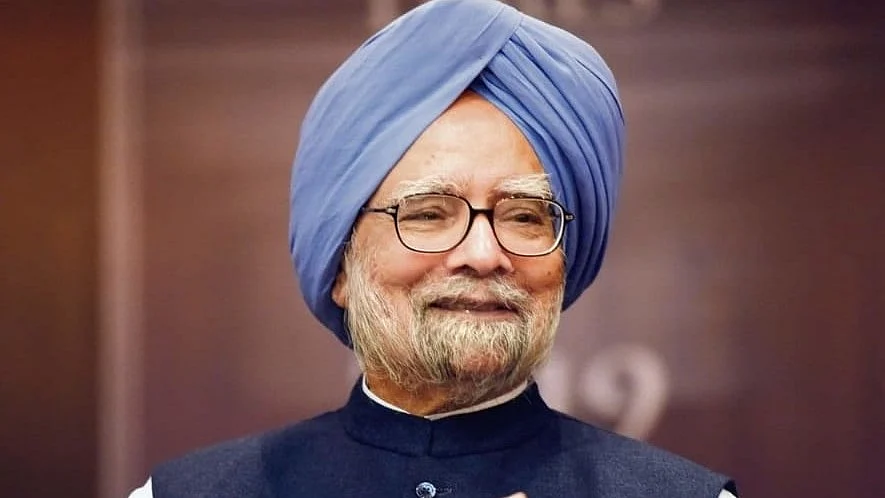
This was Manmohan Singh’s defining style of leadership: he never sought to project himself as indispensable or infallible. His hallmark was an emphasis on institutions over individual charisma, never attempting to place his persona above the system itself.
Singh once told his staff, “I am a small man in a big chair,”— underscoring how humility must always outweigh the authority of the office-holder. True wisdom in leadership, for him, was in recognising that power is a trust, not a trophy. Singh embodied a rare quiet authority, rooted in competence rather than theatrics. And the outcomes were not merely moral or institutional but also economic. India recorded an average GDP growth rate of around eight per cent during his years in office, touching an exceptional 10.08 per cent in 2010–11.
His tenure needs be assessed from another angle as well. During the global financial crisis of 2008, India emerged as one of the least affected economies with the government implementing a series of timely and calibrated measures to cushion the blow, but, receiving little public credit for this stewardship. However, in 2020, when the COVID-19 pandemic and prolonged lockdowns triggered a worldwide economic downturn, India was among the hardest hit. Yet, the government of the day was widely praised for handling the crisis.
Significantly, Singh’s inclusive development agenda embedded welfare within rights-based frameworks—a watershed in Indian policy. The Mahatma Gandhi National Rural Employment Guarantee Act (MGNREGA) enshrined the right to work; the Right to Education institutionalised education access; and the Right to Food ensured food security for millions.
These measures were not electoral gimmicks but principled initiatives affecting enduring change. Poverty rates dropped from 37.2 to 21.9 per cent during his term, a testament to these policies’ effectiveness. Alongside these, he strengthened democratic accountability by ushering in the Right to Information Act, a landmark step towards transparency in governance.
It is equally true that Singh did not monopolise. Left parties asserted that MGNREGA was implemented because of their pressure; civil society groups claimed ownership of the Right to Education Act; L.K. Advani argued that the groundwork for the Right to Information was laid during his tenure as Home Minister; and the Right to Food often attributed to a Supreme Court directive. Singh never contested any of these claims.
Unlike current leaders who chase headlines and thrive on instant applause, Singh was, at his core, a statesman guided by data and reason. His choices were anchored in academic discipline, empirical evidence, and a sober understanding of long-term consequences, rather than the allure of short-term populism.
As he once said, “The future belongs to those who believe in the beauty of their dreams.” Manmohan Singh not only believed in those dreams he patiently built the foundations on which India’s aspirations could stand. Advani argued that the groundwork for the Right to Information was laid during his tenure as Home Minister; and the Right to Food often attributed to a Supreme Court directive. Singh never contested any of these claims.
Unlike current leaders who chase headlines and thrive on instant applause, Singh was, at his core, a statesman guided by data and reason. His choices were anchored in academic discipline, empirical evidence, and a sober understanding of long-term consequences, rather than the allure of short-term populism.
As he once said, “The future belongs to those who believe in the beauty of their dreams.” Manmohan Singh not only believed in those dreams—he patiently built the foundations on which India’s aspirations could stand.
Join our official telegram channel (@nationalherald) and stay updated with the latest headlines