


Nobody believes in dialogue, except screenplay writers
Ruling parties are wont to forget that people may give up the vigil, but hold on to the fury and the pain


Democracy and dialogue are married by definition and divorced by intention. Any ruling party at first ignores dissent, as if that does not and should not exist in this best of all possible regimes.
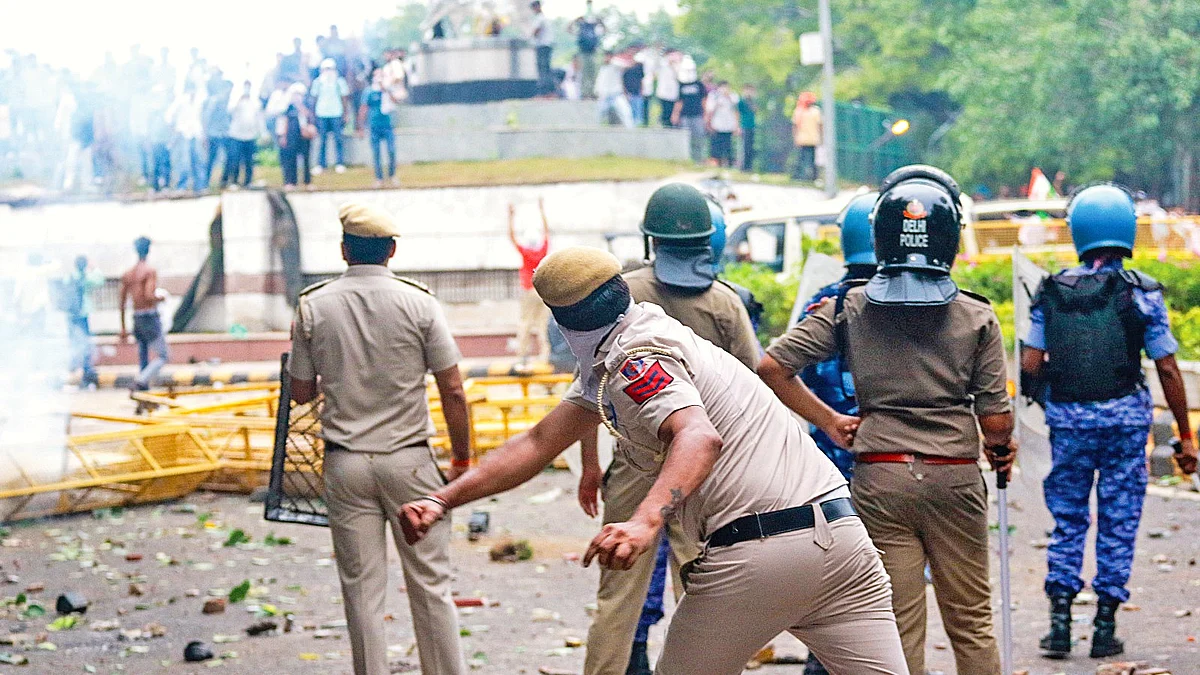
Then, as the number of dissenters swells, as the marches get bigger and the protesters louder, when it becomes impossible to ignore nationwide support for a movement, the regime has a Eureka-moment: “Let’s beat them to a pulp!” The police are supplied with ample tear gas and water cannons, and a heavily one-sided lathi-charged fight unfolds on the streets — and on screens.
When scenes of a government torturing its own people ripple across mobiles and media the regime hasn’t been able to gag, when a collective horror ripples through the nation seeing the bloodied heads and scarred skin of peaceful protesters, the eminences in the ruling party realise: “Oops, this doesn’t bode well for future votes!”
Only then does it consider having a dialogue, a civilised conversation about grievances and policies. What should have been the first step in a civilised society comes last, and that too only when pushed into a corner.
Most of us have a fuzzy idea of democracy. Ruling parties throughout India seem to think that democracy is just autocracy decided by votes. They think of themselves as kings, entitled to absolute power.
Kings dictate, dominate, decree — why should they listen? And a party that gets to rule for a long period starts believing it has been appointed dictator-for-life, that it has the right not to listen, not to consider, not to learn, not to introspect — ever. It begins to run on infinite arrogance, muscle power, IT-cell generated memes, and a never-ending supply of bulldozers.
What happens when it encounters young, honest, fearless faces demanding answers to important questions? It barks through mega-phones that the entire movement is sponsored by another country or even another planet. It pushes the idea that the government is syno-nymous with the nation, that anybody who rises against the government is therefore anti-national.
But Gen Z is sharp, articulate, reflective and prepared. Patiently, logically it makes its case. Slowly but surely people begin to distinguish between propaganda and common sense. Because the callousness of the government towards students driven to suicide by paper leaks has not gone unobserved.
Gen Z toppled the government in Nepal. Street protests in Ukraine forced Zelenskyy to fire his top general Syrskyi. Will our Indian cockroaches — nourished by the sympathy and support of common people coming forward with food, water, medication — win this match? Will the government realise that in a democracy it is not a favour to grant dissenters an audience — it is a responsibility?
Will this protest kindle others against this government — against its communal rhetoric, its habit of leaving dissidents to rot in jail on the whiff of a suspicion?
We do not know and we cannot say. Yet.
In India, things have a tendency to fizzle out. A movement that is led and backed not by a political party but by ordinary people has a high probability of not producing extraordinary results, however passionate and vigorous it might be. Time waits for no one. But for the powers-that-be, time can be made to slow down. Rulers can sit on a decision for months, but people cannot protest for months on end.
They have colleges to attend, offices to report to, homes to run, families to feed. The intensity that burns in the short run starts flickering in the long run, and that’s the opportunity governments play for.
But what they tend to ignore are the seeds that scatter and invariably bloom. In West Bengal, the movement against the rape and murder of a lady doctor in R.G. Kar Hospital spread like wildfire but lost its steam after a few months. The government thought it was over, until the election results two years later, where the anger exploded. People give up the vigil, but hold on to the fury and the pain.
Each movement has its visible footprint, which in this digital age manifests through millions of photos, comments, shares, likes, reels. These come back to haunt the rulers. Equally, each movement has its abstract footprint, one that unmasks authority’s apathetic attitudes and undemocratic beliefs and sets in motion a chain of unstoppable questions.
The answers usually blow in the wind, and are not hard to catch.
Chandril Bhattacharya is a lyricist, poet, essayist and filmmaker from Kolkata
Join our official telegram channel (@nationalherald) and stay updated with the latest headlines