


Syama Prasad Mookerjee: selfless patriot or spineless collaborator?
Shamsul Islam raids RSS and Hindu Mahasabha archives in search of an answer
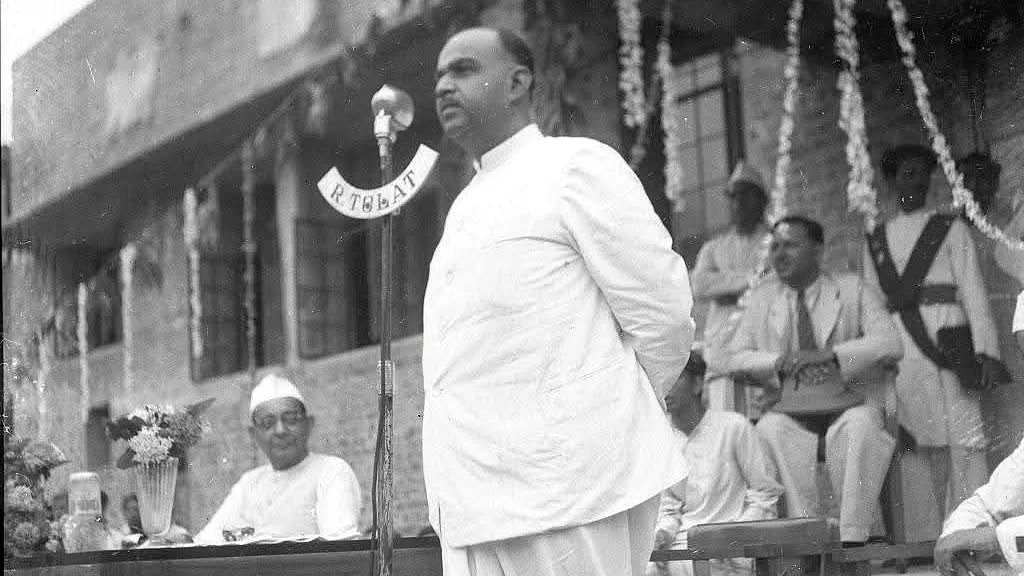


Celebrating his party’s victory in the West Bengal Assembly elections at the BJP headquarters in New Delhi, Prime Minister Narendra Modi declared, “the soul of Syama Prasad Mookerjee must be at peace today”. Modi has often described him as “a statesman, thinker and patriot who devoted his life to strengthening national integration”.
Dr Syama Prasad Mookerjee (1901-53) is a prominent Hindutva icon for the RSS/BJP brigade. It was Mookerjee who — on the advice of M.S. Golwalkar, the second chief of the RSS and its most prominent ideologue — founded the BJP’s forerunner the Bharatiya Jana Sangh (BJS) in 1951 and became the first president of the political arm of the RSS.
Hindutva rhetoric about Mookerjee’s patriotism needs to be cross-checked against contemporary documents available in RSS and Hindu Mahasabha archives. These documents clearly reveal that the claim of being a ‘selfless patriot’ is a white lie. Mookerjee never participated in the freedom struggle. Not only did he stay away from it, he betrayed it — by collaborating with the British Empire and the Muslim League to crush and communally polarise our freedom movement.
Pre-Independence, Mookerjee was a prominent leader of the Hindu Mahasabha, led by Vinayak Damodar Savarkar. In 1942, when the Congress launched the Quit India Movement, the British unleashed a reign of terror. The Congress was banned, its provincial governments were dismissed, all of India was turned into a jail and thousands died in the action unleashed by the armed forces of both British and native rulers. The crime of many of those who were killed was that they dared to unfurl, or even carry, the tricolour.
Hindu nationalist organisations, namely the Hindu Mahasabha and RSS, along with the Muslim League — which had been demanding the partition of India since1940 — not only boycotted the Quit India Movement but also decided to support the British government in its repressive campaign. Hindu nationalists, under the leadership of Savarkar, even ran coalition governments with the Muslim League led by Mohammad Ali Jinnah.
In 1942, ‘Veer’ Savarkar joyously chronicled this ganging up in his presidential speech at the 24th session of the Hindu Mahasabha in Kanpur in 1942 with the following words: "In practical politics, the Mahasabha knows that we must advance through reasonable compromises. Witness the fact that only recently in Sind, the Sind-Hindu-Sabha on invitation had taken the responsibility of joining hands with the League itself in running Coalition Government.
"The case of Bengal is well known. Wild Leaguers whom even the Congress with all its submissiveness could not placate grew quite reasonably compromising and sociable as soon as they came in contact with the Hindu Mahasabha and the Coalition Government, under the premiership of Mr Fazlul Huq and the able lead of our esteemed Mahasabha leader Dr Syama Prasad Mookerji, functioned successfully for a year or so to the benefit of both the communities." [Savarkar, VD., Samagra Savarkar Vangmaya (Collected Works of Savarkar), Hindu Mahasabha, Poona, 1963, pp. 479-480]
Later, this coalition arrangement was extended to NWFP (Khyber Pakhtunkhwa, now in Pakistan). Mookerjee was deputy prime minister (those days, the chief minister was designated prime minister) and held the home portfolio which oversaw the crushing of the Quit India Movement.
Following the Hindu Mahasabha’s directive, Mookerjee assured the British masters of cooperation in a letter dated 26 July 1942. In an autobiographical work he confessed: ‘Let me now refer to the situation that may be created in the province as a result of any widespread movement launched by the Congress. Anybody, who during the war, plans to stir up mass feeling, resulting in internal disturbances or insecurity, must be resisted by any Government that may function for the time being.’ [Mookerjee, Shyama Prasad, Leaves from a Dairy, Oxford University Press, p. 179]
His letter to the Bengal governor saying that the Fazlul Haq-led government, along with its alliance partner the Hindu Mahasabha, had made concrete plans to quell the movement has to be read to be believed:
‘The question is how to combat this movement (Quit India) in Bengal? The administration of the province should be carried on in such a manner that in spite of the best efforts of the Congress, this movement will fail to take root in the province. It should be possible for us, especially responsible Ministers, to be able to tell the public that the freedom for which the Congress has started the movement, already belongs to the representatives of the people. In some spheres it might be limited during the emergency. Indian have to trust the British, not for the sake for Britain, not for any advantage that the British might gain, but for the maintenance of the defence and freedom of the province itself.’ [Cited in A G. Noorani, The RSS and the BJP: A Division of Labour, LeftWord Books, pp. 56–57]
Here was abashed glorification of foreign rule! Now consider the words of R.C. Majumdar, regarded as a true ‘Bhartiya’ historian by the Hindutva brigade: ‘Shyam (sic) Prasad ended the letter with a discussion of the mass movement organised by the Congress. He expressed the apprehension that the movement would create internal disorder and will endanger internal security during the war by exciting popular feeling and he opined that any government in power has to suppress it…’ [R.C. Majumdar, History of Modern Bengal, vol. 2, G. Bharadwaj & Co, Calcutta, p. 350]
The Hindu Mahasabha’s decision to betray the Quit India Movement resonated with the RSS. Golwalkar, the then chief, admitted: ‘In 1942, there was a strong sentiment in the hearts of many. At that time … Sangh vowed not to do anything directly… However, upheaval (uthal-puthal) in the minds of Sangh volunteers continued. Sangh is an organisation of inactive persons … many of our volunteers did talk like this...’ [Shri Guruji Samagar Darshan (The Collected Works of Golwalkar in Hindi), vol. IV, Bhartiya Vichar Sadhna, Nagpur, nd, p 40]
Nowhere in pre-Partition RSS literature do we find references to any work which the RSS might have done ‘indirectly’ for the Quit India Movement.
In an even more shocking development, Mookerjee’s Hindu Mahasabha decided to help the British in World War II. That was the time Subhash Chandra Bose, ‘Netaji’, was organising the INA (Azad Hind Fauj) in a military campaign to force the British out. The extent to which the Hindu Mahasabha was willing to help their British masters is clear from the following directive issued by Savarkar as president of the Mahasabha:
‘So far as India’s defence is concerned, Hindudom must ally unhesitatingly, in a spirit of responsive cooperation, with the war effort of the Indian government in so far as it is consistent with the Hindu interests, by joining the Army, Navy and the Aerial forces in as large a number as possible … Hindu Mahasabhaites must, therefore, rouse Hindus especially in the provinces of Bengal and Assam … without losing a single minute.’ [V.D. Savarkar, Samagra Savarkar Vangmaya: Hindu Rashtra Darshan, vol. 6, Maharashtra Prantik Hindusabha, Poona, 1963, p. 460]
If we are to go by the definitions provided by our prime minister and the Hindutva brigade, a ‘patriot’ and ‘selfless freedom fighter’ must therefore be a stooge of the British, a collaborator with the Jinnah-led Muslim League and an organiser of the mass murders of those who participated in the Quit India Movement. All those who laid down their lives to win freedom from our colonial masters for the sake of all-inclusive democratic-secular ideal must have been fools!
Join our official telegram channel (@nationalherald) and stay updated with the latest headlines