


The deafening silence of ‘Vishwaguru’ India
The turn of events in West Asia has left prime minister Narendra Modi with very little to say, writes Yogendra Yadav
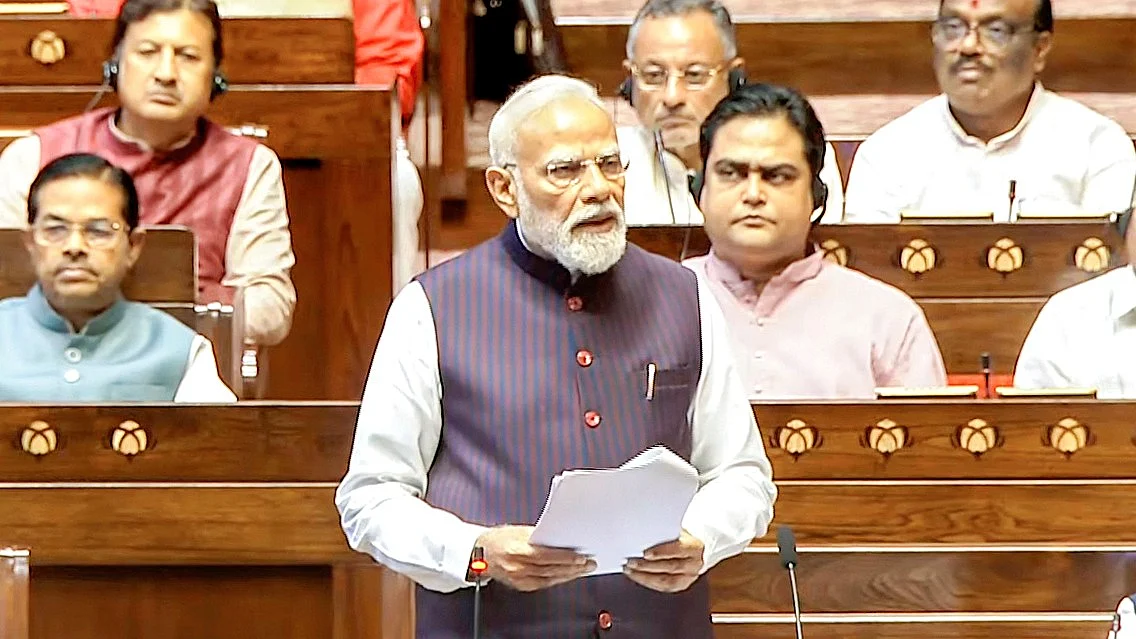


Whatever else he may be, this wasn’t the prime minister of a self-styled ‘Vishwaguru’ nation. Not the man who claims India’s drumbeat echoes across the world — or so his usual swagger may lead you to think. This didn’t even sound like a leader. Nor even a stage actor delivering punchlines.
If you heard the prime minister’s statement in Parliament on the West Asia crisis, you’d struggle to recognise him. Gone was the bluster, the bravado, the theatrical flourishes. This was a dull recital, marked by the anxiety to not deviate from the script — lest a word slip, lest a call come in from Washington.
No quips, no zingers. Even the ritual desk-thumping from the benches came in half-hearted taps, as if to tick a box. You could mistake this speech for a manager’s report or an accountant’s ledger. Or perhaps the backstage monologue of an actor written out of the script. It was not the address of a leader.
How could it be? The turn of events in West Asia has left the prime minister with very little to say. Despite all the eager deference to the United States, Donald Trump seems in no mood to indulge him. Even after bending the knee on a trade deal, India now finds itself under investigation. Word is that Washington has chosen Pakistan — not India — for mediation with Iran.
Two days before the war, the prime minister wore an Israeli medal around his neck; yet Israel has not found it necessary to even name him. Back home, a constituency may have been cultivated to embrace Israel with open arms, but in Israel, there is no comparable wave of affection for India.
Also Read: The meaning of energy sovereignty
India has made no new friends, and old ones have slipped away. Iran, which counted India among its partners for decades, now sees India in the rival camp. The fault does not lie with Iran. In his parliamentary address, the prime minister directed his criticism on Tehran, without naming it, expressing concern over attacks on commercial vessels and energy infrastructure. But he uttered not a word, directly or indirectly, on the unprovoked, unlawful strikes by the United States and Israel.
It is hardly surprising, then, that India initially did not feature among the countries permitted to move ships through the Strait of Hormuz. When the prime minister called the Iranian president on this matter, he reportedly got an earful on how India had behaved in this hour of crisis.
Russia, too, is cold-shouldering India, which had curtailed imports of Russian oil under US pressure. Now, when the Gulf crisis has forced India to turn to Russia once again, Moscow has ruled out ‘friendship rates’. A seventy-year-old relationship has gone cold.
Even beyond the battlefield, on the diplomatic stage, India is nowhere. When the world confronts a crisis, it looks for leadership. When Britain and France attacked Egypt over the Suez Canal, an India that was far weaker, economically and militarily, still found its voice. Prime Minister Jawaharlal Nehru spoke openly in support of Egypt, rallied global opinion against imperial aggression, and in doing so carved out a place for India as a moral leader.
Today, the world listens instead to the prime minister of Spain, looks t Brazil and South Africa, even applauds the prime minister of Sri Lanka. No one is looking to India.
When speaking is imperative but there is nothing to say, one resorts to circumlocution. That was the prime minister’s predicament too. Abstract invocations of humanity. Calls for peace without naming those who started the war. Hollow appeals to ‘all sides’ to de-escalate. Small claims about India’s sensitivity and vigilance in a global crisis — as if the country’s concerns now extend no further than the safety of Indians stranded in the Gulf and the availability of oil.
Even in laying out these details, the truth was rationed. We were told how much oil India has in reserve, but not that it would last barely a week. We were not told that China has built reserves for three months, while India has not secured even three weeks. Credit was claimed for blending ethanol into fuel, but there was no mention of who ran India’s public sector exploration giant ONGC into the ground.
When the world faces a grave crisis and a leader uses the nation’s highest forum to present petty gains in petty detail, it does not just diminish him; it lowers the head of the entire country.
Views are personal. More of Yogendra Yadav’s writing can be read here
Join our official telegram channel (@nationalherald) and stay updated with the latest headlines