


The government has a Wangchuk problem of its own making
Refusing accountability over NEET has turned a hunger strike into a larger battle over democracy, writes Aakar Patel
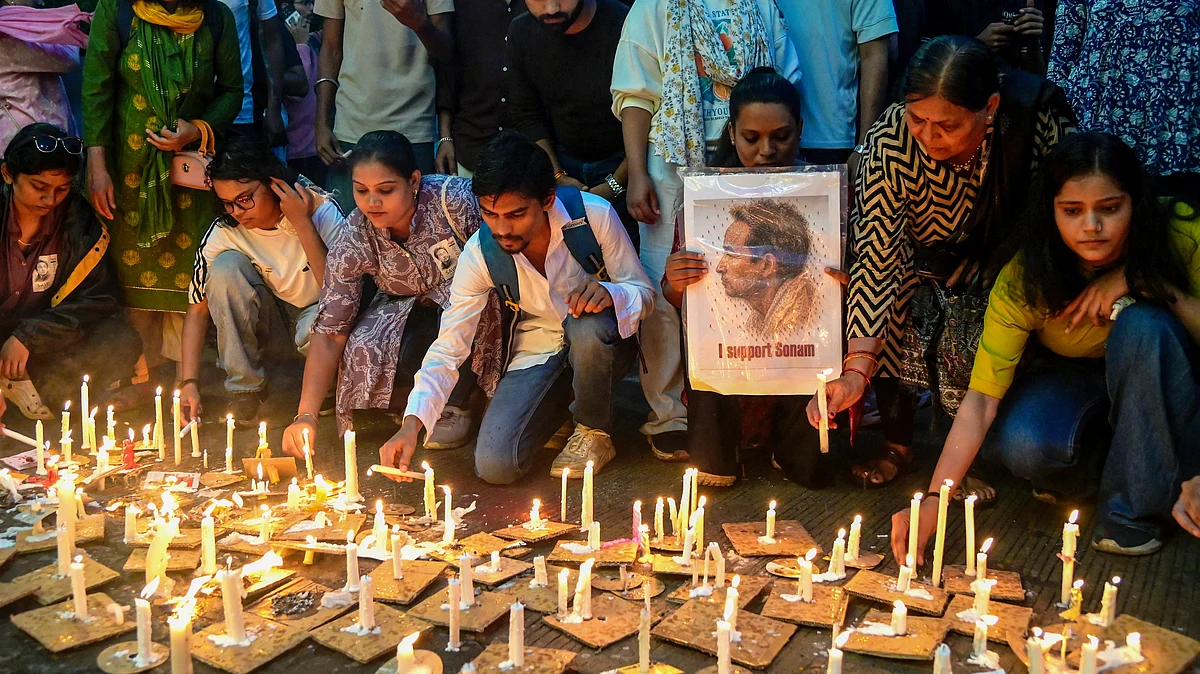


A few thoughts on the Cockroach Janata Party's protest come to mind.
The hunger strike by activists, including Sonam Wangchuk, had one demand: the minister of education should resign. Why? Because the minister failed at one of the most important tasks assigned to him: conducting the NEET examination without corruption. Readers may recall that in 2024, the paper leaked while the same minister was in charge, yet he remained in office.
This year, the government was compelled to admit there had been corruption in the process and cancelled the examination, inconveniencing 20 lakh students. Add their families and we are talking about nearly 1 crore Indians directly affected — all subjected to high levels of stress, anxiety and the insecurity that constantly plagues Indians.
At least 12 young girls and boys died by suicide in the 37 days between the cancelled examination and the retest. These are only the cases we know of. The government effectively conceded that the education ministry could not be trusted with the examination papers and entrusted their transportation to the Indian Air Force. We can interpret this either as a publicity stunt or as an acknowledgement of a genuine threat of paper leaks. Under neither interpretation does the government emerge looking good.
Having accepted that his education minister had failed to prevent corruption in NEET, the prime minister nevertheless rejected the idea of accountability. He chose to retain the education minister, and people can tell themselves stories about why.
Also Read: Has the hunger strike lost its moral charge?
Those who dislike the prime minister may speculate that autocrats shy away from admitting mistakes because of arrogance, or because doing so reflects poorly on them. Those who support him may construct their own explanations for why Narendra Modi retained Dharmendra Pradhan. Neither story is particularly important. The fact remains that Pradhan has been retained despite the scandal and despite demonstrable incompetence.
What happens from here is that he will remain a political liability and an easy target for criticism. India's problems of incompetence and corruption are real, structural and societal. Only the delusional believe that the prime minister waved them away with a magic wand in 2014.
The second thought that comes to mind is that protest, even when it is peaceful and inconveniences absolutely no one, is increasingly treated as unacceptable in India because we are only partly democratic. Several democracy indices have reached that conclusion, and evidence of it appears before us every day.
Over the years, the right to peaceful assembly under Article 19 has gone from being a fundamental right — one that enjoys a high degree of protection from state encroachment — to being treated as a nuisance, and then almost as an offence. The so-called mother of democracy is remarkably intolerant of her children when they disagree.
The judiciary and the executive have steadily narrowed the physical spaces in which peaceful protest may be held. In Mumbai, it is confined to Azad Maidan; in Bengaluru, to Freedom Park, where protests often go to die; and in Delhi, to Jantar Mantar. Indians have now been told that even protests in these designated spaces are unacceptable to this government.
The third thought is that when protesters possess both resolve and strategy, they often prevail and force governments to retreat. Farmers demonstrated this most dramatically when they laid siege over the farm laws. The prime minister tried to wait them out, failed, and eventually not only withdrew the laws but also apologised.
Also Read: True resistance comes from satyagraha
It is perhaps not viewed in quite the same way, but the protests against the National Register of Citizens are arguably the reason India does not yet have detention camps housing lakhs of people. Even in the most oppressive and authoritarian states, peaceful protest can leave an impact that cannot simply be bulldozed away. There is a reason the world remembers Tiananmen Square. Those brave enough to raise their heads above the parapet may suffer the consequences, but their stories are heard.
This, of course, is why the government moved to scuttle Wangchuk's hunger strike. Those who despaired that it was achieving little may have overlooked the fact that, structurally, the protest had much in its favour. It had public attention and it had public sympathy.
So what happens from here? The government's problem is that the protesters have left it with very little room for manoeuvre. The Cockroach Janata Party's demand is modest and reasonable: remove the minister responsible. The government's response, as far as it can be understood, is: yes, there is a problem, but no, we will not act. That is not a tenable position, and the protesters know it. The momentum is with them.
The final thought is that those who participate in these long, demanding protests acquire an education that those of us watching from the outside never will. Whatever the outcome, these young people will come away with a deeper understanding of the Indian government, the judiciary, the media, the police, the law and, indeed, Indian society itself. That understanding cannot be acquired from the outside, no matter how old, knowledgeable or wise we may believe ourselves to be.
Views are personal. More of Aakar Patel’s writing here
Join our official telegram channel (@nationalherald) and stay updated with the latest headlines