


Has the hunger strike lost its moral charge?
Shailendra Chauhan on the continued relevance of Gandhi’s tradition of nonviolent resistance in a changed India


The history of Indian democracy is not merely the history of elections. It is equally a history of dissent, resistance and moral intervention. Among the many political instruments that have shaped this history, one acquired unparalleled moral legitimacy: the fast.
Mahatma Gandhi transformed fasting from a simple act of abstaining from food into a means of cultivating inner strength, exerting moral pressure and shaping public opinion. Gandhi believed that no matter how powerful a government might be, if it were confronted by an unwavering commitment to truth and moral conviction, it would ultimately have to yield.
Three decades into the 21st century, a question presents itself with renewed urgency: has fasting as a political instrument lost its effectiveness?
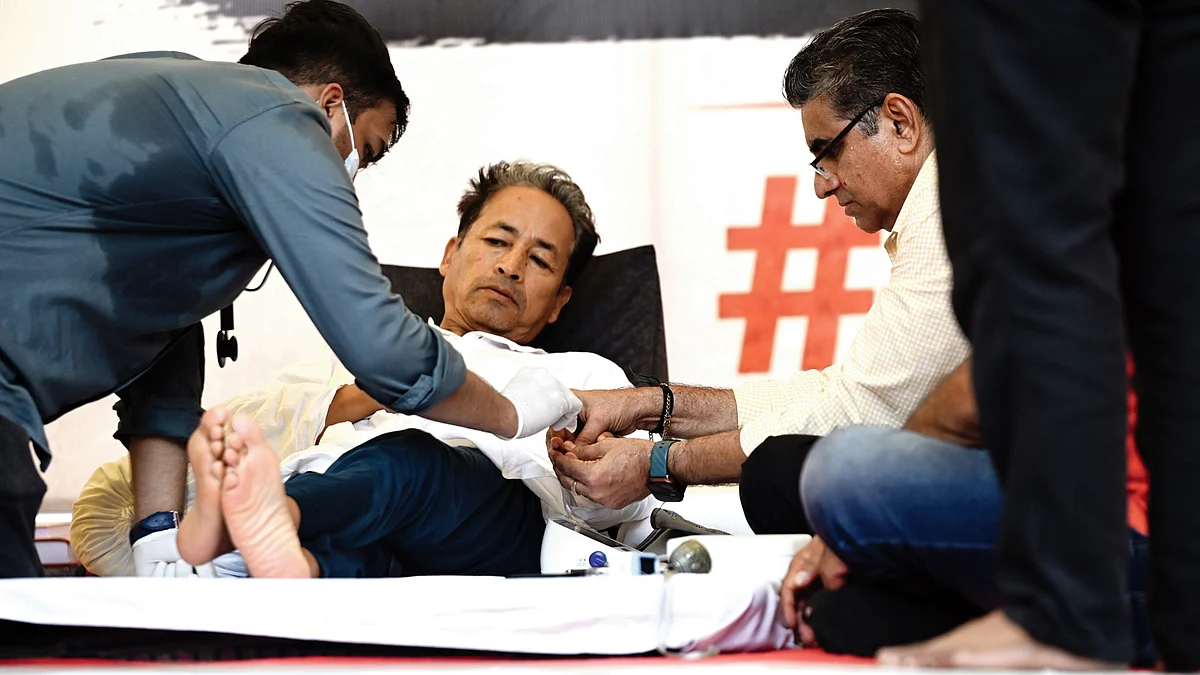
Sonam Wangchuk’s prolonged fast — first over Ladakh’s environmental concerns and constitutional rights and now seeking Dharmendra Pradhan’s resignation — the farmers’ movement, sit-ins by various civil society organisations and numerous local protests have revived a fundamental question: is today’s political establishment less responsive to moral pressure? Or has the very nature of democracy changed?
The answer lies not merely in the conduct of any particular government but in the broader political and social landscape.
During Gandhi’s time, fasting was effective because it was embedded within extensive public engagement, dialogue and moral credibility. Every fast Gandhi undertook was more than an act of personal asceticism; it was an appeal to the conscience of society. News of his fasts reached villages across the country, dominated newspaper headlines and influenced the British government. The British were colonial rulers, but they were not entirely insulated from the pressures of global politics, parliamentary scrutiny, the press and democratic criticism. They still felt compelled to demonstrate a degree of political legitimacy.
Today, the circumstances are markedly different. Democratic governments derive their legitimacy from electoral majorities. That confidence, rooted in electoral success, can sometimes foster the belief that winning elections represents the electorate’s ultimate and final endorsement. Consequently, voices raised on the streets are often viewed as expressions of limited interest groups, partisan opposition or temporary discontent. In such an environment, the moral force of fasting no longer carries the same weight it once did.
It would be inaccurate to suggest that this is a phenomenon unique to the present government. Governments across the political spectrum have generally responded to large-scale movements through a familiar sequence: first, a period of waiting, followed by administrative control and, eventually, limited dialogue. This trend is visible in democracies around the world. The modern state has become increasingly technocratic, security-obsessed and centralised. Administrative management has taken precedence over ethical persuasion.
It is equally true that many contemporary Indian social activists and public intellectuals have expressed concern that the State’s response to protests is harsher than it once was. Restrictions on demonstrations, prolonged delays in granting permissions, the detention of protesters, internet shutdowns and limitations imposed on movement in the name of security have intensified the debate over whether the public space available for dissent is steadily shrinking.
The government argues that maintaining law and order, preventing disruptions to public life and safeguarding national security are part of its constitutional responsibilities. For that reason, this debate resists simplistic or one-sided conclusions.
It is within this context that Sonam Wangchuk’s movement assumes particular significance. His campaign was not centred on a personal grievance but on the protection of Ladakh’s fragile environment and constitutional safeguards for the region.
The activist-educator then went on a fast seeking reforms in the education system. His fast has succeeded in drawing the attention of many citizens, yet it also underscores an important reality: moral appeals alone do not necessarily produce immediate policy changes.
Another significant change deserves attention. In Gandhi’s era, channels of communication were limited. A major fast naturally became national news. Today, society exists amid an overwhelming abundance of information. In an age of 24-hour news cycles and social media, each day brings new controversies, new campaigns, new public debates. Sustaining public attention around any one movement has become difficult. This crisis of visibility has also diminished the effectiveness of fasting as a form of political action.
A second major shift has occurred within civil society. During Gandhi’s time, the Indian National Congress functioned as a mass movement. Today, political parties, social organisations and citizens’ groups operate as distinct, often disconnected entities. The coordination that once existed among them is less evident. Consequently, it has become far more difficult for any single fast to embody the moral voice of society as a whole.
It is also worth recognising that the excessive use of fasting can weaken its moral authority. When every minor or major dispute culminates in a hunger strike, society gradually becomes desensitised. Gandhi himself regarded fasting as a moral measure of last resort, not an everyday political tactic. Its dignity rested precisely in its restrained and judicious use.
Does this mean that Gandhi’s philosophy of nonviolence has become irrelevant?
The answer is no.
Nonviolence is not synonymous with fasting alone. It encompasses dialogue, truth, public organisation, constructive action, moral courage and democratic pressure working in concert. Detached from these elements, fasting is reduced to little more than a symbolic abstention from food. Combined, it can still stir public conscience, even if its immediate impact is not readily visible.
History bears witness to the fact that many movements did not achieve immediate success, yet profoundly reshaped the politics of later generations.
The Chipko Movement, the Narmada Bachao Andolan, the struggle for the Right to Information and numerous environmental campaigns initially appeared ineffective. In time, however, they deeply influenced both public policy and collective consciousness. The success of a fast, therefore, cannot be judged solely by whether the government accepted its demands at that particular moment.
The true test of democracy lies in the responsibilities of both those who govern and those who resist. Governments must recognise that dissent is not the enemy of democracy but one of its essential conditions. Social movements must recognise that symbolic resistance alone is insufficient without moral credibility, evidence-based discourse and sustained public engagement.
What is needed today is not a mechanical imitation of Gandhi’s methods but a fresh understanding of the philosophical principles that animated them. Were Gandhi alive today, he would likely not rely on fasting alone. He would probably integrate digital platforms, public dialogue, environmental concerns, local self-governance and community organisation into a wider moral movement. His objective would not be the defeat of any particular government but the awakening of society’s collective conscience.
To declare that fasting has become entirely meaningless does justice neither to history nor to politics. A more accurate conclusion is that the social and political context in which fasting operates has fundamentally changed.
The greatest challenge before Indian democracy is whether it will continue to treat dissent as an administrative problem or begin to embrace it as one of democracy’s life-giving forces. The answer to that question will shape the future. If the space for moral voices continues to contract, not only will social movements suffer — democracy itself will become less responsive and less humane. But if both the State and society succeed in reviving a culture of dialogue, Gandhi’s philosophy of nonviolence will remain relevant, not simply as a historical memory, but as an indispensable foundation for the future of democracy.
Join our official telegram channel (@nationalherald) and stay updated with the latest headlines