


Beware the ‘Goldilocks’ mirage
The current moment should be read as a signal that the growth process is patchy — strong in some areas, weak in others, writes Ajit Ranade


The Union finance minister will present the Budget on 1 February against a macroeconomic backdrop that would be the envy of the world. India’s growth forecasts have been revised upwards by major institutions like the IMF. The quarterly GDP numbers also suggest an upward momentum. And consumer inflation has drifted to strikingly low levels, lower than even the RBI’s comfort band.
This combination of high growth and low inflation is a ‘sweet spot’ described as a ‘Goldilocks’ economy. The temptation is to conclude that macroeconomic management is fine and that the task of policy is simply to preserve the trajectory.
However, a closer examination suggests caution. Not because the headline numbers are ‘wrong’, but because they mask uneven, potentially reversible forces. The Budget should use this window not to relax but to strengthen foundations for robust development.
The first issue is to understand the current ‘low inflation’. In October 2025, inflation fell to 0.25 per cent, largely due to food price deflation, which moved from double-digit inflation in October 2024 to nearly -5 per cent. Food carries a heavy weight in the Consumer Price Index (CPI) basket and that’s why the latter is low. Yet ‘core’ inflation, excluding food and fuel, stubbornly hovers near 4 per cent. This low CPI inflation tells us more about agricultural price cycles and supply conditions than sustained deflation.
That is why the monetary policy debate has an unusual note of caution. One member of the RBI’s monetary policy committee recently argued that inflation that is ‘too low’ may not be healthy for a developing country, because it reflects slack in demand. This warning deserves attention for fiscal policy too. The sustained food price deflation may not last, and may well conceal distress rather than stability.
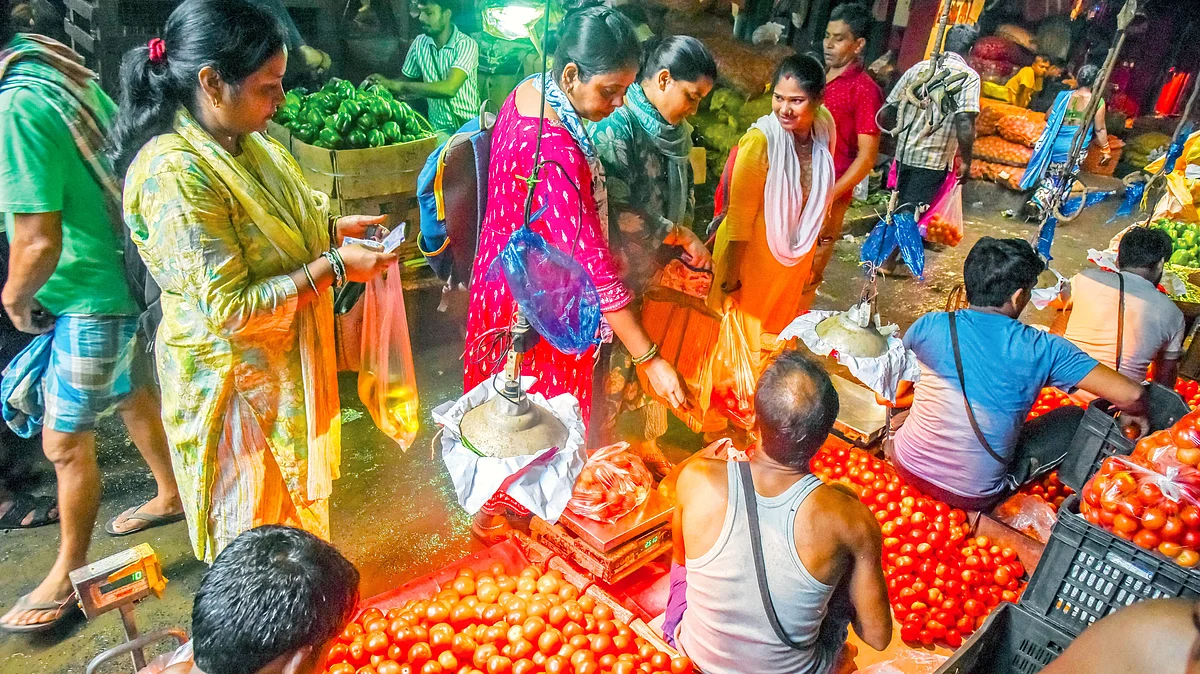
Food deflation, while suppressing inflation, can adversely affect farm incomes and rural wages. Low food inflation can therefore coexist with rural distress because food producers do not benefit as much.
Also Read: The death of a lifeline called NREGA
This becomes relevant for the Budget because the credibility of high growth depends on broad-based demand. If rural incomes and wages stagnate, consumption will remain fragile and dampen private investment. The current moment, therefore, should be read not simply as ‘macro stability achieved’, but as a possible signal that the growth process is uneven — strong in some segments, weak in others.
Data on rural wages is particularly concerning. Nominal rural wages have risen modestly, but real wages have been flat or negative for long periods — including before the Covid pandemic. During 2023–24, rising food inflation further eroded purchasing power, amplifying the stagnation.
Two factors underpin this trend: expanding rural labour supply, including increased female participation often driven by distress, and relatively capital-intensive growth that has not translated into proportional wage growth. Significantly, 57 per cent of employment under the rural employment guarantee scheme was taken up by women, pointing to distress-induced labour supplementation. The Budget must treat rural earnings as a core macro variable. Growth that bypasses these areas cannot sustain inclusive development.
A third concern is external — the rupee’s relative weakness and the latent risk of imported inflation. The rupee has depreciated even as CPI inflation remains near zero. The immediate question is why the pass-through has been muted.
Part of the answer lies in food deflation — a domestic phenomenon that has dominated the CPI story, and crude oil prices that have remained relatively steady.
But muted pass-through today does not guarantee muted pass-through tomorrow. Farm prices can turn quickly; and price pressures in metals and precious metals can seep into costs and inflation expectations.
When food inflation drops from a high positive to a negative, next year’s comparisons become more likely to show a rebound, which is a base effect. In addition, the CPI basket is scheduled for revision. The Budget’s macro assumptions should not be built around the expectation that 0–2 per cent inflation is a ‘new normal’.
Also Read: The quiet build-up of India’s household debt
Finally, there is nominal GDP growth. Exceptionally low inflation narrows the gap between real and nominal GDP growth. Tax revenues are linked to nominal growth, not real. If nominal GDP growth disappoints, revenue buoyancy weakens, adding pressure to government expenditure.
Given the growing welfare expectations, a shortfall in revenue can exacerbate fiscal deficits. Widening deficits, if unanticipated, risk fuelling inflation and currency depreciation, creating a vicious cycle policymakers want to avoid.
The Budget should hence be pragmatic and resilience building. First, construct macro assumptions that anticipate normalisation. Planning for a return toward 4 per cent inflation is safer than expecting persistently ultra-low inflation.
Second, treat rural earnings and employment-rich growth as central objectives. The Budget should emphasise interventions that raise earning capacity — rural infrastructure, irrigation and storage, value-chain development, rural non-farm clusters and MSME credit ecosystems — rather than treating rural stress as a welfare-only issue.
Third, public capex is still needed, but it should tilt toward job creating sectors such as housing, logistics, urban public services and decentralised energy.
Fourth, recognise that currency stability is partly a fiscal credibility function. Fifth, clear and precise public communication. Low inflation does not mean low cost of living. Many citizens facing stagnant wages and high lived costs will doubt official narratives unless policymakers acknowledge this disconnect honestly.
India’s current combination of strong real growth and very low inflation is unusual — and partly welcome. But it rests heavily on food price dynamics and favourable base effects, while the labour market — especially rural wages — continues to show strain. The rupee and commodity prices add external uncertainty; low nominal GDP growth further complicates fiscal arithmetic.
The finance minister’s challenge, therefore, is not to celebrate or to fear the moment, but to interpret it correctly. It is an opportunity to strengthen the conditions that make growth inclusive and durable — rising wages, broad-based consumption, steady investment, and credible fiscal assumptions, before the inflation cycle inevitably turns again.
Ajit Ranade is a noted economist. More of his writing may be found here
Article courtesy: The Billion Press
Join our official telegram channel (@nationalherald) and stay updated with the latest headlines