


When a river turns into a faultline
K.A. Shaji on the attempt to recast an ecological and administrative issue as a civilisational conflict
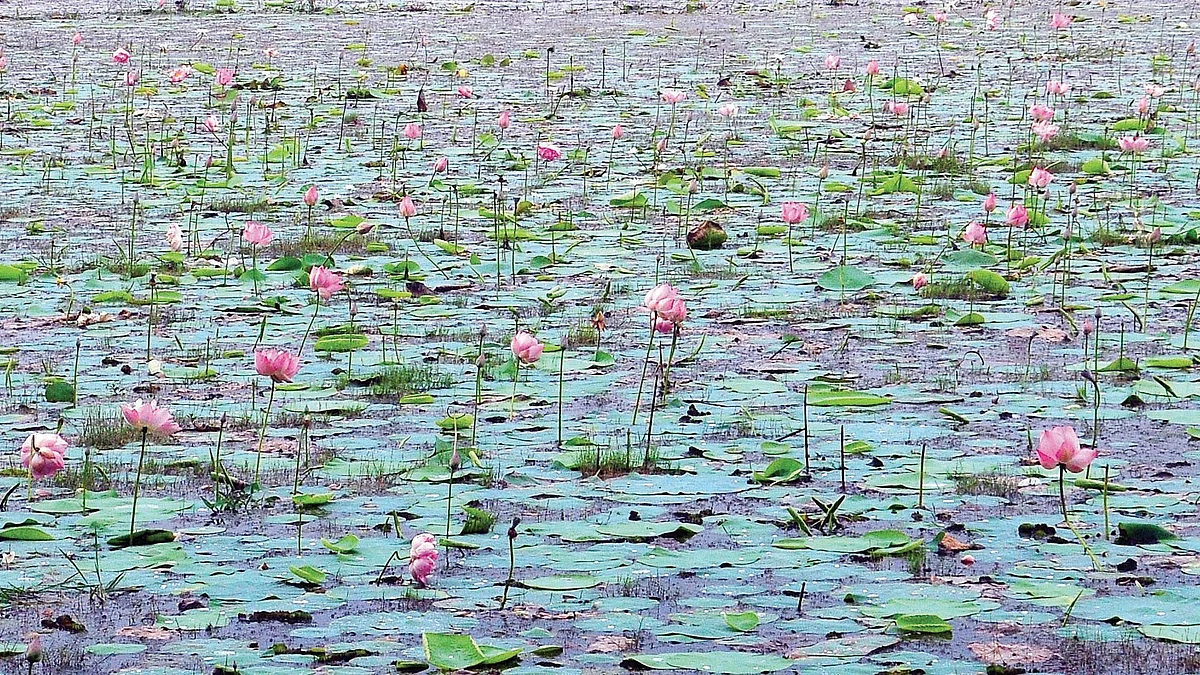


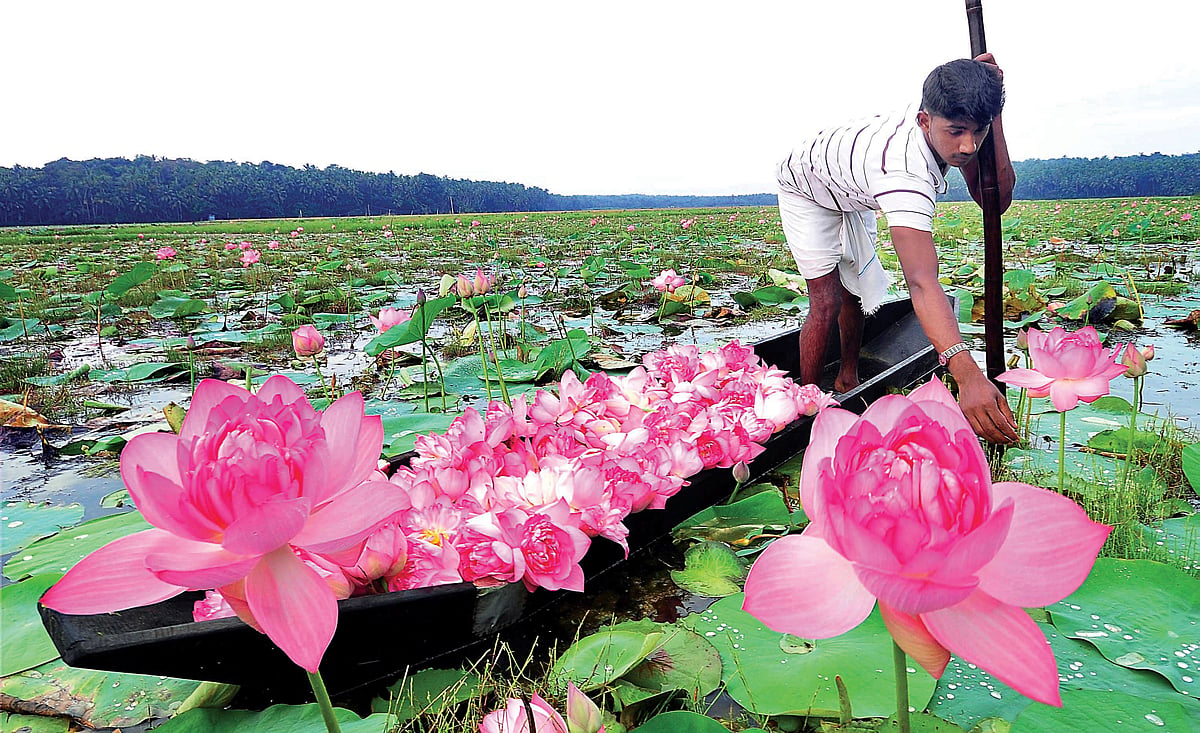
At dawn in Thirunavaya, before the Bharathapuzha stirs, Muslim lotus growers step quietly into the shallow ponds close to the river. Their movements are careful and practiced. Stems are cut, flowers gathered, mud washed away. By mid-morning, bundles of pink and white lotus are loaded onto autorickshaws and small trucks. They will travel to temples across Kerala—to Guruvayur, Sabarimala, Kodungallur—and also to several shrines in Tamil Nadu and Karnataka.
Traders here say that when Prime Minister Narendra Modi visited the Guruvayur temple two years ago, the lotus offered to the deity likely came from these very ponds in Thirunavaya. No drama here. No speeches about harmony. No statements on coexistence. The lotus simply moves from Muslim hands into Hindu ritual life, as it has for decades. This unremarkable continuity is the everyday reality of Thirunavaya. It is also the reality that sits awkwardly with the controversy that has now engulfed this riverside town.
The Maha Magha Mahotsavam (18 January to 3 February) in Thirunavaya was projected as Kerala’s first ‘Kumbh Mela’ by organisers and sections of the political class. Even before the first ritual bath was taken, the festival triggered a storm: an administrative stop memo was framed as proof of Hindu faith being threatened in Muslim majority Malappuram. Repeated often enough, the claim sounded plausible in distant television studios. On the ground, it quickly collapsed.
Thirunavaya is not an accidental venue. It occupies a distinctive place in Kerala’s cultural memory. Situated on the banks of the Bharathapuzha, also known as the Nila, it was once the site of Mamankam, a medieval assembly held every twelve years. Mamankam was not a ‘religious’ festival, in the narrow sense of the word. It was a grand convergence of ritual, commerce, politics and spectacle. Pilgrims, traders, poets and warriors from across South India gathered on the river’s wide sandbanks. The Bharathapuzha was the axis of this gathering. It did not divide communities. It brought them together.
By the late 18th century, Mamankam faded, disrupted by political upheaval and colonial intervention. But Thirunavaya did not lose its character as a place of convergence. Muslim and Christian settlements grew, shaping a town where shared spaces became the norm rather than the exception. The Navamukunda temple, one of the 108 Divya Desams of Vaishnavite tradition, continues to draw devotees.
Today, Thirunavaya’s social life reflects that layered history. Temple festivals depend heavily on Muslim percussionists, electricians and technicians. Many of the most sought-after chenda artists and fireworks experts are Muslim. Mosque renovations routinely employ Hindu labour. Church feasts spill into common streets and markets. These arrangements are not extraordinary, they are simply how life works here.
It is into this ecosystem that the Maha Magha Mahotsavam was introduced. Organisers of the festival called it a revival, a spiritual and cultural reawakening, an attempt to restore Thirunavaya to its historical prominence in the Hindu ritual calendar. Led by Swami Anandavanam Bharathi, a Mahaman daleshwar associated with the Juna Akhara, one of the oldest monastic orders in India, the programme included daily ritual baths on auspicious dates, yajnas and homams, spiritual discourses, cultural performances, community feeding and commemorative rituals linked to the Mamankam tradition.
The ambition was evident. By invoking the language and symbolism of the Kumbh, the organisers sought to place Thirunavaya on a national religious map dominated by North Indian pilgrimage sites.
In early January, a stop memo directed the organisers to halt construction work on the Bharathapuzha sand bed. This included the building of a temporary pedestrian bridge and ground-levelling by machines. Officials cited the absence of clear permissions, violation of river protection norms and concerns about public safety. The memo categorically applied only to construction activity on the riverbank. It did not prohibit the religious festival or ritual bathing. That distinction was quickly lost in the din.
No drama here. No speeches about harmony. No statements on coexistence. The lotus simply moves from Muslim hands into Hindu ritual life, as it has for decades
Senior BJP leader Kummanam Raja sekharan publicly criticised the stop memo, calling it illegal and a violation of religious freedom. He alleged a conspiracy to sabotage the event and demoralise devotees.
As the political temperature rose, Malappuram district collector V.R. Vinod stepped in to contain the situation. Subsequently, the administration granted conditional permission, subject to strict compliance with safety and environmental norms.
The collector issued a detailed 21-point safety directive. It mandated certification of the temporary bridge by competent agencies, limits on the number of people allowed on it at any given time, round the clock deployment of lifeguards, 24-hour medical teams, emergency evacuation plans, sanitation facilities and coordinated crowd management systems. The organising committee was made responsible for ensuring compliance.
What vanished from the debate was the river. Bharathapuzha is Kerala’s second longest river. It is also among the most degraded. Decades of sand mining, reduced flow due to upstream interventions, encroachments and pollution have left it ecologically vulnerable. Its wide, exposed sandbanks are symptoms of stress.
Environmental activists point out that mass gatherings on riverbeds pose real risks. Temporary structures can destabilise sand formations. Heavy footfall can accelerate erosion.
Waste generation can further pollute an already weakened river. These concerns apply regardless of whether the gathering is religious, political or commercial.
What gave the controversy a nasty edge was the way Malappuram entered the frame. As a Muslim-majority district, Malappuram has long been a convenient target for communal stereotyping. In this case, administrative action was quickly recast as evidence of Muslim opposition to a Hindu festival.
There is no factual basis for this claim. No Muslim organisation issued a statement opposing the festival. There were no protests, no formal objections, no mobilisation.
What did circulate were rumours— WhatsApp forwards and online posts alleging that Muslims were stopping Kerala’s Kumbh, that Malappuram was hostile to Hindu worship and concern for the river was ‘a Muslim plot’.
Mainstream Muslim organisations and leaders chose not to dignify the controversy with comments, recognising it as an externally manufactured furore.
Malappuram-based author and documentary filmmaker Shajahan Thoppil put it clearly: “Malappuram is a land of harmony and coexistence. No hate agenda can survive here. What is being projected has very little to do with the lived reality of this place.”
Examples of that lived reality are easy to find. In Angadipuram, home to the historic Thirumandhamkunnu temple, local Muslim communities have traditionally played a role in protecting temple processions, especially during periods of heightened communal tension elsewhere.
Such acts rarely attract attention because they disrupt the preferred narrative of conflict.
The political culture of the district has also played a role.
The Indian Union Muslim League, a major political force in Malappuram for decades, has consistently positioned itself as a stakeholder in communal peace, working to de-escalate sensitive moments.
During floods and other disasters, Malappuram has repeatedly demonstrated a capacity for collective response that cuts across religious lines.
Mosques have opened their halls as relief camps. Temples have run community kitchens. Churches have coordinated medical aid and rehabilitation.
At dawn, the lotus blooms still open quietly in the ponds of Thirunavaya. The Bharathapuzha flows on.
Long after the slogans fade and the social media storms move elsewhere, the river will remain.
So, one trusts, will the habits of coexistence it has nurtured.
Join our official telegram channel (@nationalherald) and stay updated with the latest headlines