


Who decides how Bengal celebrates Durga Puja?
What is happening in Bengal today is an attempt to force an alien culture, writes Dwaipayan Banerjee
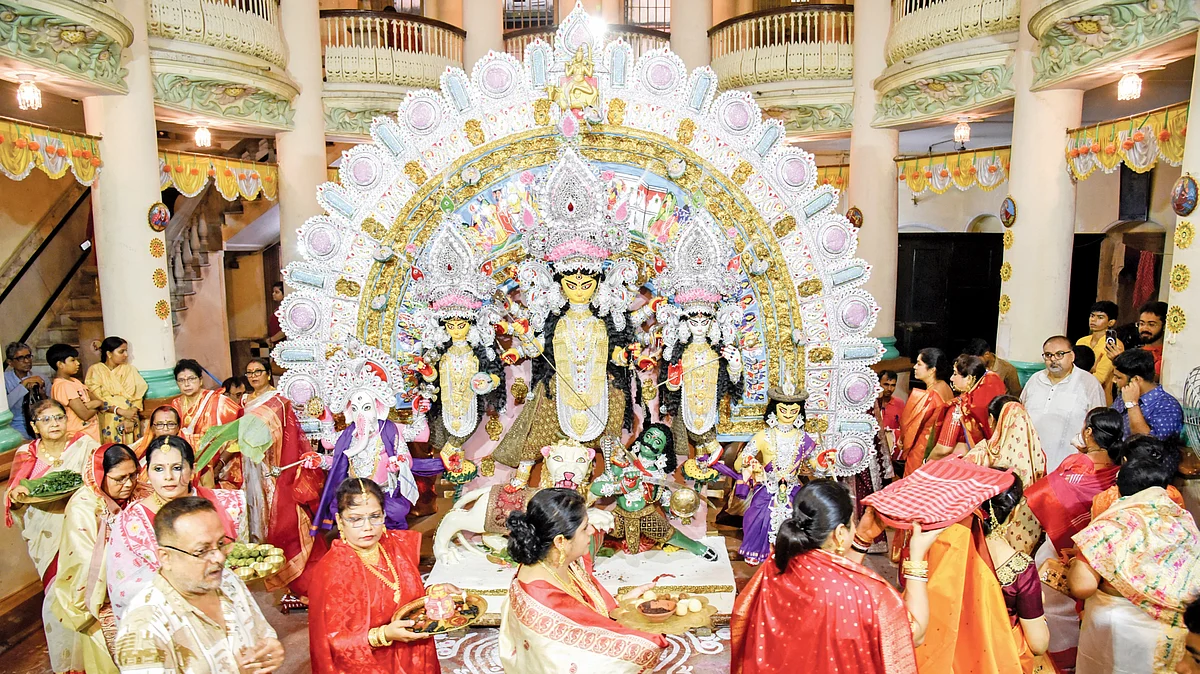


In early September, Dhirendra Krishna Shastri, a.k.a. Bageshwar Baba, the 30-year-old priest who presides over the Bageshwar Dham in Chhatarpur, Madhya Pradesh and is closely linked to the BJP, visited West Bengal.
The visit was a widely publicised affair. The chief minister and chief secretary went to meet him, paid obeisances, shared a meal and invited him to set up a temple in the state. However, Shastri created an uproar when he said, during a Hanumant Katha programme in Howrah, that Hindus who eat fish and meat during Durga Puja are pakhandi (hypocrites). “I am offended that during Navratri and Durga Puja, they make ganda khana (dirty food) behind the pandals,” he said.
The remark, predictably, provoked a storm. Social media filled with memes and gags, and Opposition parties were strident in their condemnation. In Bengal, consumption of fish and meat during the Puja is an old, living tradition. In many traditional homes, ancient temples and local community pujas, mutton and fish are offered to the goddess, within Shakta rituals, as prasad.
Most Bengali Brahmins from Smarta families, like their Maithil counterparts in neighbouring Bihar, have long been fish and meat eaters. (In north India, even Smarta families are mainly vegetarian.) The Ashtavimsatitattva (28 ritual digests) written by Raghunandan, a 16th-century contemporary of Chaitanya, is a uniquely Bengali reading of the Smriti-shastras, whose text is still followed by traditional families.
Raghunandan’s magnum opus makes space for ‘deshachara’ (regional custom/local tradition), which sanctions consumption and ritual offering of fish/meat in religious festivals including the Durgotsava, to which he dedicates one of his 28 digests, called the Durgotsava-tattva.
Of course, in Vaishnava households it was customary not to offer fish, and in some Vaishnava Banik (merchant/trader) households, Durga came not as a demon-slayer but with her husband Shiva by her side and their children in tow. No one thought they had to change for the others; they coexisted peacefully.
Shastri was not alone in making these demands. A few days earlier, Nirgunananda Brahmachari of the Vishwa Hindu Parishad said something similar. He complained that people enter pandals carrying non-veg food and asked organisers to ban such items in the pandal area.
The VHP also called on committees to adhere to shastric norms for idols rather than modern artistic interpretations, warning that pandals should not improvise in violation of the injunctions of the shastras. It insisted that organising committees should consist of Sanatani Hindus only, again targeting the popular local belief that religion is personal and festivals belong to everyone.
Book stalls and food stalls around the puja pandals are managed by committees of all faiths, especially in neighbourhoods with mixed populations.
Durga Puja is easily the biggest event on the socio-cultural calendar of West Bengal. People throng the pandals in their thousands, and for artists and artisans, this ‘sarbojanin’ (for all) festival is a showcase like no other. The idols, the pandals, the lighting are all their canvas, so to speak.
In recent years, they have found more patrons and encouragement. Artists and art students labour over their puja projects for months. Often their work has political overtones. The themes are varied: it could be the CAA-NRC protests, the genocide in Palestine, the farmers’ movement… but with a few exceptions, their political undertone is progressive and liberal.
The VHP call to refrain from taking artistic liberties is, then, likely a forewarning to ensure these art installations do not embarrass the current government.
When the backlash grew, the VHP backtracked, clarifying that it was not imposing a ban on non-vegetarian food but merely asking that food stalls be kept outside the pandals. The food stalls are never inside the pandals, in any case. The BJP tried to distance itself in both instances, but that didn’t fool anyone.
Are these teething problems for the Sangh Parivar or are we witnessing a more fundamental shift? Does Hindutva have the capacity to hegemonise societies that stand so far apart in their beliefs and everyday life than what the Parivar has known in its traditional strongholds? I pondered these questions when I was trying to map the rise of the Sangh Parivar in Bengal a few years ago.
****
The VHP office in Kolkata, not far from the five-point crossing in Shyambazar, has a quiet, old-fashioned charm. When I went there in 2019 to meet Sachindra Nath Singha, who was in charge of the eastern zone, one detail stood out: among the pictures on the walls — of Ram, Vivekananda, Shankaracharya besides their organisational leaders — there was no picture of Kali. Yet Kali is ubiquitous in Bengal, and was unmissable right outside that office. From the iconic temple at Kalighat to the quiet neighbourhood temples to the Shakta peeths dotting the region, she is everywhere.
This deity, who consumes meat and alcohol, and is typically seen standing atop Shiva, tongue sticking out, is a reminder of the old Samkhya tradition, which has deep roots in Bengal.
I asked Singha how they planned to grow in a state without changing their approach to fit Bengal. He instead spoke about how Ram Navami rallies were growing larger, how their organisation was expanding, and how they were connecting with all religious bodies.
When I pressed him further, he could only mention a past rally that followed Chaitanya Mahaprabhu’s journey from Bengal to Odisha. He was right that they were growing, but he wouldn’t acknowledge that this brand of Hinduism was at odds with the Bengali Hindu’s faith, religious practice and everyday life.
As recent events show, they still don’t know any better. The effort to impose dietary rules and ideas from north India collide with Bengal’s Shakta heritage, revealing the incomprehension, or possibly the dogmatism, of an organisation that either cannot or will not speak the language of the land it seeks to win over.
Why is that?
The answer possibly lies in the contested history of Hinduism, where Shaiva, Shakta and Vaishnava traditions have coexisted and often collided. The history of Indian religious sects, whether between non-Vedic traditions like Buddhists, Jains or Ajivikas, or sects within Hinduism, is one of constant polemical conflict.
If caste struggles were central to Indian religious history, battles over creed were no less so. Unlike Abrahamic faiths, Indian traditions never accepted a single supreme leader or a single holy book. Diverse religious sects and schools of thought have flourished in different eras and geographies, shaped by historical forces, making our past uniquely argumentative.
The Sangh appears intent on imposing a north- and west-Indian-inflected Bania-Vaishnava model, blended with Jain notions of purity, as the sole legitimate form of Hinduism. But this model won’t travel well, it won’t be possible to transplant it across India. What is happening in Bengal today is not an initial hiccup; it is an attempt to force an alien culture. If the Sangh cannot regionalise its vision of Hinduism, it will face worse than just the current backlash in Bengal.
But I wonder whether a political ideology built on pan-Indian cultural nationalism and a religious supremacist agenda can ever be ‘regional’, or whether this represents a fundamental contradiction at its core.
Views are personal
Join our official telegram channel (@nationalherald) and stay updated with the latest headlines