


Whose movement is it anyway?
The anger over exams makes sense only when viewed against the widening gap between citizens and the State
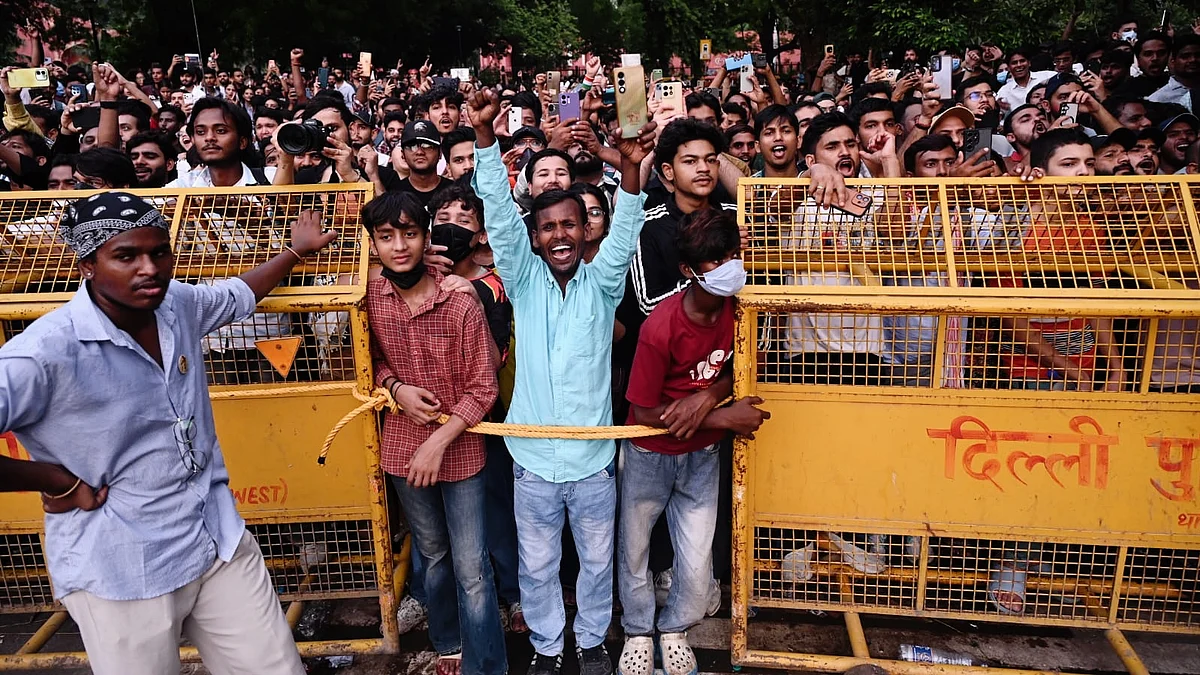


Many were puzzled by the size of the (now called off) protests and the speed with which they sprang up. To understand the environment that produced this anger, we need to set aside the immediate issue over which the youth have mobilised and step back to assess the larger picture.
Let us begin with a question: what is our relationship with the State? By 'State', I mean the government, whether local or central.
For some of us, such as those writing and likely reading this, the points at which the State intersects with our lives are few. This is the upper class. (Only 3 per cent of India pays income tax, so we cannot properly speak of a middle class — only an upper class and the rest.) Professionally, this class operates in English and lives in India's cities. English, which nine out of ten Indians do not speak, allows those of us who work in it to be global. In cultural and even professional terms, we inhabit a wider world than the majority of Indians.
Physically, too, our lives are less touched by the State than those of most Indians. We are unlikely to have been educated in government schools, and our children have probably not spent time in anganwadis. Our health is taken care of by the private sector — its doctors and hospitals — not by the nearly 10 lakh women who serve as Accredited Social Health Activists or ASHA.
Our reliance on the Public Distribution System (PDS), through which the State distributes subsidised grain, is likely to be low or non-existent. Yet 80 crore people — roughly two-thirds of India — depend on it, receiving five kilograms of rice or wheat every month. More than 20 crore Indians remain undernourished because their access to State support is inadequate or absent. Readers of this column are unlikely to be among them.
Also Read: The full worth of citizens as custodians
The flat we live in probably does not have a toilet built with a government subsidy. We do not rely on public transport — particularly cheaper options such as intra-city and inter-city buses — as much as most Indians do. Many of us have abandoned trains for planes. So the deterioration in rail services — a third of all India's trains ran late in 2018 — barely affects us.
When the Union government first eased Covid-19 restrictions, it allowed airlines to fly at full capacity but operated fewer than 300 of its 16,000 daily trains for several months. During 'notebandi (demonetisation)', too, we were either unaffected or far less affected than crores of other families by the actions of the State.
Then there are the negative points of contact with the State. Here again, our club is less exposed to the criminal justice system than many Indians are, both in the frequency of our encounters and in the way we experience them.
We may not even be familiar with some of the peculiar features of India's criminal justice system, such as administrative detention. This is how the Indian State holds individuals for months, and often years, without a crime being proved or a trial taking place. They are imprisoned on the mere suspicion of the State and its agents — the police and the bureaucracy — that, if free, they may commit an offence in the future.
Few among us, or those we know, have been subjected to a system of justice where punishment precedes any crime. Many of us may not even be aware that such a system exists.
The few points of contact we do have with the State lie elsewhere, and occur infrequently. We may need an electricity connection restored, a road repaired, a passport renewed or a driving licence issued. We feel harassed by the bureaucracy involved (there are always agents who can smooth things for us).
Also Read: A victory that may still fall short
When we complain about the inefficiency of the State, it is usually through experiences like these, rather than through the systems that shape everyday life. Our food, health, shelter and education are not dependent on the State. It would not be inaccurate to say that we are poorly placed to judge the efficiency of governance because we engage with it so little.
The majority, by contrast, knows far more about the reality of governance simply because it possesses richer and more frequent first-hand experience.
The spaces in which we have direct familiarity with what the government does — and how well or poorly it does it — are limited. We, the elite and the few, probably know less about how well India is governed than the many.
Elections are perhaps the only time we engage politically with the State in any structural sense. Even here, our relationship with the system is more distant than it is for most Indians. Electoral promises and delivery do not mean the same thing to us.
How many of us have actually approached our legislator with a demand that would materially improve our lives? It is the more abstract promises in manifestos that attract us rather than the more immediate ones. Identity, nationalism and India's standing in the world are compelling issues for an elite that considers itself — and in many ways is — global. A permanent seat on the UN Security Council, or the promise of decisive military action led by a strong leader, resonates with this class.
The failure of the State, when it directly affects our lives through a corrupt examination system, has produced the current anger. Let us now consider the many ways in which this same State fails the vast majority every single day.
Views are personal. More of Aakar Patel’s writing here
Join our official telegram channel (@nationalherald) and stay updated with the latest headlines