


AAP Rajya Sabha ranks split wide open as Chadha leads exit; party slams ‘Operation Lotus’
Sanjay Singh hits out at ‘poaching’ as seven MPs quit; long-simmering rift with Chadha comes to a head
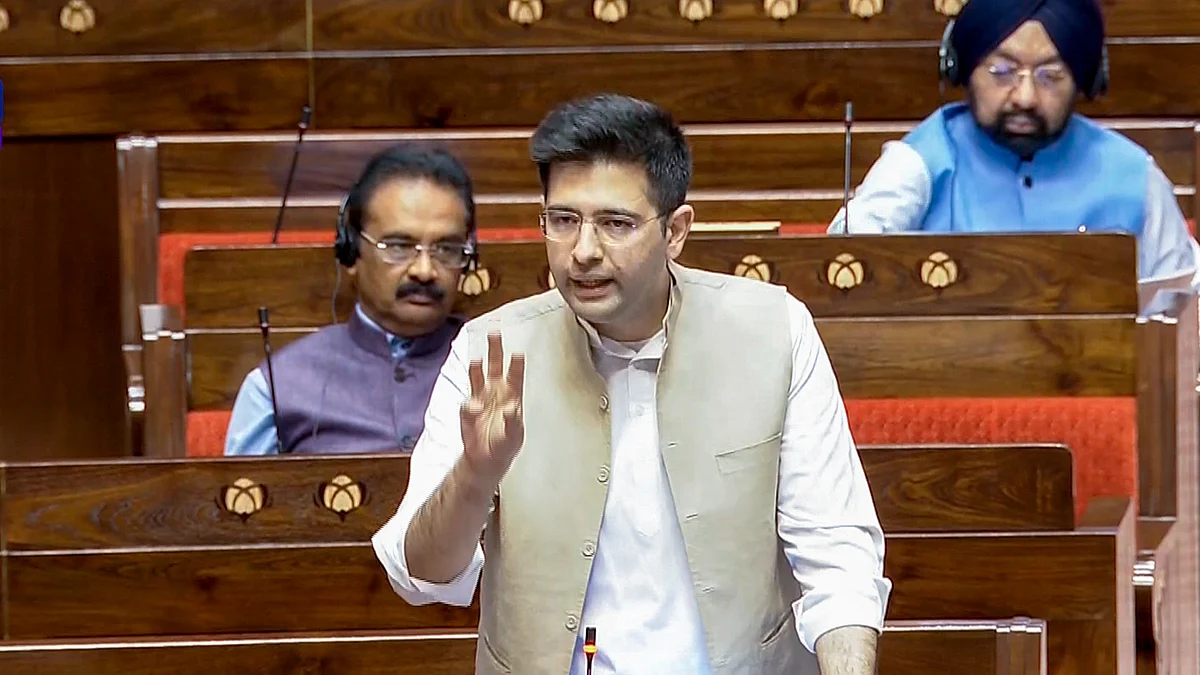


In a major political setback for the 14-year-old Aam Aadmi Party (AAP), seven of its ten Rajya Sabha MPs on Friday revolted against the leadership and announced their decision to join the Bharatiya Janata Party (BJP).
The development comes at a politically sensitive moment. Assembly elections are underway in Trinamool Congress-ruled West Bengal, where AAP chief Arvind Kejriwal and Chief Minister Mamata Banerjee are seen as part of a broader anti-BJP political alignment, both inside and outside Parliament.
The crisis also unfolds ahead of the Punjab Assembly elections, where the AAP government led by Chief Minister Bhagwant Mann is preparing to face a crucial electoral test.
Announcing his resignation from the party, former AAP leader and Rajya Sabha MP Raghav Chadha alleged that the party, born out of an anti-corruption movement, had itself “fallen into the grip of corruption”.
Chadha, along with two of his close associates — Sandeep Pathak and Ashok Mittal — declared that they would be joining the BJP. He further claimed that Rajya Sabha MPs Harbhajan Singh and Swati Maliwal would also switch sides.
“There are 10 AAP MPs in the Rajya Sabha. More than two-thirds of them are with us in this move. They have signed, and this morning we submitted the signed letters and documents to the Rajya Sabha chairman,” Chadha said.
Explaining his decision, Chadha remarked that he felt like “the right person in the wrong party.”
“The AAP, which I nurtured with my blood and sweat and to which I gave 15 years of my youth, has deviated from its principles, values, and core morals. The party now works not in the interest of the nation but for personal benefits,” he said.
Justifying his shift, Chadha praised Prime Minister Narendra Modi’s leadership, stating that the government had taken “strong decisions” that previous regimes had avoided, including on national security and economic reforms.
He noted that the public had endorsed this leadership “not once, not twice, but three times,” and expressed his willingness to work under Modi and Home Minister Amit Shah.
Notably, Chadha, who served as AAP’s deputy leader in the Rajya Sabha, had earlier been removed from the post by the party, which accused him of maintaining a “soft stance” towards the BJP and failing to adequately challenge the government.
Following his removal, Chadha had posted a series of messages on social media, signalling his discontent with the party’s decision.
Meanwhile, Ashok Mittal, who replaced Chadha as the party’s deputy leader in the Upper House, has faced multiple Enforcement Directorate (ED) raids on business entities linked to him. He also joined the BJP.
The AAP has alleged that these actions are part of a pattern of targeting opposition leaders ahead of elections, particularly in Punjab.
Reacting sharply to the developments, AAP leader Sanjay Singh accused the BJP of orchestrating defections through “Operation Lotus.”
“The BJP, under Narendra Modi and Amit Shah, has launched ‘Operation Lotus’. This is cheap politics aimed at destabilising the Bhagwant Mann government in Punjab and obstructing its work,” Singh said.
Political observers say the current crisis underscores a broader trajectory in AAP’s journey. The party, which emerged as a disruptive force in Indian politics with its sweeping victories in the Delhi Assembly elections of 2013, 2015, and 2020, has seen a steady erosion of its original leadership.
Several founding members, including Prashant Bhushan, Yogendra Yadav, and Kumar Vishwas, had earlier parted ways with the party.
Although AAP secured national party status in 2023, it has faced significant electoral setbacks since, including a defeat to the BJP in the most recent Delhi Assembly elections. Allegations linked to the liquor policy case have dented the party’s anti-corruption image once its strongest political plank contributing to its declining political fortune.
Join our official telegram channel (@nationalherald) and stay updated with the latest headlines