


Gehlot seeks disclosure of Rajasthan-Haryana Yamuna water agreement
Former chief minister says public has a right to know the terms of the latest MoU, alleging lack of transparency over a project linked to the state's water interests
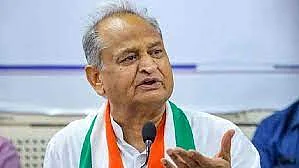


Former Rajasthan chief minister Ashok Gehlot on Monday called on the state government to release the full text of the recently signed memorandum of understanding (MoU) with Haryana on the Yamuna water project, arguing that an agreement of such significance should be placed in the public domain.
Gehlot said the BJP-led government had entered into a fresh pact with Haryana but had not disclosed its contents. He maintained that the people of Rajasthan were entitled to know the terms governing an issue that directly affects the state's water resources.
The senior Congress leader also referred to an earlier MoU signed on 17 February 2024, claiming it had remained undisclosed until after the Lok Sabha elections.
According to Gehlot, the previous agreement stipulated that Haryana would receive 24,000 cusecs of water before the remaining flow was allocated to Rajasthan.
He argued that if the latest agreement contained a similar provision, it would run contrary to the principles of the 1994 Yamuna water-sharing pact, which envisaged distribution among participating states in proportion to water availability rather than giving priority to any one state.
Earlier on Monday, Rajasthan and Haryana signed a fresh agreement on the Yamuna water project in New Delhi in the presence of Union home minister Amit Shah. The details of the agreement have not yet been made public.
Under the agreement, the two states have also agreed to jointly develop the infrastructure required to transport the allocated water. The project envisages the construction of an approximately 295-km underground pipeline from Hathnikund in Haryana to Rajasthan at an estimated cost of Rs 3,900 crore.
Both governments will coordinate on land acquisition, construction, project monitoring and the pipeline's subsequent operation. Instead of setting up a joint board as initially proposed, Rajasthan and Haryana have decided to establish a Special Purpose Vehicle (SPV) to oversee the project's construction, operation and maintenance.
Rajasthan will, for now, bear the entire cost of the project, although the state will seek financial support from the Centre. The government also expects that Rajasthan's future share of water from the Kishau, Lakhwar and Renukaji dam projects in the Upper Yamuna Basin could be conveyed through the same pipeline network.
With PTI inputs
Join our official telegram channel (@nationalherald) and stay updated with the latest headlines