


As Bengal CM vows to teach protesters 'a lesson', eyewitnesses contradict his stand
Suvendu Adhikari says 11 protesters from Left-CJP rally in Kolkata arrested under anti-goonda law so far, 10 of them Muslim
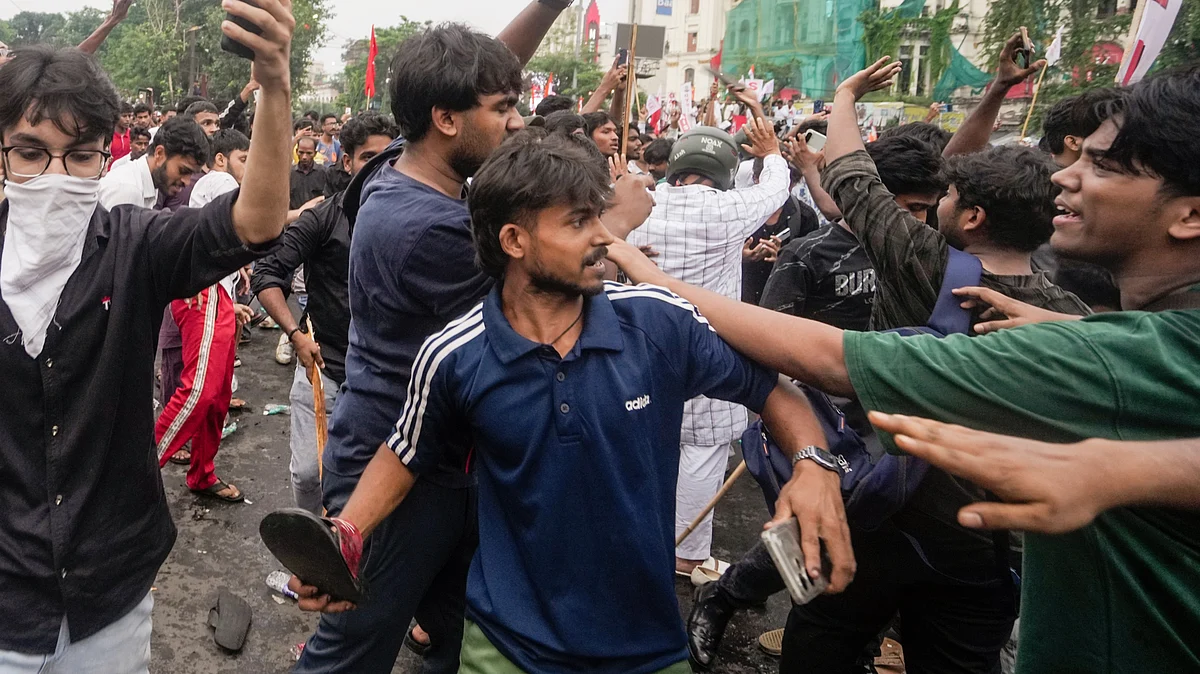


An irate chief minister Suvendu Adhikari used the West Bengal Assembly on Saturday, 25 July to do three things: defend the police action against Friday's Left-Cockroach Janta Party (CJP) rally participants, threaten them with the state's newly enacted anti-goonda law and publicly identify those arrested. Ten of the 11 names he read out, he pointedly noted, belonged to Muslims.
Yet even as the government sought to establish a narrative of organised violence, first-person accounts from people who said they were present at the march painted a strikingly different picture.
The protesters were not students or NEET examinees, the chief minister asserted, nor were they members of the CJP. Yet they manhandled pro-BJP journalists and hurled brickbats and water bottles at the police, he informed the House. At least 70 of the alleged miscreants had been identified and 11 arrested, he disclosed before reading out their names.
The chief minister's threat to invoke the Public Safety and Control of Anti-social Activities Act, 2026 — popularly known as the anti-goonda law — triggered a political row. The legislation, which came into force in the state on 13 July, provides for preventive detention of up to 12 months, seizure of property and externment from one or more districts. Intended to deal with "habitual offenders", the law is expected to face constitutional scrutiny.
"What happened at Esplanade was hooliganism. Journalists were attacked. Shoes, bottles and stones were thrown at the police. They wanted the police to resort to lathi-charge and fire tear gas shells in order to engineer a spectacle. The police did not fall into that trap," the chief minister said.
Police have registered seven FIRs, charging those involved with unlawful assembly, rioting, obstructing public servants, assaulting government officials and violating prohibitory orders. According to the police, protesters ignored repeated warnings to disperse, blocked roads and threw bottles, shoes, sticks and stones at officers.
Also Read: Whose movement is it anyway?
Social media posts did show some people in the crowd heckling journalists from television channels perceived to be pro-government. Godi media, in other words. Adhikari alleged that the miscreants had been backed by "political parties which lost the last Assembly election" (with no evidence to support this assertion) and were attempting to incite communal violence. Rioters would not be spared, he declared.
An eyewitness account by a college professor who frequently writes for newspapers, however, challenged the government's version of events. In a social media post, the professor wrote: 'The scenes of clashes with the police in Kolkata were not caused by the protesters. The march was overwhelmingly peaceful, with mostly young people coming together in solidarity against the alleged police excesses in Delhi and the NEET paper leak issue. The police, too, largely exercised restraint because the protest remained peaceful.
'The shoe-throwing and bottle-throwing at the police was carried out by a group of local rowdies who had no connection with the protest. The organisers repeatedly appealed to everyone not to indulge in any violence and ensured that the students did not participate in such acts... It was a massive protest, yet peaceful from both sides. The provocations came from local hooligans and goons who were not part of the demonstration. These same individuals also targeted journalists covering the event. I personally intervened to help a Zee 24 Ghanta reporter.'
The professor's account broadly mirrored claims made by the organisers, who maintained that the procession itself had remained peaceful and that the violence was triggered by people unconnected with the march. CPI(M) leaders, in turn, accused the BJP of planting troublemakers and circulated social media posts claiming to identify the alleged culprits, demanding that action be taken against them as well.
An estimated one lakh people participated in the procession. The chief minister, however, maintained that 70 troublemakers had been identified and listed the localities they hailed from, including Park Circus, Khidirpur and Metiabruz, all areas with sizeable Muslim populations.
The government also alleged that six journalists had been seriously injured during the unrest. Media reports on Sunday, 26 July, however, said all six had been discharged after receiving first aid.
The chief minister went on to name some of those arrested. "Afroz from Rajabazar, Nahin from Khidirpur, Tanvir from Ekbalpur and Rahul Jamal from Watgunge — we will take such action under the anti-goonda law that three generations of these miscreants will remember it."
The threat to invoke the anti-goonda law also drew criticism from within the erstwhile ruling establishment. "In my opinion, applying a law meant to curb crime is excessive in this case," Trinamool Congress (TMC) leader Sovandeb Chatterjee said.
Meanwhile, Justice Arka Kumar Nag of the Calcutta High Court had declined permission for the TMC to hold a rally on Saturday. "Why didn't you join yesterday's protest organised by the Left?" he asked, observing that the situation was not conducive to another procession in the city.
TMMC supremo and former chief minister Mamata Banerjee, however, complained that while permission was being granted to other political parties to hold rallies and processions, the TMC had been denied the same. Banerjee — who was scheduled to join the youth protest at Delhi's Jantar Mantar on Monday — led a protest in Kolkata on Saturday against the court directive, as TMC supporters gathered at Padmapukur.
As Banerjee arrived, supporters raised slogans in solidarity with students affected by the NEET controversy. Police repeatedly asked the crowd to disperse, and tensions rose as officers detained several TMC leaders including Kunal Ghosh and Vaishwanar Chatterjee, who were taken to the police HQ in Lalbazar and later released.
Join our official telegram channel (@nationalherald) and stay updated with the latest headlines