


Congress seeks clarity from Sarbanand Sonowal on Great Nicobar port project
Jairam Ramesh seeks timeline for private bids and operator selection for proposed port
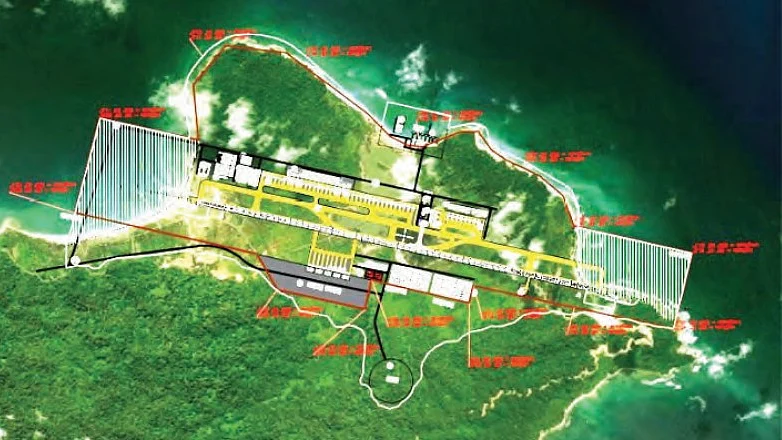


Congress leader Jairam Ramesh has intensified his campaign against the ambitious Great Nicobar Island (GNI) project, writing to Union ports, shipping and waterways minister Sarbanand Sonowal to seek clarity on the proposed International Container Transhipment Port (ICTP) at Galathea Bay and to question the economic and environmental rationale behind the venture.
In his latest intervention, the former environment minister raised concerns over the government's plans to bring in private players for the development and operation of the transhipment port, while warning that the project could inflict irreversible ecological damage on one of India's most sensitive island ecosystems.
"I am writing to you as one among the very large number of people concerned with the ecological devastation that will be caused by the Great Nicobar Island Project," Ramesh said in his letter to Sonowal.
The Congress leader sought details on the timeline for inviting bids from private companies and the eventual selection of a private co-owner and operator for the proposed port. He also asked whether the government's proposed ownership structure would permit complete private control of the project.
"Since the minimum private shareholding is to be 55 per cent, does it mean that 100 per cent private shareholding will be allowed, or is there a minimum shareholding by public entities as well?" he asked.
Ramesh further questioned whether safeguards would be put in place to prevent the concentration of strategic infrastructure in the hands of a single corporate entity.
"Is private ownership of ports to be diversified, or will the airports-like situation be permitted, where only one private company has acquired the six airports sold off so far?" he wrote.
His concerns stem from discussions held earlier this year by the Public Private Partnership Appraisal Committee (PPPAC), which examined the ministry's proposal for developing the transhipment port at Galathea Bay.
Citing official records of those meetings, Ramesh noted that the ministry itself had identified two major risks associated with the project: the challenge of building a large greenfield port from scratch and the difficulty of attracting transhipment traffic away from established regional hubs.
"I take it that these competing well-established ports are Colombo, Singapore and Port Klang," Ramesh said. "It is extraordinary that even while recognizing these huge risks — quite apart from the certainty of ecological devastation that will be caused by its construction — the transhipment port is being pushed through."
The Congress leader also sought clarity on financing arrangements after the PPPAC reportedly rejected the ministry's request for Viability Gap Funding (VGF).
"Since the PPPAC has turned down the ministry's request for a VGF grant, will the Ministry provide VGF or capital grant support from its own allocated budget?" he asked.
The letter is the latest in a series of attacks mounted by Ramesh against the multi-billion-dollar Great Nicobar project, which envisages an international transhipment port, a civilian-cum-military airport, a township and a power plant as part of a broader effort to transform the strategically located island into a major economic and logistics hub.
Over the past two years, Ramesh has repeatedly written to environment minister Bhupender Yadav, defence minister Rajnath Singh and tribal affairs minister Jual Oram, alleging that the project has been pushed forward without adequate environmental scrutiny and with insufficient regard for indigenous rights.
He has argued that the environmental impact assessments conducted for various components of the project are "demonstrably inadequate" and has warned that the development could result in extensive destruction of pristine forests, coral reefs and wildlife habitats.
The Congress has consistently maintained that the Galathea Bay transhipment port could trigger large-scale ecological damage in one of India's most biodiverse regions.
Congress leader Rahul Gandhi has also entered the debate, accusing the government of masking commercial interests behind claims of strategic necessity. The government's assertion that the project is primarily about national security and a transhipment hub is a "lie", Rahul Gandhi said recently, alleging that the real objective is to benefit private business interests through tourism and commercial development on ecologically fragile land.
The Centre, however, has defended the Great Nicobar project as a strategically important national infrastructure initiative that will strengthen India's maritime capabilities, improve connectivity and boost economic development in the Andaman and Nicobar archipelago.
With the government moving ahead with plans for the transhipment port and opposition leaders stepping up their criticism, the battle over the future of Great Nicobar is increasingly emerging as a clash between competing visions of development, environmental protection and national strategy.
With PTI inputs
Join our official telegram channel (@nationalherald) and stay updated with the latest headlines