


Pradhan’s ‘Vanavasa’ likely to be short as Joshi ensures ‘continuity’ for RSS
Barring Smriti Irani, all education ministers since 2014 had RSS links; Pralhad Joshi now faces expectations to deliver on Sangh’s agenda
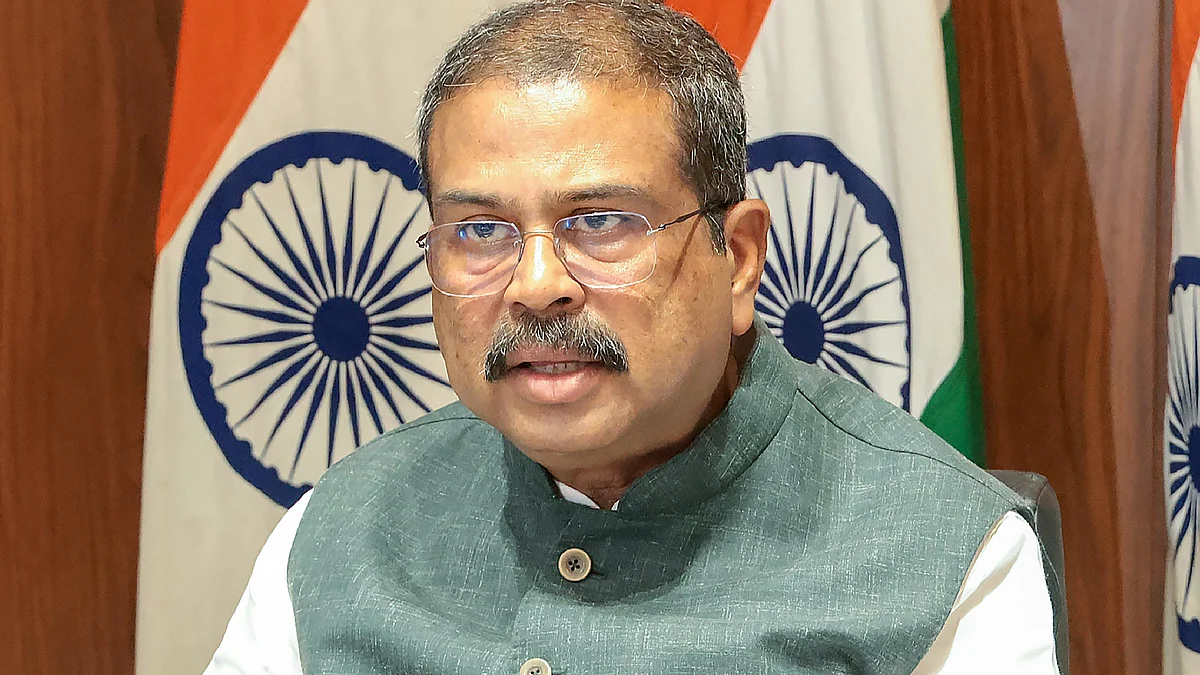


The ‘forced resignation’ of Dharmendra Pradhan on Saturday, 25 July is unlikely to be the end of the road for him. He is an old RSS organiser and at the age of 57 is far too young to be parked in a Raj Bhavan as is being speculated in some quarters. He has delivered the education sector to the RSS during his tenure, ensuring that all key appointments meet with the approval of the Sangh. He has also delivered one state election after another for the BJP, which won in Odisha and West Bengal for the first time with Pradhan in-charge. So, neither RSS nor the BJP are keen to dispense with his services and see him fade away.
It is safe to assume therefore that Pradhan will be rehabilitated sooner than later. Whether he is given a prominent role in the government, organisation or sent back to Odisha as chief minister at the ‘appropriate time’ is the question.
The reason why BJP and the RSS do not want a prolonged ‘vanavasa’ or forced exile for Pradhan is partly because of his life-long association with the Sangh. His father Debendra Pradhan, a BJP leader in Odisha, became a union minister in the Atal Bihari Vajpayee government. Starting as an ABVP activist when he was a higher secondary student in Talcher College, Pradhan became its national secretary in 1995. He ironically led a protest in 1996 outside the Odisha Assembly over a leak of the Class XII Board examination paper. He joined the BJP in 1998 and in 2004, was appointed the national president of Bharatiya Janata Yuva Morcha. The same year, in 2004, he was elected to the Lok Sabha.
Just about a month ago Pradhan had called the student protesters at Jantar Mantar the ‘B team of terrorists’ and was clearly in no mood to step down. His resignation was forced by the unexpected expansion of the protest in the rest of the country and also because the protest had begun to draw the middle classes which form part of BJP’s core constituency. There were also other factors at play. Delhi University and JNU were scheduled to re-open on 28 July 2026 and the protest would possibly have been boosted by a section of students from the two universities.
The first week of the Parliament’s monsoon session washed away because of the protests at Jantar Mantar, it threatened the government’s legislative agenda and there was an urgency to bring the protest to an end. Another factor that hastened Pradhan’s resignation is the Independence Day on 15 August being precisely three weeks away.
The prime minister’s choice of Pralhad Joshi as Pradhan’s successor is a signal that the old order will continue, that the government is not really serious about making fundamental changes. Joshi like three other education ministers before him is from the RSS and will do the Sangh’s bidding. In fact, four of the five education ministers since 2014 have been hard wired RSS workers. Only the first one, Smriti Irani, was not from the Sangh but the rest including Pradhan, Ramesh Pokhriyal Nishank and Prakash Javadekar were from the RSS like Joshi now.
The statement issued by Dharmendra Pradhan after his resignation is also revealing. He defended the steps taken after the NEET-UG paper leaks and patted his own back while preening that several students from disadvantaged sections of society successfully passed in the re-test. He put in his papers, he stated, was only because he did not want anti-national forces to take advantage of the protest and misguide the youth. Pradhan also enigmatically added that he resigned to prevent Gen Z from facing legal complications in future.
Was Pradhan hinting at what the government is planning to do with the protesters? There is already a view that celebrations are premature, that Pradhan’s resignation has not moved the needle, that nothing has changed. The resignation is unlikely to improve the dismal state of education and that it is only a matter of time before the ruling regime hits back at the protesters and the students. There is apprehension that it will soon become even more difficult for the youth to hit the streets and protest. Pradhan does not however explain how his resignation is going to help Gen Z to avoid legal complications.
At least two prominent pro-government voices on Saturday, 25 June hinted at a ‘operation clean up’. While Republic TV editor-in-chief and anchor Arnab Goswami spoke of the need to identify subversive forces and toolkits, he asserted that now that the protests are over and the government has pulled back from the brink, the government should go after activists like Yogendra Yadav. A little more restrained BJP MP Nishikant Dubey asserted that while Dharmendra Pradhan’s resignation was ‘sad’, he would appeal to the parents of students and teenagers to ensure that they stay at home, study and not attend protests.
So, nothing has changed barring cosmetic changes promised by the prime minister.
Join our official telegram channel (@nationalherald) and stay updated with the latest headlines